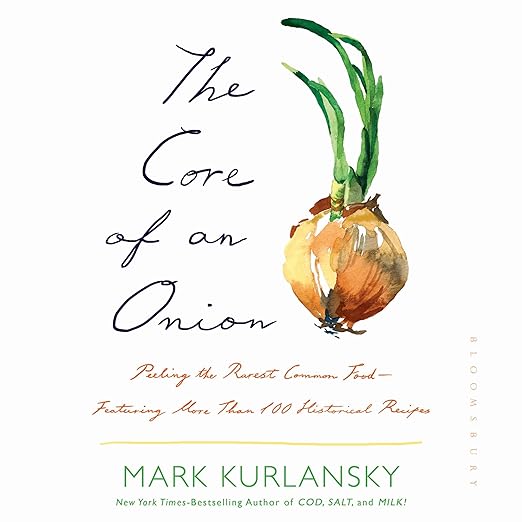
Quick Take
- Narration: Mark Kurlansky reading his own food history is the right call – his enthusiasm for the subject is audible, and the recipes land with the warmth of someone who has actually cooked them.
- Themes: The onion as a lens for agricultural history and cultural exchange, culinary anthropology, the overlooked as significant
- Mood: Curious, affectionate, and lightly nerdy – the kind of company you want in the kitchen
- Verdict: A worthy addition to Kurlansky’s single-ingredient canon that will satisfy his existing fans and make comfortable sense to anyone who loved Salt or Cod.
I put this one on while making dinner on a Tuesday, which is the correct way to encounter Mark Kurlansky. There is something about chopping onions while listening to a man explain the entire cultural history of onions that creates a specific kind of contentment – the feeling of doing something ordinary that has, as it turns out, been done by humans for thousands of years in dozens of cultures and for reasons stranger and more interesting than you knew.
Kurlansky built his reputation on this kind of work. Cod (1997) and Salt (2002) established the template: take a single commodity that seems too humble to carry the weight of history, then demonstrate through patient and wide-ranging research that it carries more than you could possibly have imagined. The onion is, if anything, a better subject for this treatment than either of his earlier single-ingredient books, because it is more universally present. Cod is a North Atlantic story with global ramifications. The onion is grown on every continent, in every climate, in virtually every cuisine. Its ubiquity turns out to be a feature rather than a limitation.
Our Take on The Core of an Onion
The book begins with science – the onion as the world’s only sulfuric acid-producing plant, the chemistry of the tear response, the twenty varieties and their different properties – before moving through agricultural history, cultural uses, medicinal applications, and finally into the kitchen proper. Kurlansky is not a scientist, but he reads primary sources carefully and explains chemistry accessibly without condescending to listeners who already have some background. The historical sweep is his strongest mode: the onion in ancient Egypt, in medieval European medicine, in the folk traditions of India and the street food of Southeast Asia, in Hemingway’s specific culinary preferences.
The inclusion of more than a hundred recipes from around the world makes this book more practically useful than either Cod or Salt, and in audio the recipe sections work better than you might expect. Kurlansky narrates the dishes with the same tone he brings to the history – as if they are all equally interesting, which they mostly are. Alain Senderens’s onion soup, the Gibson martini with its pickled pearl onion, the raw onion and peanut butter sandwich that Hemingway apparently consumed with conviction: each recipe is accompanied by enough context to make it feel like a discovery rather than a list of instructions.
Why Listen to The Core of an Onion
Kurlansky reading his own work is a quiet pleasure. He brings a warmth and dry humor to the material that a professional narrator might smooth away. When he talks about varieties of onion the way other people talk about varieties of wine, there is genuine delight in his voice rather than performed enthusiasm. At five hours and eight minutes, this is a compact listen for the amount of material it covers – Kurlansky writes efficiently, and the audio version benefits from that compression.
The book also works well as background listening in the way that Kurlansky’s food histories generally do. You can put it on while cooking and not miss anything critical if you tune out for three minutes. The structure is organized around layers of the subject rather than a building narrative argument, so re-entry is easy. That said, the most interesting material tends to come in concentrated bursts – the science section at the opening, and the deeper cultural history chapters – and those reward full attention.
What to Watch For in The Core of an Onion
One structural complaint that appears in reviews is genuine: the book ends abruptly. Kurlansky does not build toward a conclusion so much as stop when he runs out of material. This is a characteristic of his genre and approach rather than a specific flaw of this title, but listeners expecting a rounded ending will feel the flatness. There is also a repetition problem in the Kindle edition that one reviewer flags – some sentences appear twice within a paragraph. It is unclear whether this carries into the audio version, but it is worth noting.
The book is also more interested in breadth than depth on any individual culinary tradition. If you are hoping for an exhaustive account of French onion culture, or a deep dive into the role of the allium in Indian regional cooking, you will get a chapter on each rather than a book. The encyclopedic approach is Kurlansky’s method, and it means the book rewards readers who want to discover where to look next rather than readers who want the definitive account of any single thing.
Who Should Listen to The Core of an Onion
Existing Kurlansky readers know exactly what they are getting and will not be disappointed. New readers should start here only if the onion specifically appeals as a subject – Cod or Salt are more narratively complete as entry points. Food history enthusiasts, home cooks curious about the cultural dimensions of a pantry staple, and anyone who has ever cried while chopping onions and wanted to know why will find this genuinely engaging. People who prefer their audiobooks to build toward a dramatic conclusion should look elsewhere in the food-history genre.
Frequently Asked Questions
Do the recipes work in audio format, or are they better experienced in the print edition?
The recipes are narrated with enough context that they work as listening material – Kurlansky frames each one as a cultural artifact as much as a cooking instruction. That said, the print edition includes visual elements (illustrations, photographs) that the audio obviously cannot replicate, and listeners who want to cook from the book will need a physical copy.
How does The Core of an Onion compare to Kurlansky’s earlier single-ingredient books like Cod and Salt?
The subject is arguably broader in global reach, and the recipe section is more substantial. The narrative structure is similar: history, culture, science, kitchen. Cod is generally considered his tightest work; this one is slightly more diffuse but equally warm in tone.
Does Kurlansky engage with the onion’s current role in food culture, or is the book primarily historical?
Both. He covers agricultural history and ancient uses extensively, but the book moves into contemporary culinary applications and includes recipes from living chefs alongside historical ones. It feels current rather than purely archival.
Is the book accessible to listeners without any culinary or food-history background?
Very much so. Kurlansky’s entire method is making specialized knowledge feel approachable. You do not need to know anything about agricultural history, botany, or culinary tradition to find this entertaining – those things are explained as they come up.