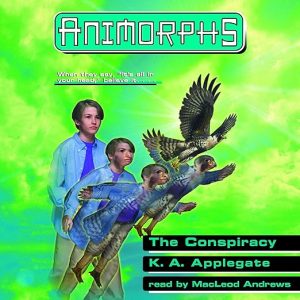
In Brief
- Narrator: MacLeod Andrews has two and a half hours and no battle to hide behind, so the file rests on how wrong a brother is made to sound.
- Subjects: A sibling under occupation, family loyalty against necessary secrecy, a war fought by children.
- Tone: Tense, domestic and bleaker than the shelf it sits on.
- Bottom line: One of the series' quiet entries and the better for it, provided you have already read the thirty that come before.
Animorphs number thirty-one is a funeral book, and the audiobook is over in less time than most novels take to set up a premise. A great-grandfather dies. A mother leaves for the arrangements. A father plans to follow two days later with both sons, and that ordinary itinerary is a crisis, because Tom is a Controller and the thing living in his head needs a Kandrona every three days. Jake sees the bind his brother is in and spends the book turning over a question no kid should have to hold: whether to hope the Yeerk starves, knowing exactly what starving it might cost Tom.
The Verdict, Briefly
Tom's problem is the engine, and the description lays it out with unusual precision. Tom resists the trip. The father insists, three days minimum, no arguments. Jake would rather not go either, for his own reasons, and is far more interested in watching his brother squirm than in solving anything. Then the counter-move arrives: a note pulled out of the trash saying the father is going with Tom to a meeting of The Sharing, and Jake works out what that means. For once the tactical mind freezes. Saving his father without exposing himself, the other Animorphs and Ax is the entire book.
Subtlety is what a five-star from May 2000 values, and it argues the case directly, insisting this installment is nothing like the one before it whatever other readers claim. What it praises is the absence of large set-piece battles: the book is more subtle and undercover, the schemes are more interesting than the usual pattern, and the death in the family is woven into the story rather than parked beside it. That entry stops in the middle of a word as it starts a comparison between two kinds of battle, and that is a pity, because it was making the sharpest argument on the page.
The Best Parts of The Conspiracy
Ethics are where a December 2000 five-star locates the value, and it advises reading slowly and paying attention to Applegate's ethical explorations: war, good and evil, and the making of genuinely hard decisions. That entry also supplies the column's only reservation, noting that the plot drags slightly, before adding that a reread improved it considerably. Both observations matter for an audio buyer, because a book that rewards close attention and sags a little in the middle is a different proposition when skimming is not available to you.
Momentum across the series is what a February 2025 five-star tracks, reading this one as a direct follow-up to The Reunion and crediting it with pushing two characters forward at once. Its larger point is the one that keeps this series alive in adult memory: the group may still be children, but the war is real and the consequences reach into their own houses. That is exactly what this installment demonstrates, since the danger here is not a battle but a father walking willingly into a room full of people who are not what they appear to be.
Two hours and thirty-two minutes is the whole recording, short by any measure outside this series, and MacLeod Andrews carries all of it alone. The demand is interiority rather than spectacle. Even the description is written from inside Jake's deliberation, thick with questions he is asking himself, and the crisis is a decision rather than a fight. A reader has to make hesitation audible, and hold the difference between a brother who is present and the thing occupying him, without any of the visual shorthand a printed page can supply.
Points to Consider
Spoilers are not a risk on this page. They are the page. The description walks the entire plot from the death in the family to the note in the trash to Jake's realization about involuntary infestation, and it addresses its reader as somebody already inside the series, with a parenthetical explaining that Tom is a Controller needing a Kandrona every three days, prefaced by the words as we know. That is a plot summary written for existing readers rather than marketing copy written for new ones, and anyone arriving fresh should stop after the first sentence.
Five written responses sit underneath, and all five award five stars, which says more about the affection this series commands than about this installment in particular. One is a note from a buyer who picked the book up as a gift for a brother and reports that he loves it, which is a purchase record rather than an assessment. The oldest entry carries a 1999 date and the newest a 2025 one, on a recording released in 2022, so most of this column is grading a paperback somebody finished decades ago.
Who Should Listen to The Conspiracy
Children's audiobooks is where this record files, with tags for action and adventure and for animals and nature, and the second tag does something odd. It promises wildlife, and what the description supplies is a parasite living inside a human head. The content sits heavier than the shelf implies as well: a boy calculating whether to hope his brother's occupier starves to death, and a father at risk of being taken over without knowing or consenting. Capable young readers handle this material well. Parents should simply know that this is what they are handing over.
Newcomers should start earlier, obviously, because this is book thirty-one and the description assumes you know who Ax is and what The Sharing recruits for. Returning listeners who left the series as children will find precisely the thing they remember: short chapters, real stakes, and a moral problem sitting underneath a plot that never slows down. As a purchase the risk is small and the runtime is smaller. As an experience, this one trades battle for dread, and dread is the harder thing to write.
Common Questions
Can I start the series with this audiobook?
Not realistically. Thirty books come first, and this page treats all of their furniture as given: Tom's condition, the three-day deadline, Ax, and the real business behind The Sharing. A 1999 entry assumes exactly that familiarity among fans, which is roughly what the book itself expects. Start earlier.
How much of the story is family drama rather than action?
The family drama is the action. The crisis is a trip out of state for a funeral, several days long, which threatens the creature in Tom's head and puts the boys' father within reach of the organization Tom answers to. Nothing here turns on a set-piece battle. The stakes stay domestic and stay lethal.
Is this audiobook suitable for a young listener?
The record shelves it as children's, and the material runs darker than that implies: a boy weighing whether to hope the creature controlling his brother starves, and a parent walking unknowingly toward the same fate. Nothing resembling age guidance sits on this listing, which leaves one genre tag doing all of the work.
Does it stand up if I read the earlier books years ago?
Yes, with one caveat. The setup restates the essentials quickly, that Tom is a Controller and that the family is traveling, so the mechanics come back fast enough. What will not come back is the accumulated weight, and this installment leans hard on it: a note in the trash is frightening because of thirty books you may only half remember.