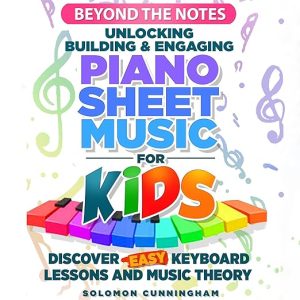
Solomon Cunningham's piano method stands out from the crowded field of children's music instruction guides because it refuses to treat sheet music as the endpoint. The audiobook version of Beyond the Notes Unlocking Building & Engaging Piano Sheet Music for Kids, narrated by Mauricio R. Borrell, is a structured 5-hour guide aimed at parents and educators introducing children to the piano for the first time, and its central argument is consistent throughout: learning to read music should feel like learning a language, not like passing an exam. The format pairs a verbal guide with a downloadable PDF companion in the Audible library, which is an essential detail for anyone purchasing this title. The written materials contain the sheet music, visual aids, and illustrated exercises that the audio track references throughout.
Parents who purchase this expecting a passive listening experience for their child should recalibrate expectations. This is a participatory audiobook, one that works best when a child has the PDF materials open alongside the audio, ideally at a keyboard. The 5-hour runtime is not designed to be consumed in one sitting; it is a curriculum delivered in audio form, and its value scales with the degree of active engagement.
Borrell's Pacing Does the Pausing for You
Cunningham's five-step approach to piano mastery sequences the material thoughtfully. The book opens with posture, hand positioning, and the mechanics of producing a clean tone before moving into note identification, rhythm, and eventually the over-20 beginner-friendly tunes that reviewers consistently highlight as the book's most immediately engaging content. That sequencing is correct pedagogically: the temptation in children's music education is often to lead with fun songs and patch in the theory later, which creates gaps. Cunningham reverses this, establishing the foundations first, but does so with enough accessible language and creative framing that the foundational material does not become a slog before the tunes arrive. The decision to work through easy piano theory with vibrant visuals and child-friendly language, as Cunningham describes the approach, reflects an understanding that younger learners need conceptual scaffolding that maps onto their existing cognitive frameworks rather than adult music theory vocabulary.
Borrell's narration is well-suited to the material. His delivery carries the enthusiasm appropriate for a children's educational title without condescending to the young listeners or their parents. The pacing is measured enough to let children process instructions before the next step arrives, which reflects an understanding of how audio-format instruction for young learners needs to operate differently from a printed book they can pause and return to at their own speed. The audio does not allow for that kind of organic pause, so Borrell's pacing must do some of that work, and largely it does. For home practice sessions where a parent is guiding the child through the material, this pacing creates natural checkpoints without requiring the adult to constantly pause and resume the recording.
Reading Sheet Music Becomes an Adventure Here
Several reviewers note that the book's framing of music learning as adventure rather than obligation resonates with children who might otherwise resist structured lessons. The imaginative methods for reading sheet music, which Cunningham introduces in place of the dry note-name drilling common to many beginner methods, are the title's most distinctive contribution. One reviewer described the approach as transforming piano learning into an exciting adventure, and another noted that it helps children move beyond memorization to genuine musical expression, which is the gap most beginner methods fail to bridge.
The inclusion of hand coordination and finger strength exercises is a practical asset. These are the physical fundamentals that many young beginners skip in their eagerness to play actual songs, and the deficiency shows up later when technical demands increase. Cunningham addresses this early, and the audio format makes it easy for parents to follow along with their child and ensure the exercises are being performed correctly. For home learning situations where a parent is involved but not musically trained, this practical scaffolding is particularly valuable.
Audio References the PDF but Can't Reproduce It
The PDF companion is not optional. Listeners who purchase the Audible edition without downloading and using the accompanying materials will miss the visual and tactile components that the audio track is built around. The sheet music, colorful illustrations, and fingering diagrams exist in the PDF; the audio references them but cannot reproduce them. This is a hybrid format, and it works as designed only when both components are in use.
The 5-hour runtime also implies a curriculum structure rather than a single-session listening experience. Parents who approach this as a multi-week program, completing a section per practice session, will get substantially more value from the material than those who attempt to move through it quickly. The songs included span from genuinely simple beginner pieces to slightly more demanding tunes that reward the technical foundations Cunningham establishes in the early chapters. That range means the material does not expire once a child gains basic competency; there is room to grow within the book's scope.
Ages Six to Eight Find This Most Accessible
This audiobook is designed for parents and educators guiding children through their first encounter with piano. The target age range based on reviewer feedback appears to run from approximately 5 to 10, with the content most immediately accessible to children in the 6-to-8 range who can engage with the PDF materials independently or with light parental guidance. Musically trained adults will not find new pedagogical theory here, but those without a music background will find the explanations accessible and the sequencing sensible. Children who have already completed basic beginner instruction may find the early sections too familiar, though the intermediate tunes in the later chapters provide room for continued development.
The Short Version
- Read by: Mauricio R. Borrell paces the instructional content with child-appropriate deliberateness, giving young listeners time to absorb each step before the next arrives.
- At its heart: Music education as adventure, foundational technique before fun, home-based learning
- Vibe: Enthusiastic and structured
- Short version: A genuinely useful children's piano primer in audiobook form, but only when the PDF companion materials are used alongside the audio.
Before You Listen
Is the PDF companion included when I purchase the audiobook version?
Yes. The accompanying PDF with sheet music, visual aids, and exercises is available in your Audible library alongside the audio. It is essential to download and use it while listening, as the audio track references the visual materials throughout.
Can a child listen to this audiobook without a parent present?
Older children who can manage the PDF materials independently may progress on their own, but for younger listeners and absolute beginners, parental involvement will improve outcomes significantly. The hybrid audio-plus-visual format works best as a shared activity.
Does this audiobook assume the child already owns a piano or keyboard?
The material is designed to be used at an instrument, and the finger exercises and song practice require a keyboard of some kind. A basic, affordable keyboard is sufficient; a full acoustic piano is not necessary to benefit from the curriculum.