
In Brief
- Performance: Elliot Felix reads his own consulting work, which keeps the emphasis where the author intended it across a long practitioner argument.
- What it covers: student belonging, siloed campus services, advising and career connection, institutional change
- Feel: Practical, briskly consultative, committee-room clear
- Our call: A useful argument for higher education leaders, sold on a listing so muddled you should verify the contents first.
Higher education has no shortage of consultants, and most of their books read like a pitch deck with the slides removed. Elliot Felix comes to this one having advised more than a hundred institutions, and the argument he wants to make is narrower and better than the genre average: colleges do not fail students through bad intentions, they fail them in the gaps between offices that never talk to each other. The audiobook runs nine hours and fifty minutes with Felix reading it himself, and the buying decision here involves an unusual amount of homework.
A Hundred Campuses, One Recurring Broken Handoff
Connection is the organizing idea, and it is more specific than it sounds. The stated goal is colleges and universities where students find belonging, feel supported, and can connect what they study to a career worth having. Those three things are usually owned by three different departments with three different budgets, three different data systems and no shared definition of success, which is exactly why the outcomes stay stubborn while every individual office reports doing its job well.
A consultant is genuinely well placed to see that problem. Nobody working inside one institution gets to compare a hundred versions of the same broken handoff between admissions, advising, student affairs and career services. Pattern recognition across that many campuses is real expertise, and the promise of stories, statistics and strategies drawn from it is the reason to consider this over a purely academic treatment of student success.
Breadth cuts both ways, though. Advice distilled from a hundred institutions tends to average them, and a community college with a majority of working adult students shares almost nothing operationally with a residential research university beyond the vocabulary. Listeners should expect frameworks that need translating rather than procedures they can adopt, and should be ready to discard whichever half does not fit their institution's funding model.
The Closest Preparation for Nine Hours of Argument
Author narration is the right call here, and the credits confirm it. Consultancy books are essentially the transcript of a person's judgment, and hearing that judgment in the voice of the person who formed it preserves the emphasis a hired reader has to guess at. Felix is also, by trade, someone who spends his working life explaining these ideas to committees, which is about the closest professional preparation available for reading nine hours of your own argument aloud.
Much of this audience lives in a car or an airport. Administrators move between campuses, conferences and system offices constantly, and a ten-hour recording covers a decent share of a semester's travel. Practical nonfiction with a clear thesis holds up well in that setting, particularly when the material is anecdotal rather than tabular, and a consultant's stories are built to be told rather than read.
What the recording promises is a specific mix: institutional stories, supporting numbers, and strategies drawn from practice. That combination survives the format better than most business writing, because the stories carry the framework instead of the other way around. Anyone who has sat through a strategic planning retreat will recognize the value of hearing how another campus solved the thing your campus keeps rescheduling.
This Listing's Copy Describes a Different Product
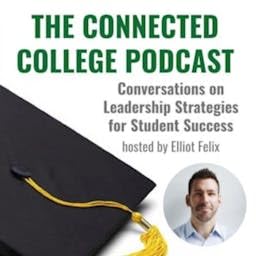
Read the product description carefully before you buy, because it is not describing a book. The copy on this listing is the blurb for The Connected College Podcast, inviting you to join Elliot Felix for interviews with higher education innovators. A podcast and a nine-hour single-narrator recording are different products with different structures, and nothing on the page clarifies which one your money is buying. Verify the contents at the retailer before purchase; this is the most important caution attached to the title.
Metadata elsewhere on the page is equally thin. No publisher is listed at all, no ratings or reviews have accumulated since the October 2022 release date, and even the runtime is formatted differently from neighboring entries in the catalog, which points to a record assembled from more than one source. None of this reflects on Felix's work. It does mean you are buying with less information than a title like this ordinarily carries.
Category placement is the third oddity. This sits under business development and entrepreneurship, alongside startup and sales titles, which is not where a provost, dean of students or director of advising would ever look. Anyone hunting for institutional strategy will struggle to find it, and anyone browsing that category for entrepreneurship material will find a book about university operations. Expect the language of consulting throughout as well: ecosystems, alignment, journeys and touchpoints do a lot of work in this corner of the field.
Confirm What You're Buying Before You Buy
Administrators are the natural readership: student success leads, advising directors, career services teams, institutional researchers, facilities planners and the cabinet-level people who have to make those functions cooperate. Trustees and board members would also get more from ten hours of this than from another governance briefing, since the failures being described are structural rather than personal. Graduate students in higher education administration will find it a useful counterweight to the theory-heavy reading lists.
Students, parents and general business listeners should skip it, since the advice is aimed at people who can change how an institution operates rather than at people navigating one. Anyone wanting peer-reviewed evidence rather than practitioner pattern-matching will find the register frustrating. No one should buy this particular listing without first confirming what nine hours and fifty minutes actually contains, because the page as it stands describes something other than the recording it is selling.
A Few Questions About The Connected College
Is this audiobook the book or a compilation of the podcast?
The listing does not resolve it. The description on the page is the blurb for The Connected College Podcast, which features interviews with higher education innovators, while the recording is presented as a single-narrator title of nine hours and fifty minutes. Confirm the format with the retailer before buying.
Does Elliot Felix narrate the audiobook himself?
Yes, the listing credits him as the reader. For consultancy writing that is usually the better arrangement, since the emphasis and the qualifications live in the delivery. It also means you are hearing the same voice that has presented these ideas to more than a hundred institutions.






