Quick Take
- Narration: Margaret Wakeley’s delivery is measured and clear, appropriate for a reference-style text where precision matters more than atmosphere.
- Themes: Herbal medicine traditions, plant identification, self-sufficient healing
- Mood: Practical, encouraging, gently evangelical about natural remedies
- Verdict: A well-organized beginner’s introduction to herbalism that covers impressive ground in ten hours, best experienced alongside the companion PDF for the reference sections.
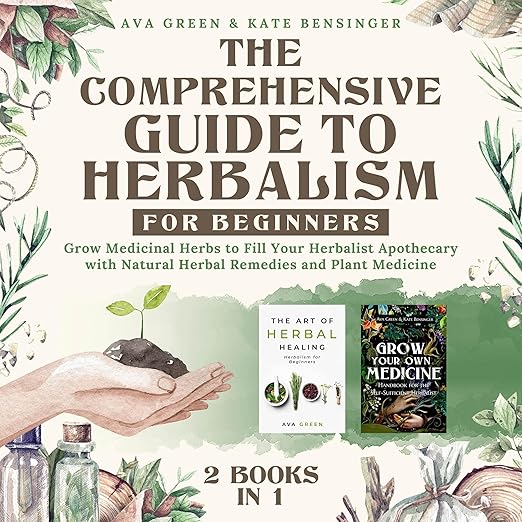
I came to this one on a Saturday morning in early spring, the time of year when the garden starts demanding attention and the idea of knowing what to do with what grows in it feels newly urgent. The Comprehensive Guide to Herbalism for Beginners by Ava Green had been sitting in my queue for weeks, and at over ten hours it is more substantial than most books with the word beginner in the title. That length turns out to be justified. Green covers a genuinely impressive range of territory, from growing herbs across all thirteen climate zones to identifying over forty wild species and extracting their medicinal properties, and the resulting listen is dense with practical information rather than filler.
The framing device is the familiar one, modern pharmaceutical culture masks symptoms without healing the whole person, and herbal medicine offers a different relationship with the body. Green does not lean too heavily on this argument, which is wise. The book is most persuasive when it is simply instructional: here is ginger for immune support, basil for nausea, garlic as an antimicrobial. Here is how to make a tincture, a poultice, an ointment. Here is what part of the plant you use and when to harvest it. The science-backed framing she claims for her seventy-plus remedies is selective but present, and the alphabetical herb list and illness-indexed sections make the audio content navigable in ways that companion PDF access extends considerably.
Our Take on The Comprehensive Guide to Herbalism for Beginners
One reviewer described this as pushing them toward the earth, they came in as a mushroom forager with limited interest in herbs and left planning to integrate herbalism into their nature practice. That is a meaningful endorsement of the book’s ability to convert skeptics through the quality of its information rather than ideology. Another reviewer is planning to start their own herb garden directly after finishing the listen. Green writes with the voice of a mentor rather than an evangelist, which keeps the material grounded. Her personal experience with the plants she describes, her materia medica, as one reviewer calls it, gives the content specificity that more generic herbal guides lack. The combination of gardening instruction, wild identification, and preparation technique in a single volume is the book’s most distinctive quality.
Why Listen to The Comprehensive Guide to Herbalism for Beginners
Margaret Wakeley narrates with the kind of deliberate clarity that reference material requires. She does not rush measurements, plant names, or preparation steps, which matters enormously when you might be listening while actually making a preparation rather than sitting comfortably with a book in hand. The pacing suits the content: this is material you absorb in sections, return to, and look things up in, and Wakeley’s delivery accommodates that relationship with the text. The companion PDF is worth accessing for the visual elements, identification guides, measurement charts, preparation instructions, that inevitably work better on the page than as narrated audio.
What to Watch For in The Comprehensive Guide to Herbalism for Beginners
The anti-pharmaceutical framing, while not aggressive, does occasionally tip into overclaiming. Green’s assertion that her seventy-plus science-backed ailments and remedies are all well-evidenced should be taken as a general orientation rather than a clinical standard. Some remedies have robust research support; others have traditional use as their primary backing, which is not the same thing. Listeners with serious health conditions should treat this as a complement to, not a replacement for, medical advice. The audiobook also references visual content throughout, plant identification in particular is difficult without images, making the PDF companion more necessary than optional if you intend to use this practically rather than just absorb it conceptually.
Who Should Listen to The Comprehensive Guide to Herbalism for Beginners
This is for gardeners who want to use what they grow, kitchen herb enthusiasts curious about going deeper, or anyone who has felt drawn to herbal medicine but did not know where to start. The beginner framing is accurate, no prior knowledge is assumed, and the pace of introduction is genuinely accessible. Skip it if you want clinical rigor or evidence-based medicine at a research level; this is traditional knowledge with selective scientific support, not a pharmacological reference. It is also less useful in audio-only form than with the PDF companion, so plan accordingly from the start.
Frequently Asked Questions
Is the companion PDF necessary, or can the audiobook stand alone as a practical herbalism guide?
The audio stands alone well as an overview, but the PDF becomes important for practical application. Plant identification, measurement charts, and preparation instructions are all significantly easier to reference visually. Listeners who want to actually make the preparations described should plan to access the PDF through their Audible library.
How does Ava Green handle the science behind herbal remedies, is there genuine research cited, or is this primarily traditional knowledge?
A mix of both. Some remedies have strong research backing; others rely primarily on traditional use. Green frames everything as science-backed, but the level of evidence varies considerably by remedy. Treat the scientific claims as a general orientation and verify specifics through additional sources for anything you plan to use medicinally.
Does this cover foraging and wild herb identification, or is it primarily about cultivated garden herbs?
Both. Green covers growing herbs in garden and container settings across multiple climate zones, but also includes wild identification for over forty species. Listeners interested in foraging will find relevant content, though identification in audio form is necessarily limited, the companion PDF and additional field guides are important supplements.
Is the ten-hour runtime appropriate for a beginner’s guide, or does it feel padded?
The length reflects genuine breadth rather than filler. Green covers growing, harvesting, identification, preparation methods, and an indexed remedy guide. Reviewers consistently describe it as comprehensive rather than overwhelming, and the structured organization makes it possible to return to specific sections without re-listening to the whole.