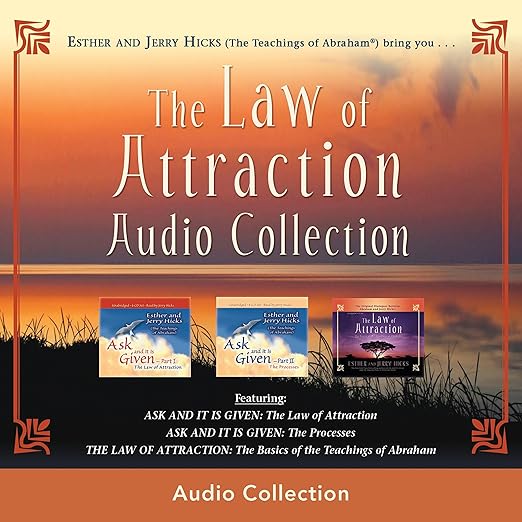
Esther Hicks narrating three of her foundational Abraham-Hicks recordings back to back produces a particular kind of listening experience: cumulative rather than discrete, with each program building vocabulary and conceptual depth that the next one assumes. The Complete Law of Attraction Collection gathers Ask and It Is Given: The Law of Attraction, Ask and It Is Given: The Processes, and The Law of Attraction: The Basics of the Teachings of Abraham into a single audiobook spanning fourteen hours and twenty-eight minutes. Note on authorship: the input metadata for this title lists James Allen, but the content is entirely the Esther and Jerry Hicks recordings of the Abraham teachings. James Allen was a separate writer whose most well-known work is As a Man Thinketh. This appears to be a data mismatch, and listeners should confirm the actual content matches their expectations before purchasing.
The three programs within this collection each serve a distinct function. The first lays out the theoretical framework: the argument that emotional states function as signals that attract corresponding experiences, and that deliberate attention to those states can influence outcomes across health, relationships, finances, and career. The second is the most immediately practical, offering twenty-two specific exercises for redirecting emotional momentum. The third presents the original series of recordings that introduced the Abraham teachings to a public audience and remains the clearest distillation of the core ideas.
The Verdict, Briefly
Esther Hicks's narration is not trained performance but something closer to direct transmission. Her workshop speaking style, which developed over decades of live presentations, carries a quality of ease and genuine conviction that professional narrators approximating the same material simply cannot replicate. Reviewer Shayla E. Middleton noted that the recordings work particularly well during drives, and that observation captures something real about the material's audio format. The cadence is conversational and repetitive by design, building through iteration rather than linear argument, which suits the listening mode better than close reading.
The collection functions well as an introduction to the framework precisely because it spans foundation through application. A listener coming to these teachings for the first time gets the theoretical basis, the practical toolkit, and the original source recordings in a single purchase. Reviewer Tracey Darabasz noted learning more from this set than from other law of attraction recordings and returning to the material repeatedly, which reflects how the collection is designed to be used. The exercises in the Processes program are structured for repeated application rather than one-time conceptual understanding, and Hicks's spoken delivery of those exercises makes them usable directly during a listening session in a way that reading the same instructions would not. The exercises address a range of emotional starting points, from active frustration to general contentment, with specific processes calibrated for each level of what Hicks describes as the emotional guidance scale.
At over fourteen hours, the runtime is substantial, but the format rewards non-linear listening. The three programs can be approached in sequence or sampled according to what a listener needs in a given period. Reviewers have specifically noted the warmth and humor that appear throughout Hicks's presentations, which prevent the material from taking on the austere quality that metaphysical instruction can sometimes acquire. Reviewer Crafty Artist described the recordings as painting a different picture of a higher power than what they had been raised with, which points to the emotional function this material serves for many of its listeners: not just intellectual instruction but a reframing of fundamental assumptions about how the universe works and what one's place within it might be.
The fourteen-hour collection also represents genuine value compared to purchasing the three programs individually. Each program was originally sold as a standalone audio set, and the collection format gives a listener the full Abraham-Hicks foundational library in one place. For listeners who have encountered excerpts of Hicks's teachings through secondary sources and want to engage with the primary recordings, this is the most efficient entry point.
Before You Commit to The Complete Law of Attraction Collection
The collection operates within a specific metaphysical framework that involves the existence of a non-physical consciousness called Abraham and the premise that emotional vibration directly influences material reality. Listeners who require empirical grounding for self-development ideas will find the framework uncomfortable. The teachings do not argue their premises from evidence but assert them from a position of direct experiential authority, and that approach is either compelling or it is not depending on the listener's prior orientation.
The repetitive structure that makes the material well-suited to repeated listening can also make it feel slow on a first pass, particularly for listeners accustomed to the faster pace of contemporary business or self-help audiobooks. The teachings are drawn from a live workshop tradition and carry that deliberate, circling quality. Those expecting linear progression through a conventional argument will need to adjust their expectations accordingly before committing to fourteen hours of this format.
Who Will Get the Most From It
Listeners already receptive to the Abraham-Hicks teachings who want a consolidated, authoritative collection will find this the most efficient way to access the core programs. Those new to the material who are open to metaphysical frameworks will find the three-program structure a sound introduction. The listener who needs scientific validation for self-development claims, or who finds repetitive instructional cadences frustrating, will likely not connect with the format. Listeners familiar with other law of attraction content who found that material too generic may find that Hicks's original recordings carry more conceptual precision than later interpretations that have diluted the source framework.
The Short Version
- Performance: Esther Hicks narrating her own teachings gives this collection an authority that no outside reader could replicate; her workshop-style cadence is unhurried and consistent across all three programs.
- What it covers: Law of attraction, vibrational alignment, emotional guidance system
- Feel: Warm, meditative, and gently prescriptive
- Our call: Three of the core Abraham-Hicks recordings in a single collection; the ideal entry point for new listeners and a practical consolidation for those already familiar with the material.