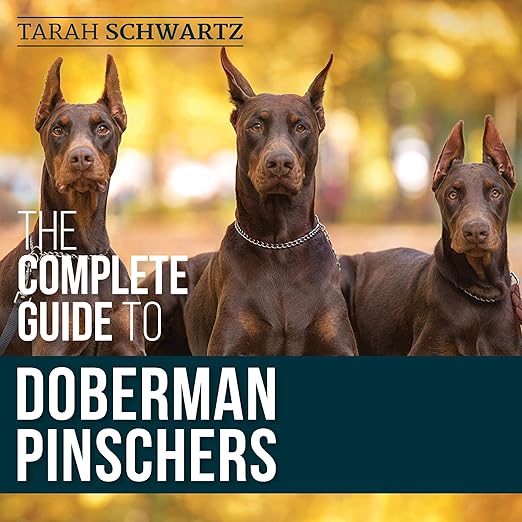
The Complete Guide to Doberman Pinschers
Audiobook & Ebook

The Complete Guide to Doberman Pinschers by Tarah Schwartz | Free Audiobook

By Tarah Schwartz

Narrated by Pam Emme

🎧 6 hours and 37 minutes 📘 LP Media Inc. 📅 March 17, 2021 🌐 English
🎧 Listen Free on Audible 📖 Read on Kindle

Free 30-day trial · Cancel anytime

About This Audiobook

The Complete Guide to Doberman Pinschers is the perfect book for anyone looking to purchase or adopt their first Doberman Pinscher. Intelligent, loyal, and athletic, Doberman Pinschers can be the ideal pet for the properly prepared family.

This book will give you the knowledge you need as you begin your ownership journey, covering topics such as:

Doberman Pinscher History
Choosing a Doberman Pinscher
Preparing Your Home for Your Doberman Pinscher
Bringing Home Your Doberman Pinscher
Being a Puppy Parent
Housebreaking
Socializing with People and Animals
Doberman Pinschers and Your Other Pets

Doberman Pinschers fall in the working class of dog breeds and are well-known by professional dog trainers for their natural athleticism and drive. A highly intelligent breed full of energy can be a hassle for any dog owner! This is why The Complete Guide to Doberman Pinschers includes sections on:

Physical and Mental Exercise
Training Your Doberman Pinscher
Basic Commands
Dealing with Unwanted Behaviors
Traveling with Your Doberman

All Dobermans require the best of care to maintain their naturally sleek but substantial physique from puppyhood to old age. We cover all the basics, so you will know all about what your Doberman Pinscher needs for nutrition, grooming, basic health care, and special health needs for your aging Doberman.

From the history of the breed from its days as an intimidating guard dog for the tax collectors of Germany, to choosing the perfect puppy and then caring for your older Doberman, The Complete Guide to Doberman Pinschers is your go-to resource for all things about “Dobie”.

🎧 Listen Free on Audible

Free 30-day trial · Cancel anytime

Quick Take

  • Narration: Pam Emme delivers a clear, practical performance that suits the guide format without adding unnecessary warmth or emotional register to what is fundamentally a reference work.
  • Themes: Breed-specific care and history, the working dog’s training requirements, responsible ownership from puppyhood to old age
  • Mood: Informative and methodical, structured for reference rather than narrative enjoyment
  • Verdict: A thorough and well-organized breed guide that covers what it claims to cover, useful for first-time Doberman owners and a solid refresher for experienced ones.

I have reviewed enough breed guides to know that most of them cover the same material in slightly different orders, and most of them fail in the same places: they are either so cautious that they tell you nothing useful, or so prescriptive that they refuse to acknowledge the enormous variation between individual dogs. The Complete Guide to Doberman Pinschers, written by Tarah Schwartz for LP Media’s Complete Guide series, largely avoids both failure modes. It is direct, specific, and honest about what Doberman ownership actually requires.

I listened to this during a week when I was already thinking about working breeds, having recently spent time with a friend’s Belgian Malinois. The Doberman sits in a similar space, highly intelligent, athletically driven, requiring owners who understand that a bored working-breed dog is a problem dog. Schwartz understands this and communicates it clearly from the early chapters onward.

Our Take on The Complete Guide to Doberman Pinschers

The book’s organizational structure is its strongest quality. Schwartz moves logically from breed history through selection and home preparation, puppyhood and socialization, training and behavior management, physical and mental exercise, and finally nutrition, grooming, and senior care. That sequence follows the natural progression of ownership rather than an arbitrary chapter order, which makes the audiobook useful at multiple points in the ownership journey rather than only at the beginning.

The breed history section is brief but contextually important. The Doberman was developed in late nineteenth-century Germany, originally as a guard dog for tax collectors, and that working heritage is directly relevant to the training and exercise requirements that the later chapters address. Understanding why the breed was developed the way it was helps owners understand why their dog does what it does. Schwartz makes this connection clearly without overstating it.

Why Listen to The Complete Guide to Doberman Pinschers

One reviewer who was preparing to bring home a Doberman puppy planned to listen to the entire book twice, specifically to absorb the training and health sections more fully. That use case reflects the book’s real strength: it is comprehensive enough to support repeated reference. A listener who skims through in a single session will retain the broad strokes; one who returns to specific chapters before a vet appointment or a training session will get considerably more value from the material.

Pam Emme’s narration is functional for this format. She does not bring dramatic color to the material, which is appropriate given what the material is. A breed guide does not benefit from theatrical delivery. What it benefits from is clarity and appropriate pacing, and Emme provides both. At six and a half hours, the runtime is substantial for the genre but never feels padded. Each section earns its time.

What to Watch For in The Complete Guide to Doberman Pinschers

The book positions itself as a beginner resource, and it is most confident in that lane. Experienced Doberman owners or professional trainers may find the training sections insufficiently advanced. The unwanted behavior chapter covers the basics of positive reinforcement and correction without the depth that a working dog trainer would want. One reviewer described it as a good beginner book, which is accurate and also implies a ceiling. If you already own a Doberman and are dealing with a specific behavioral or health challenge, this guide will provide context but is unlikely to resolve the issue on its own.

The sections on physical and mental exercise deserve particular attention from prospective owners. Schwartz is honest that a Doberman with insufficient stimulation becomes destructive and difficult, and she specifies what adequate exercise actually looks like for the breed. These are not guidelines that work for a low-activity household, and Schwartz does not pretend otherwise. That honesty about fit is one of the things that distinguishes this from more aspirationally positive breed guides that underplay difficulty.

Who Should Listen to The Complete Guide to Doberman Pinschers

This book is for first-time Doberman owners who want a comprehensive orientation before their puppy arrives, or prospective owners trying to determine whether the breed is a realistic fit for their life. It is also useful as a refresh for owners who got their Doberman several years ago and want a structured review of training and health fundamentals. It is not a substitute for working with a professional trainer, and it does not pretend to replace veterinary guidance on health matters. As a foundational resource, it earns its positive reviews from the people who used it for what it was designed for.


Frequently Asked Questions

Does this book cover Doberman health concerns specific to the breed, such as dilated cardiomyopathy, or does it stick to general health care?

The book addresses Doberman-specific health needs including conditions common to the breed and senior care requirements. The level of medical detail is appropriate for a general owner’s guide rather than a veterinary reference, so listeners should expect practical awareness rather than clinical depth.

How useful is this audiobook format for a reference guide, compared to having a physical book to flip through?

The audiobook works best for a first complete listen to get the full picture, then as a refresher for specific sections. The logical chapter structure means chapters are individually navigable. For quick mid-puppy-crisis lookups, a print or ebook version would be more efficient.

Does Schwartz address the Doberman’s reputation as an aggressive breed, and if so, how?

The book addresses the breed’s guard dog origins and working instincts directly, contextualizing the intelligence and drive that can manifest as aggression in poorly managed dogs. The socialization chapters are thorough specifically because the breed requires early, consistent socialization to develop stable temperament.

Is this guide appropriate for someone considering a Doberman but not yet committed to getting one?

Yes, and arguably it is most valuable at that stage. The book’s honesty about exercise requirements, training demands, and the commitment level the breed requires gives prospective owners realistic expectations. Several reviewers noted it helped them confirm their readiness for the breed.

Ready to listen?

🎧 Listen to The Complete Guide to Doberman Pinschers for free

Free 30-day trial · Cancel anytime

What Listeners Are Saying

★★★★★

Recommend

The author does a nice job and covers great information about the breed. Good quality book and delivered on time.

– Karrie
★★★★★

Very helpful

Really informative and helpful

– Brandy
★★★★★

Lots of Great Information

I am getting a doberman puppy and bought this to education myself. I'm going to read it again to ensure I really absorb all of the information in here; especially about training and health. There's a lot of great information about the breed which I was clueless on.

– Nell Azurius
★★★★☆

Good beginner book

Good beginner book

– Traci Clifton
★★★★★

Informative

I’m someone that has questions about every little thing and this book does a great job explaining everything! Of course if you want to get more in depth about a specific subject you can get books for that particular thing, but this book covers from choosing your dobbie to its…

– amal

Start Listening: The Complete Guide to Doberman Pinschers


Free 30-day trial · Cancel anytime

Alexandra Reed

Written by Alexandra Reed

Founder & Literary Critic