Quick Take
- Narration: Candace Thaxton brings a warm, unhurried quality to Rebecca Beyer’s plant profiles, creating the sense of a knowledgeable companion rather than a reference reader.
- Themes: folk herbalism and traditional healing, plant folklore and cultural history, sustainable foraging ethics
- Mood: Grounded and contemplative, like spending an afternoon in a very well-organized kitchen garden
- Verdict: A genuinely beautiful reference work that translates to audio better than most books of its type, thanks to Beyer’s narrative instincts and Thaxton’s measured warmth.
I came to The Complete Folk Herbal on a grey October afternoon, which turned out to be exactly the right conditions for it. Rebecca Beyer’s writing has the quality of something that wants to be read slowly, in a warm room, with time to think about what each plant profile is describing. The audiobook, narrated by Candace Thaxton, manages to preserve that atmosphere more successfully than most herbal reference works do in audio form, and that is a harder achievement than it sounds.
Beyer is a forager and ethnobotanist with a genuine scholarly grounding in folk traditions, and the book reflects that dual identity consistently. This is not a wellness-market herbal cobbled together from internet sources. The plant profiles in The Complete Folk Herbal are built from traditional use records, folklore, and a careful attention to the cultural contexts in which these remedies developed. The result is a book that functions as both a practical guide and a work of cultural history.
Our Take on The Complete Folk Herbal
The structure is plant-by-plant, with nearly one hundred entries covering origins, physical appearance, folklore, traditional uses, and modern applications. Each profile concludes with a traditional recipe, whether for a tea, tincture, decoction, salve, or balm. One reviewer described it as almost like a plant encyclopedia, which is accurate as a description of the scope, though it undersells the quality of the writing. Beyer has a narrative sensibility that makes even a plant profile feel like it is going somewhere.
A reviewer who had studied herbal medicine making with Beyer in person wrote that her books feel like building a genuine relationship with the plants rather than simply acquiring information about them. That quality comes through in the audio version as well. The combination of botanical detail, cultural story, and practical recipe gives each entry a satisfying completeness that most herbal references, which tend to emphasize one element at the expense of the others, do not achieve.
Why Listen to The Complete Folk Herbal
Candace Thaxton’s narration is the audiobook’s most pleasant surprise. Herbal reference content can be dry in delivery, a series of profiles that blur together without the visual differentiation that headers, illustrations, and layout provide in print. Thaxton avoids this by finding the human dimension in each profile, the folklore story, the traditional use that connects a specific plant to a specific community’s way of solving a problem, and letting that dimension carry the entry. The result is a listening experience that one reviewer described accurately as feeling like a conversation with a knowledgeable friend rather than reading a reference book.
The sustainable foraging sections, which address ethical harvesting and mindful stewardship of plant populations, are integrated throughout rather than relegated to an appendix. Beyer takes the ethics of foraging seriously as part of the folk tradition itself rather than as a contemporary addition, and Thaxton’s narration honors that integration. Listeners who come to the book from a sustainability or environmental ethics perspective will find these sections as substantive as the medicinal ones.
What to Watch For in The Complete Folk Herbal
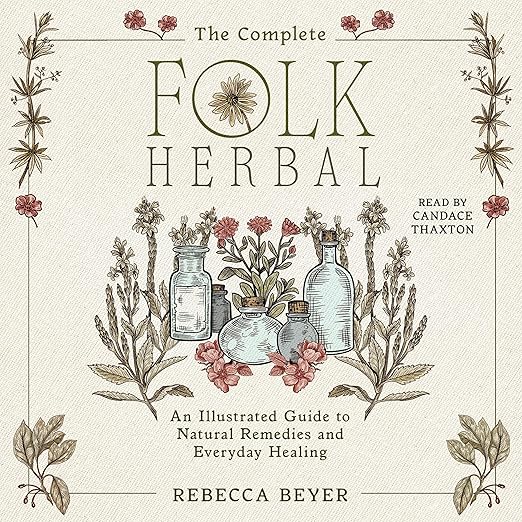
The print edition includes illustrations that are described by multiple reviewers as gorgeous and as one of the book’s most significant features. These are entirely absent from the audio experience. For a book that organizes its content around plant identification as well as use, this is a genuine limitation. Listeners who want to use the book as a foraging or gardening reference, where being able to identify a plant visually is part of the point, will need the print edition alongside the audio.
The audiobook format also changes the natural use pattern of a reference work. Print herbals are browsed, dipped into, returned to. Nine hours of audio narration is better suited to a sustained listen than to the reference mode that most herbal enthusiasts will actually want to use. The narrative quality of Beyer’s writing makes it work as a continuous listen in a way that most reference texts do not, but listeners should be aware that they are getting something closer to an extended course than a quick-reference companion.
Who Should Listen to The Complete Folk Herbal
This audiobook will find its most appreciative audience among listeners with an existing interest in herbalism, foraging, or folk medicine traditions who want to deepen their understanding of the cultural and historical contexts behind traditional plant remedies. It also works for anyone drawn to the intersection of natural history and cultural history, who likes learning how specific communities across time have understood and used the plants around them. Those looking purely for a practical remedy guide should note that the folkloric and historical content is as substantial as the practical, which is a feature rather than a limitation for the right listener. Have the print edition available for the illustrations and for reference use.
Frequently Asked Questions
Is The Complete Folk Herbal useful as a practical remedy guide, or is it primarily historical and folkloric?
Both equally. Each plant profile covers origins, folklore, and traditional uses alongside modern applications and a traditional recipe. Beyer does not separate the cultural history from the practical guidance but treats them as inseparable, which is consistent with the folk herbal tradition itself. Listeners who want a purely clinical reference should look elsewhere; those who want context alongside remedies will find this ideal.
Does the audiobook work without the illustrations, or are they essential to the content?
The text stands on its own as a narrative and cultural work, and Thaxton’s narration makes it more listenable than most reference content. But the illustrations are described by multiple reviewers as a highlight of the print edition, and for any plant identification purpose they are genuinely necessary. The audio works as a companion to the illustrated print edition rather than as a full replacement.
How does Candace Thaxton’s narration handle the botanical terminology and Latin plant names?
Thaxton handles the botanical vocabulary confidently and consistently throughout the nine-hour listen. She gives the Latin names enough care to be useful for identification without making the narration feel like a taxonomy lecture. The overall effect is of informed, warm guidance rather than clinical reading.
Does the book address foraging safety and plant identification for beginners?
The sustainable foraging sections address ethical harvesting and mindful stewardship throughout the text. However, this is not a beginner foraging guide with identification keys or step-by-step safety protocols. Beyer assumes some familiarity with plants and focuses on traditional use and cultural context. New foragers should supplement this with a region-specific field guide.