Quick Take
- Narration: Rachael Doolen reads with a clear, practical warmth that suits the instructional format, no filler enthusiasm, just the material delivered accessibly.
- Themes: Companion planting methods, natural pest management, maximizing small garden spaces
- Mood: Practical and encouraging, like advice from a knowledgeable neighbor
- Verdict: A genuinely useful beginner’s guide that earns its format, the Three Sisters method alone is worth the listen, and the 30-plus plant pairings give new gardeners a real working foundation.
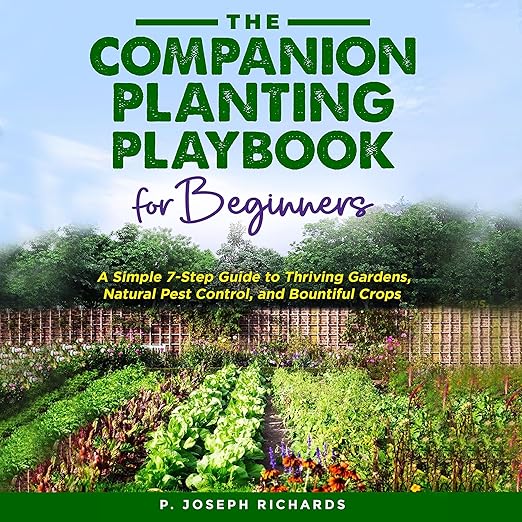
I do not garden in any organized way, but I’ve spent enough time reading garden writing, from Elisabeth Rothammer’s kitchen garden columns to the ecological gardening work of people like Toby Hemenway, to know what separates practical instruction from gardening mysticism. P. Joseph Richards’ Companion Planting Playbook for Beginners sits firmly in the practical camp, which is where a beginner actually needs it. I listened to it on a slow Saturday morning with coffee, and I came away with the clearest understanding of companion planting I’ve encountered in a short listening block.
The concept is ancient. The Three Sisters method, corn, beans, and squash grown together in a mutually supportive system developed by Indigenous North American agricultural communities, is the most famous example, and Richards explains not just what it is but precisely why it works: the corn provides structure for the beans to climb, the beans fix nitrogen in the soil that the corn depletes, and the squash’s broad leaves shade the ground to retain moisture and suppress weeds. That kind of mechanistic explanation, not just which plants go together but what is actually happening between them, is what elevates this guide above the common “tomatoes like basil” level of companion planting coverage.
Our Take on The Companion Planting Playbook for Beginners
The book covers thirty-plus plant pairings organized by gardening goal, which is a more useful organizational principle than alphabetical order or plant family. Richards addresses the most common beginner frustrations, pests, limited space, contradictory advice from different sources, directly and with practical strategies rather than theoretical discussion. One reviewer who came to this book feeling overwhelmed by the concept found it immediately accessible, which is a meaningful endorsement of Richards’ calibration of complexity for the intended audience.
What the book doesn’t do is account for regional variation. A reviewer who found it otherwise excellent noted that adapting the information to your specific region is necessary, and that point deserves emphasis. The Three Sisters method works differently in the Pacific Northwest than in central Texas; some of the pest management companion plantings are more relevant to certain climates and common pests than others. Think of this as a foundation to be refined rather than a universally applicable recipe book.
Why Listen to The Companion Planting Playbook for Beginners
Rachael Doolen’s narration is a good match for the instructional genre. She reads with a quality of helpful directness that doesn’t oversell the subject or perform enthusiasm she hasn’t earned. Gardening audio guides sometimes fall into the trap of relentless cheerfulness that makes you feel lectured at rather than helped; Doolen avoids that. At three hours and forty-one minutes, this is a short audiobook designed for a single, focused listen, and the concision is appropriate to the content, Richards doesn’t pad to meet a page count.
The accompanying PDF, available in the Audible library alongside the audio, is noted in the synopsis and is worth downloading before or during your listen. Companion planting information is inherently spatial, which plants to place where, how to maximize a raised bed’s layout, what goes on the edges versus the center, and visual reference materials for this kind of content are more useful than they might be for narrative or conceptual books.
What to Watch For in The Companion Planting Playbook for Beginners
The book is exactly what it advertises: a beginner’s playbook. More experienced gardeners who have already worked through companion planting basics will likely find this covers familiar territory without adding depth or nuance beyond an introductory framework. The audience is explicitly new gardeners, including people coming from balcony containers or small raised beds rather than established plots, and the content is calibrated for that starting point.
The sections on common gardening mistakes, paired with the how-to-avoid-them guidance, are among the most useful in the book for listeners who have had frustrating early experiences. Richards doesn’t just tell you what to do; he explains what goes wrong when you don’t, which is a more useful pedagogical structure than pure positive instruction.
Who Should Listen to The Companion Planting Playbook for Beginners
New gardeners working with any scale of space, balcony containers, raised beds, backyard plots, will find this a solid starting point. The homesteading audience referenced in several reviews will find it particularly useful for moving toward more self-sufficient and sustainable growing practices. Experienced gardeners looking for anything beyond the basics should look to more specialized resources. This one earns its beginner designation and is no less valuable for it.
Frequently Asked Questions
Does the book explain why companion planting works, or does it just list which plants go together?
It explains both. Richards goes into the mechanisms, nitrogen fixation, shade control, pest confusing through aromatic plants, not just the pairings. This makes the information more durable since you can apply the logic to situations not directly covered.
Is the PDF companion useful, and do I need it to get full value from the audio?
Useful but not essential. The audio works on its own, but companion planting is an inherently spatial subject and the visual reference helps with planning bed layouts. Download it before your first listen if you can.
Does the book work for container gardening and small spaces, or is it only for people with large gardens?
It works for both. Richards explicitly addresses balcony pots and small raised beds alongside larger garden contexts, and several of the 30-plus pairings are specifically applicable to limited growing spaces.
How much do I need to adapt the advice for my region, and does the book address this?
The book acknowledges that regional adaptation is necessary but doesn’t go into regional specifics. Treat it as a foundation and supplement with region-specific resources. This is especially important for pest management, where what works in one climate may be irrelevant in another.