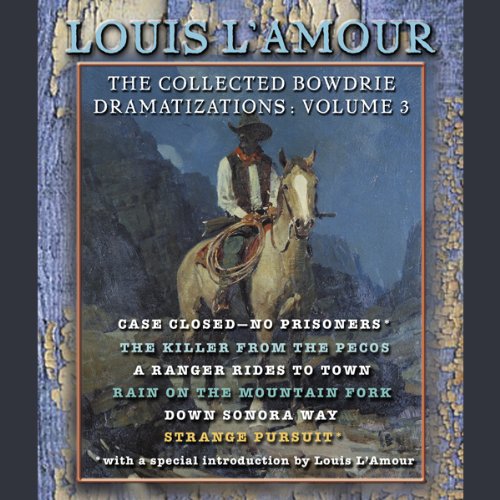
Six Chick Bowdrie stories run five hours, fifty-seven minutes here, and the audiobook credits no performer at all. Its narrator field carries one word, and that word is Dramatization. A format label is standing where a name belongs, on a production the review column makes clear is full of separate voices, and it is the one fact worth knowing before you buy. Nobody on this page will tell you who does the acting, how many of them are involved, or whether the same company returns from the earlier volumes.
How The Collected Bowdrie Dramatizations: Volume III Holds Up
Dramatization is not narration, and the difference decides whether this suits you. A narrated audiobook gives you L'Amour's prose with one reader carrying description, dialogue and interior thought together. A dramatization hands the dialogue to actors, replaces most of the description with sound, and cuts whatever cannot survive that translation. Under six hours across six stories works out at less than an hour each, which is radio-play length rather than short-story-read-aloud length. Nothing on the listing states which approach was taken, so the runtime and that one-word credit are the only evidence available.
Chick Bowdrie himself is the draw, and the description sells him cleanly: a man who could have been an outlaw and rode a different trail instead, recruited by the Texas Rangers to pursue the most wanted men in the Southwest. He knows the dusty trails, the cattle feuds, the desperate killers and the weather-beaten towns that could detonate at the wrong word. That is a premise built for episodic audio, where each installment resets and nobody has to remember a plot from three hours ago.
Volume III arrives with no series metadata whatsoever. The series name field is empty, the series number field is empty, and the only positional information on the entire record is a Roman numeral sitting inside the title. Somebody who wants to start at the beginning has nothing to work from and no route to volumes one and two. For an anthology of self-contained cases that costs less than it would on a continuing story, but it remains a discovery problem the publisher created and left in place.
Why The Collected Bowdrie Dramatizations: Volume III Works as an Audiobook
Mom of 3, writing in November 2013, supplies the detail that matters most on a record this bare: a daughter loves the different voices for the different characters in each story, and a pack of six feels like more for the money. That is a plain report of a multi-voice production landing well with a young listener, and it is worth considerably more than any adjective the listing applies to itself. Two independent details in one short response, and both of them concern the performance rather than the plot.
Mike Embry, writing in December 2012, names the mechanism directly: the dramatization factor makes the story more interesting, and the run of short cases about a Texas Ranger holds attention across the whole collection. Both of those responses describe production rather than prose, which is rarer than it ought to be. A buyer usually gets five opinions about a story and nothing whatsoever about the reading, so two separate reports of distinct character voices carry real weight on a page that names no performer.
Length is the other argument for it. Six complete cases inside six hours means a whole story fits an errand, a workout or an evening of chores with no cliffhanger left dangling behind you. Westerns and radio drama grew up alongside each other, and this format returns L'Amour's Rangers to something close to their native medium. A 4.8 badge across fifty-five ratings is the highest figure in this set by a clear margin, which on a title released back in 2007 usually means an audience that knew precisely what it was ordering.
Weak Spots in The Collected Bowdrie Dramatizations: Volume III
3rdRangerD, writing in August 2012, praises the unabridged CD versions while grading a dramatization, and that slip is the one every buyer here should guard against. A dramatization is by definition not unabridged, since material has to be cut to make room for performance. The same response describes seeing everything through the verbal descriptions and collecting the entire book collection, which reads like somebody moving between formats and treating them as interchangeable. They are not, and the listing does nothing at all to mark the difference.
Steve, writing in July 2021, files a five-star running to two sentences, recommending the set as required listening in every jail and every public school library. Enthusiasm rather than information, and representative of how thin this column runs. Five written responses sit beneath fifty-five ratings, the longest of them four sentences, and not one names a single actor or describes a single scene. If you want to know who plays Bowdrie before spending money, the page cannot tell you and neither can the credit field.
The Right Listener for The Collected Bowdrie Dramatizations: Volume III
Jim Cowan, writing in April 2015, puts the natural buyer in sharper focus than the listing manages: a longtime L'Amour reader whose eyesight has made print tiring, who moved to audio for that reason and found the stories held up perfectly well when somebody else did the reading. That listener is well served here, with one caveat worth stating, which is that a dramatization is a different proposition from the straight readings the same response describes enjoying elsewhere.
Newcomers to L'Amour should probably not start here, not because the stories are difficult but because an adaptation is a poor place to form a first impression of a prose writer. Families with children roughly eight to twelve are the strongest fit, given how well the multi-voice format landed with a young listener in the column. Approached as radio drama rather than as a reading, six hours of Texas Ranger cases is honest value; approached as a way to hear what L'Amour actually wrote, it is simply the wrong edition.
At a Glance
- Subjects: Frontier justice and the reformed outlaw, Texas Ranger casework, six self-contained Southwest manhunts
- Tone: Brisk and episodic, much closer to an old radio serial than to a read-aloud
- Bottom line: Strong value taken as radio drama, and the wrong entry point if you want L'Amour's actual prose.