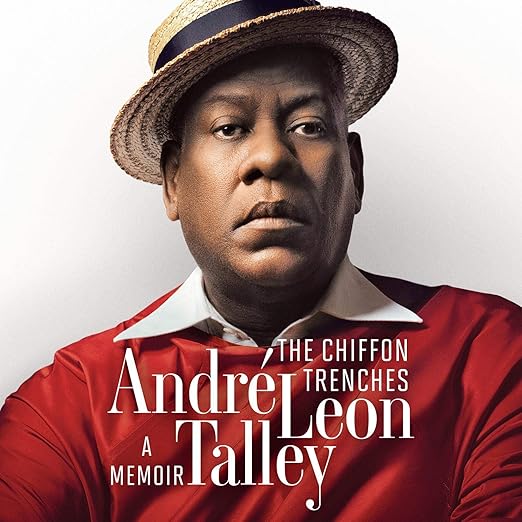
Fifty years of the fashion press get told here by the man who lived them, and he reads them to you himself. André Leon Talley's memoir runs nine hours and thirty-eight minutes, a Random House Audio release from May 2020, and the author narrating his own account of Vogue, Paris and Karl Lagerfeld is the production decision that shapes this audiobook. A memoir this dependent on tone, on who is being cut and how gently, gains something from the voice that did the cutting.
A Closer Look at The Chiffon Trenches
Talley's route through the industry is the spine. A first magazine job alongside Andy Warhol at Interview, then a friendship with Lagerfeld that ran for decades, then Paris as bureau chief of John Fairchild's Women's Wear Daily. The description names Halston, Yves Saint Laurent and Oscar de la Renta as friendships made along the way, and it names the cost in the same breath: a racially tinged encounter with a member of the house of Yves Saint Laurent that sent him back to New York.
May 26, 2020, a week after publication, brought a five-star account praising the humanity of the book's narrator and subject, finding in Talley a purity of eye and heart that the account judges missing in Lagerfeld and Wintour, who it says thrive on power, control and manipulation. Read that word narrator carefully. On this page it means the voice telling the memoir rather than the performance in the file, and the two happen to be the same man.
Karl Lagerfeld is the relationship the book is built around, described in the copy as enigmatic and often caustic. Anna Wintour is the other, formed at Vogue under Grace Mirabella and developing as she rose to the top of the masthead with Talley rising alongside her. The description calls the result at once ruthless and empathetic, which is fair warning that neither friendship gets presented as uncomplicated, and that the warmth and the score-settling arrive in the same chapters.
What Makes The Chiffon Trenches Worth Hearing
More than a book about fashion is how the May 22, 2020 account filed from the France store puts it: entertaining and sincere, and raising questions of racism, diversity and human relations set against business. That is the reading this memoir rewards. The copy's own account of a racially tinged encounter inside a couture house, and of a career built despite racism and illicit rumors in an industry it calls notoriously cutthroat, is the through line under all the name-checking.
Vogue is where the career lands. Talley arrives under Grace Mirabella, eventually becomes creative director, and the description tracks his ascent until he is, in its own phrase, the most influential man in fashion. What makes that stretch work as listening rather than as a resume is that the job itself was social: access, invitations, whose call got returned. Nine and a half hours leaves room for the small scenes that carry a story of that kind.
Southern roots and faith run underneath all of it, named in the description as what guided him from childhood, alongside personal struggles that shaped decades. His own inspirations get named too, Diana Vreeland, Diane von Fürstenberg and Lee Radziwill among them. Faith-formed manners sitting inside couture ruthlessness is the most interesting tension the memoir has, and it is the part least visible from the cover or the category.
Things to Know Before Starting The Chiffon Trenches
Name-dropping is the charge, and February 2021's dissenting grade takes it seriously enough to answer. That four-star account reports a friend dismissing the book as an overdose of name dropping, disagrees, and describes reading the memoir less as autobiography than as an expose of the design community, with extremes of kindness and generosity set against cruel behavior toward the very people these designers called friends. Great talent, it concludes, often belongs to people with very fragile egos.
Eighteen stars out of a possible twenty is what a 4.5 average across four votes has to mean, so the counted column holds exactly two stars of deduction. The written column looks nothing like that: five signed responses, four at five stars and one at four, twenty-four out of twenty-five. The counter records four ratings while five people wrote, so the average and the reviews are not coming from the same set of buyers.
Not one of the five written responses describes the reading. That is a real gap on a self-narrated memoir, because the question a buyer actually has is whether a man who spent fifty years being quoted can carry nine and a half hours of his own prose. The credit confirms he took the microphone. What happened once he did is undocumented here, and the one place the word narrator appears on the page means something else entirely.
Who André Leon Talley Is Writing For
Fashion-magazine readers are the core audience, and the October 2020 account shows why. That reader had subscribed to nearly every fashion title going and had been mesmerized by Wintour for years, yet arrived at this book without knowing how many of the industry's best had found their way to her. A memoir capable of surprising a devoted magazine reader on the basic shape of the business has real information in it.
Curiosity about how the machine worked is the best reason to buy. Anyone who reads fashion coverage and wonders who decides what gets covered will find the mechanics here, from a Paris bureau chief's desk and a creative director's chair, with the friendships and the enmities attached. The Manolo Blahnik line printed in the description calls it fifty sublime years, which rather undersells the stretches that are not sublime at all.
Buyers who want a straight chronological history of late twentieth-century fashion should look elsewhere, because this is organized by relationships rather than by seasons. The same goes for anyone hoping for a light celebrity listen. The racism, the rumors and the personal struggles named in the description are all in here at full weight, and the man reading them out is the one they happened to.
The Short Version
- Performance: Author-read for Random House Audio, a single voice across nine and a half hours with no cast and no archival inserts to lean on.
- What it covers: Access and its price, friendship with people who trade in power, race inside a closed industry
- Feel: Glittering, score-settling and unexpectedly devout
- Our call: The mechanics of the fashion press told by someone who ran them, for anyone willing to accept a memoir built out of names.
Questions Listeners Ask
Does André Leon Talley narrate the audiobook himself?
He does, credited alone across the full nine hours and thirty-eight minutes, with Random House Audio publishing in May 2020. That casting is the whole production decision on this page. What a credit cannot tell you is pacing, so two minutes with a sample is worth spending before committing to a memoir carried entirely by tone.
Is this audiobook an industry history or a personal memoir?
Personal, and organized by relationships rather than by decades. The description tracks jobs at Interview, Women's Wear Daily and Vogue, but the shape follows friendships, chiefly Karl Lagerfeld and Anna Wintour, plus the Southern upbringing and faith the copy says guided him from childhood. Expect scenes and grudges rather than seasons and collections.
Which famous names should I expect in the audiobook?
Andy Warhol at Interview, Karl Lagerfeld across decades, John Fairchild at Women's Wear Daily, Halston, Yves Saint Laurent and Oscar de la Renta in Paris, Grace Mirabella and Anna Wintour at Vogue, plus Diana Vreeland, Diane von Fürstenberg and Lee Radziwill as stated inspirations. Whether that density reads as access or as a list is the book's dividing line.