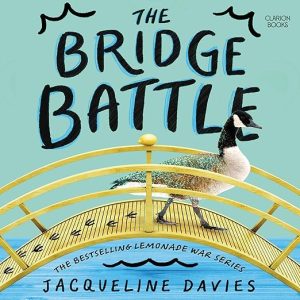
Quick Take
- Narration: Rebecca Soler brings both Jessie’s anxious precision and Evan’s social vulnerability to life with distinct, confident voices that make the dual-POV structure feel effortless.
- Themes: Bullying and peer pressure, identity under social stress, courage and self-honesty
- Mood: Warm and emotionally honest, with flashes of middle-grade tension
- Verdict: A satisfying series closer that earns its emotional payoff by putting both siblings in genuinely uncomfortable situations before letting them find their footing.
I started the Lemonade War series with my niece years ago, and when she grew out of it I kept going on my own. There is something about the way Jacqueline Davies writes children that never feels sanitized or simplified, these kids make selfish choices, feel genuinely hurt, and have to work toward decency rather than just stumbling onto it. I came to The Bridge Battle, the sixth and final book in the series, on a quiet Tuesday afternoon when I had an hour to myself, and I finished it in one sitting.
What struck me immediately was how Davies was willing to break the formula she had established over five books. Evan has always been the social one, easy with friendships, confident in groups. Jessie has always been the logical outsider, the one who struggles to read rooms and people. In The Bridge Battle, both of them end up in precisely the situations that should be most foreign to them, and that reversal is where the book finds its sharpest emotional material.
When the Sure-Footed Kid Stumbles
Evan’s storyline in this book is quietly devastating in the way that only middle-grade fiction aimed at actual children can be. A bully on the summer school playground pressures him into behavior he knows is wrong, and Davies does not let him off lightly or resolve the situation quickly. For young listeners who have ever found themselves doing something unkind because the social cost of saying no felt too high, this section of the book will land hard. Rebecca Soler captures the specific humiliation of a socially competent kid suddenly out of his depth, there is a hesitation in her voice when she reads Evan that communicates his internal conflict without overplaying it.
Jessie and the Bridge That Matters More Than the Competition
Jessie’s summer camp storyline is the more immediately funny of the two threads, at least on the surface. She is surrounded by children who are convinced fairies are scientifically plausible, and her reactions to this situation are precisely what you would expect from a girl who once put a classmate on trial for theft using correct courtroom procedure. But the girls from second grade who made her miserable reappear, and suddenly the comedy acquires some weight. Davies has always been particularly good at writing Jessie’s specific brand of social difficulty, it is never played as a quirk or a superpower, just as a genuine way of moving through the world that comes with real costs.
What the synopsis does not quite capture is how the book uses the bridge-building competition as both literal and metaphorical scaffolding. Jessie cares about the structural integrity of her bridge in the same methodical way she cares about fairness and accuracy. When the competition becomes secondary to a more pressing relational problem, the book earns that shift because we have understood all along that the bridge was never really about winning.
A Series Finale That Trusts Its Readers
Davies does not tie everything up with a bow. Both Evan and Jessie make progress, but the progress feels hard-won and proportionate rather than complete. The lesson about being true to ourselves helping us remember how to treat others is present in the text but never stated with the bluntness of a moral-of-the-story paragraph. For a series that began as a simple economics lesson about lemonade stands, the Lemonade War books have traveled a considerable emotional distance, and The Bridge Battle lands the ending with appropriate weight.
Rebecca Soler has narrated the entire series, and her familiarity with both characters shows. Her Jessie has always had a particular quality, slightly clipped, fast, literal, that distinguishes her immediately from Evan’s more relaxed register. Here, when both characters are pushed off their comfortable scripts, Soler adjusts both voices in ways that signal something is genuinely wrong without becoming melodramatic. It is the kind of narration that makes a children’s audiobook feel worth listening to as an adult.
Who Should Listen, and Who This Might Not Serve
If you have read the first five books in the Lemonade War series, this is an easy recommendation. Davies wrote a coherent arc across all six books, and the emotional payoff of watching Evan and Jessie both become vulnerable in this entry depends on knowing who they have been. Reviewer Linda K noted specifically that reading the series in order is important, and she is right, not because the plot requires it, but because the character work does.
Listeners coming to this volume without prior context will still get a functional story, but they will miss the particular satisfaction of seeing two well-established characters placed in situations that challenge their established strengths. For younger listeners, ages eight to twelve is roughly the sweet spot, though the emotional content skews toward the older end of that range. The bullying subplot is handled with care but it is present and specific enough to matter to a child who has experienced something similar.
Frequently Asked Questions
Do I need to have listened to the earlier Lemonade War books before starting The Bridge Battle?
You can follow the story without prior knowledge, but the emotional payoff depends heavily on knowing Evan and Jessie from the first five books. Davies builds on five books’ worth of character work here, and listeners who arrive fresh will miss the significance of both siblings being placed in their most uncomfortable situations.
Is the bullying storyline in Evan’s sections handled in a way that is appropriate for sensitive younger listeners?
Davies handles it with care and without graphic content, but the situation is specific enough to resonate with children who have experienced peer pressure toward unkind behavior. It is not resolved quickly or easily, which is part of the book’s honesty. Parents of younger or more sensitive listeners may want to preview that thread.
How does Rebecca Soler handle the dual-POV structure between Evan and Jessie?
Soler has narrated the full series and her familiarity with both voices shows. She distinguishes the two characters clearly, Jessie is faster and more clipped, Evan more relaxed, and adjusts both voices in ways that signal when each character is out of their emotional comfort zone without overplaying the distress.
Does the bridge-building competition actually play a central role in the plot, or is it more of a backdrop?
The competition begins as Jessie’s main focus but gradually becomes secondary to a more pressing relational conflict. This shift is earned rather than arbitrary, Davies uses the bridge as both literal plot and metaphor for what Jessie is actually building across the summer. The competition still matters, but what surrounds it matters more.