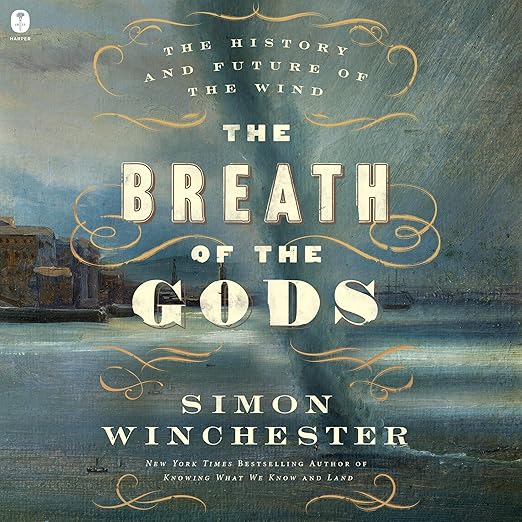
Quick Take
- Narration: Simon Winchester narrates his own book, and as with his previous self-narrated work, the performance carries the authority and enthusiasm of a scholar who has spent years immersed in the subject, he reads like a knowledgeable companion rather than a lecturer.
- Themes: Meteorology and the science of wind, climate change and extreme weather, wind as cultural and literary phenomenon
- Mood: Expansive and curious, occasionally digressive in the way Winchester’s best books are
- Verdict: Winchester at his most characteristic, wide-ranging, erudite, and genuinely informative about a subject most of us have never thought about as seriously as he has.
I started this one on a weekend afternoon when a late-season storm was moving through the northeast, which turned out to be the ideal context. There is something about reading a book about wind while the windows are flexing in their frames that makes the abstract tangible. Simon Winchester has made a career of finding subjects that appear peripheral and revealing how central they actually are, from the making of the Oxford English Dictionary to the geological history of America to the nature of maps. Wind is another entry in that tradition, and it is one of his more urgent ones.
The Breath of the Gods is structured around the tension between wind as threat and wind as resource. On one side: the devastating hurricanes, murderous tornadoes, and cataclysmic fires that have become regulars in the news cycle. On the other: the clean energy industry’s enthusiasm for the University of Northern Illinois 2022 prediction that wind strength and frequency will continue to increase. Winchester moves between those poles through history, literature, science, poetry, and engineering, which is exactly the kind of sweep that his best books manage and his weaker ones stumble over.
Winchester as Narrator of His Own Ideas
Self-narration is the right choice here, and not only for the obvious reasons of authority and authenticity. Winchester writes with a distinctive first-person curiosity, a quality of I wonder if you know about this that invites the reader into the investigation rather than presenting conclusions from a distance. In audio, that quality requires a voice that communicates genuine enthusiasm rather than performed professionalism, and Winchester has it. The passages where he traces the etymology of wind terms across languages, or describes a historical voyage that turned catastrophically on an unexpected gale, carry the energy of someone telling you about something they find genuinely extraordinary.
The supplemental enhancement PDF mentioned in the synopsis is worth noting. Winchester’s books tend to contain the kind of visual material, maps, diagrams, historical images, that adds to rather than duplicates the text. If you are listening rather than reading, accessing that PDF will meaningfully enrich the experience.
The Digressive Middle and What It Costs
One reviewer flagged that the book gets a bit tedious about halfway through with all the author’s details, which is a fair criticism of Winchester’s characteristic method. He does not move through a subject in the most direct line between opening premise and conclusion. He moves through it the way a curious person explores an unfamiliar city: following interesting side streets, returning to the main thoroughfare, following another side street. That method produces his books’ greatest pleasures and their only real weakness. Listeners who need a tighter argument may find the middle chapters of The Breath of the Gods testing their patience.
For listeners who read Winchester regularly, this is a known quality rather than a surprise. His books reward the kind of attention that is willing to follow a digression about the history of kite-flying or the role of trade winds in the spice trade without demanding that every page advance the central thesis. The 4.4 rating across eighty reviews, with multiple readers noting they will never experience wind the same way again, confirms the book is landing with the audience that responds to his method.
The Urgency That Shapes the Book
Winchester published this book in a moment when extreme weather has become a baseline condition rather than an exceptional event. The framing of wind as an unseen force that respects no national borders has particular resonance when consecutive Atlantic hurricane seasons are breaking records and wildfire smoke from Canada is graying the skies over New York. The book is not primarily a climate change argument, but climate change is the context that gives the whole investigation its urgency. Wind has always been powerful; now it is becoming more powerful in ways that require understanding it better than we currently do.
The energy industry material is genuinely interesting. Winchester traces the history of windmills and the early development of wind energy alongside the contemporary industrial wind farm, and the interplay between wind as historical engine of commerce and as contemporary clean energy source gives the book an environmental optimism that sits alongside its weather anxiety without contradiction.
Who Should Listen, Who Should Skip
Listen if you are a Winchester reader who has enjoyed his previous wide-ranging histories, or if you are looking for an accessible, authoritative, and genuinely entertaining introduction to meteorology, weather history, and the science and culture of wind. The self-narration is a significant asset.
Skip if you need a focused scientific or policy analysis of wind energy or extreme weather. Winchester’s method is humanistic and exploratory rather than systematic. For a technical wind energy briefing, this is the wrong book. For a reason to care deeply about something you have never thought carefully about, it is exactly the right one.
Frequently Asked Questions
Is The Breath of the Gods primarily a science book, a history book, or something else entirely?
It is primarily a Winchester book, which means it moves fluidly between science, history, literature, poetry, and cultural history as the subject demands. Wind is examined as a meteorological phenomenon, a historical force in commerce and exploration, a literary subject, and a contemporary energy and climate issue. The approach is humanistic rather than disciplinary.
Does Winchester cover wind energy policy and the economics of the wind power industry, or is that a minor thread?
The clean energy industry’s perspective is central to the book’s opening framing, with the 2022 University of Northern Illinois prediction about increasing wind speed and frequency positioned as an organizing tension. How deeply Winchester engages with wind energy economics across the full thirteen and a half hours is not clear from the synopsis alone, but the subject is present throughout rather than confined to a single chapter.
The supplemental PDF is mentioned in the synopsis. What kind of material does it typically contain in Winchester’s audiobooks?
Winchester’s books generally include maps, historical photographs, diagrams, and illustrations that support the narrative. For a book about wind, that might include historical weather charts, diagrams of atmospheric circulation, or images of landmark meteorological instruments and structures. The PDF is worth downloading alongside the audio.
One reviewer mentioned the book gets tedious in the middle. Is the digressive quality a feature of the whole book or specific sections?
Winchester’s digressions are distributed throughout his books rather than concentrated in a single section. The middle-book fatigue some readers experience is more a product of his cumulative method than any specific chapter going long. If you have enjoyed his other work, the pattern will be familiar. If this is your first Winchester, pace yourself and treat the interesting side streets as the point rather than detours.