Quick Take
- Narration: Korey Jackson brings warmth and forward energy to William Kamkwamba’s story, keeping the pace from feeling heavy even during the famine sequences, a strong performance for the young adult edition.
- Themes: Ingenuity under scarcity, perseverance, the transformative power of education
- Mood: Earnest and uplifting, with enough specific hardship to give the triumph its weight
- Verdict: A remarkable true story, well-served by the audiobook format, that earns its place in classrooms and family listening equally.
I came to this one through a roundabout path. A colleague mentioned her son had read it so many times the cover fell off, a detail that stuck with me, because it says something about a book that few pieces of critical praise can match. I settled in one Saturday morning with coffee and found myself not wanting to stop once the first chapter had established its rhythm.
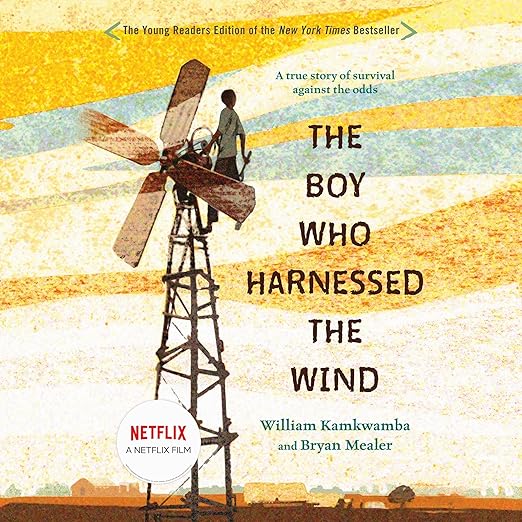
This is the young adult edition of William Kamkwamba’s memoir, retold for a younger audience with photographs and illustrations that the audiobook cannot reproduce but whose spirit Korey Jackson’s narration works to carry. That context matters: this is a deliberately adapted version of the story, streamlined for classroom use and family reading, which shapes both its strengths and its limits.
Our Take on The Boy Who Harnessed the Wind
The story itself is one of those accounts that sounds implausible until you are deep inside it and realize it is simply true. When a severe drought devastated the crops in William Kamkwamba’s small village in Malawi, his family lost everything, their harvest, their income, their ability to pay for school. Forced to drop out, William spent time in his village library and found science books that gave him an idea. Working from scrap metal, old bicycle parts, and pieces salvaged from wherever he could find them, he built a windmill that brought electricity and water pumping capability to his family’s home. He was fourteen years old.
What the book captures, and what the audiobook communicates, is not just the ingenuity of the windmill itself, but the specific texture of persistence in the face of genuine adversity. This is not motivational parable dressed as memoir. The hunger is real, the skepticism from neighbors is real, the fear that the rains may not come again is real. The windmill means something because the alternative was so concretely bad.
Why Listen to The Boy Who Harnessed the Wind
Korey Jackson handles the material with the right sensibility. His narration is warm without being saccharine, and he maintains enough forward momentum through the harder sequences, the famine, the schooling loss, the physical difficulty of construction, that the listen never feels oppressive. For the younger audience this edition targets, that tonal judgment matters. Jackson makes the story feel like it is being told to you, which is exactly right for a memoir of this kind.
The book also models a form of curiosity that is genuinely hard to teach but easy to demonstrate. William reads science books not because anyone tells him to but because a problem demands a solution and the books are there. Reviewers who have used this in classrooms note that students connect with that dynamic in a way that more abstract encouragement rarely achieves. One reviewer described sixth graders building windmill models as a class project after reading it, which tells you something about how concrete the book makes what might otherwise be an abstraction.
What to Watch For in The Boy Who Harnessed the Wind
The photographs and illustrations mentioned in the synopsis are not accessible in the audio format. For listeners who want the full visual complement to the story, this is worth noting before purchase. The epilogue that brings William’s story up to the present is included, and it is one of the better additions to the young adult edition, giving the book a sense of ongoing consequence rather than ending at the windmill itself.
Because this is the adapted young adult version rather than the original adult memoir (co-written with Bryan Mealer), some of the political and economic context that the adult text explores more thoroughly is simplified here. That is appropriate for the target audience, but adult readers who want Malawi’s post-independence history and the economics of agricultural drought in fuller detail should seek out the original edition.
Who Should Listen to The Boy Who Harnessed the Wind
This edition was designed for young listeners, and it excels in that role. But as several adult reviewers noted, the story does not require you to be twelve to find it compelling. The core narrative, one person, one idea, an impossible situation, actual results, lands regardless of age. It works well for family listening and for classroom use, and it works equally well for adults looking for a true story that trusts its reader to care about a teenager in Malawi building something from nothing.
Listeners seeking the full political and historical scope of Kamkwamba’s story, or those interested in the adult collaborative memoir as a literary object, will want to find the original text. But for what this edition sets out to do, make this story legible and meaningful to a broad, younger audience, it succeeds straightforwardly.
Frequently Asked Questions
Is this the same as the original adult memoir or a different version?
This is the young adult edition, retold for a younger audience and published by Listening Library. The core story is the same but some of the adult political and economic context is simplified. The original memoir was co-authored with journalist Bryan Mealer and goes into greater historical depth.
Does the audiobook work without the photographs and illustrations mentioned in the synopsis?
You lose the visual documentary element, but the narrative is strong enough to carry the story on its own. Korey Jackson’s narration compensates well. If the photographs are important to you, the print or e-book edition would complement the audio.
Is this appropriate for the age group that typically reads it for school?
Yes. The adapted edition was specifically designed for classroom use and has been assigned to middle school students. Reviewers note it has been used with sixth graders successfully, and the content, drought, perseverance, family, is serious without being traumatizing.
How does Korey Jackson’s narration handle the more difficult emotional sequences?
Jackson maintains warmth and forward momentum throughout, which keeps the famine and poverty sequences from feeling heavy or slow. His pacing suits the young adult format, present in the difficult moments without dwelling in them to the point of discouragement.