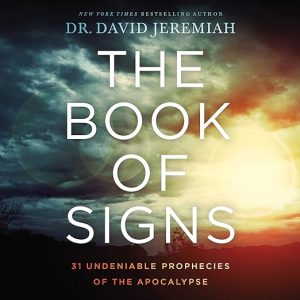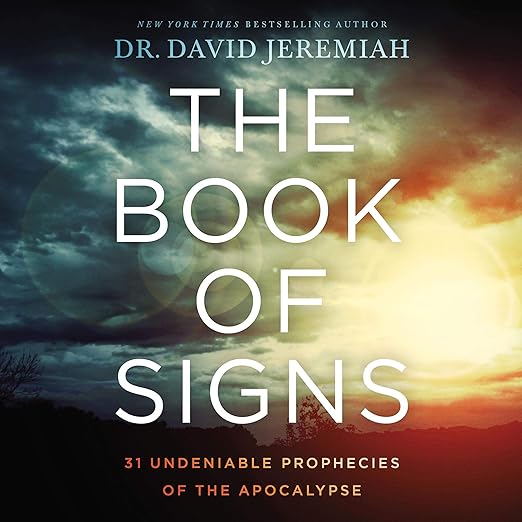
End-times theology is a subject that attracts two very different kinds of books: the sensationalist variety that maps current headlines onto prophetic texts in ways designed to generate urgency and book sales, and the serious study variety that actually does the work of biblical scholarship and lets the text speak at its own pace. David Jeremiah's The Book of Signs falls firmly in the second category. It was published in 2019 and draws on decades of Jeremiah's teaching and preaching, organized around thirty-one signs of the approaching apocalypse drawn from Scripture. At sixteen hours, it is a substantial commitment, and it is written for listeners who are prepared to engage seriously rather than be briefly entertained.
Jeremiah's organizational framework is the book's strongest structural feature. He groups the signs into five categories, international, cultural, heavenly, tribulation, and end signs, and works through each with the kind of systematic care that reflects a scholar who has spent years in this material. The approach is exegetical: he begins with the biblical text, explains what it meant in its historical context, and then considers how it might apply to the present. He is careful about the distinction between what Scripture clearly states and what is interpretive inference. That carefulness distinguishes the book from the sensationalist end of the genre, where everything current is read as direct fulfillment of specific prophecy.
Is The Book of Signs Worth Your Time?
Jeremiah narrating his own work is an asset in this particular format. He has delivered these ideas in sermons and lectures for decades, and the material has been shaped by that extended teaching practice into something that is dense without being inaccessible. His voice is measured and warm without the practiced charisma of televangelist performance, he sounds like a pastor who is thinking alongside his audience rather than performing for them. One reviewer described the book as "absolutely FABULOUS" and praised Jeremiah's ability to explain what the Apostle John was seeing and "put it to print" in ways that illuminate rather than mystify.
The sixteen hours cover a great deal of ground, and listeners who are new to Revelation and end-times theology will emerge with a much clearer map of how the tradition has organized the prophetic material. Jeremiah draws on commentators across church history, and his synthesis reflects genuine engagement with the interpretive tradition rather than a single school of thought. That range is valuable for listeners who want to understand how biblical prophecy has been read across different Christian contexts rather than simply being given one authoritative interpretation.
The Best Parts of The Book of Signs
The self-narration works because this is material Jeremiah knows from the inside. He has written and spoken about biblical prophecy his entire professional life, and the authority of that long engagement is audible in the delivery. The format of an audio Bible study, listening at your own pace, returning to sections, pausing for reflection, is also naturally suited to material that rewards rereading and consideration. The companion study guide is sold separately, but the audio stands independently for listeners who want to engage with the ideas without the more structured reflection questions.
Weak Spots in The Book of Signs
The book is written within an evangelical Christian framework, which means it takes the authority and literal truth of Scripture as a starting point rather than a proposition to be defended. Listeners who do not share that framework will find the argument's premises require translation. Additionally, while Jeremiah is careful about distinguishing text from interpretation, the book operates within a broadly premillennial dispensationalist reading of Revelation, listeners from different theological traditions may find some of the interpretive moves require scrutiny. The comparison of current events to biblical prophecy, while done carefully, also necessarily reflects the specific historical moment of the book's writing.
Should You Listen to The Book of Signs?
Christian listeners who want a serious, structured engagement with the prophetic literature of Scripture will find this among the more comprehensive audio resources available. Those who have completed a church Bible study on Revelation and want deeper material will find Jeremiah's synthesis valuable as a next step. Listeners outside the evangelical Christian tradition will need to translate some of the framework assumptions, but the biblical scholarship is substantive enough to reward the effort. Those looking for a quick overview should probably start with a shorter Jeremiah title before committing to sixteen hours.
Does The Book of Signs require prior knowledge of Revelation or end-times theology?
No prior knowledge is assumed. Jeremiah is writing for a general Christian audience and explains the biblical material as he goes. Listeners who have spent time in Revelation study will find some familiar ground, but the organization and synthesis Jeremiah provides adds value even for those already familiar with the text.
How does Jeremiah handle the connection between current events and biblical prophecy?
He draws connections carefully, distinguishing between what Scripture states clearly and what requires interpretive work. He avoids the sensationalist approach of identifying specific current figures with specific prophetic roles, while still arguing that contemporary events are broadly consistent with what the prophetic literature anticipates.
Is the companion study guide necessary for the audiobook to be useful?
No. The audio version stands independently and covers the full argument without requiring the companion guide. The guide adds structured reflection questions for those who want a more formal study experience, but it is supplementary rather than necessary.
What theological tradition does Jeremiah write from, and does it affect the book's approach to Revelation?
Jeremiah writes from within a broadly evangelical, premillennial dispensationalist tradition, which shapes some of the interpretive choices, particularly around the sequence of end-times events. Listeners from Reformed, Catholic, or Orthodox traditions will find some of the interpretive framework differs from their own, though the biblical scholarship is careful enough to be engaging across those differences.