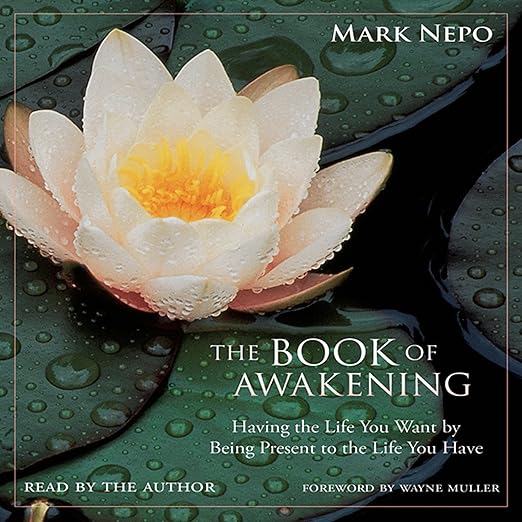
Small doses are how Mark Nepo's collection was built to be taken: one piece at a time, with the closing of the book counting as part of the practice. Seventeen hours and twenty-six minutes of continuous audio is a different instrument altogether, since pacing is the one thing an audiobook removes from a reader's hands. Nepo reads it himself, which improves the calculation, and the description says almost nothing about how the material is organized, which spoils it again.
Sold as Three Essays, Read Like a Calendar
Nowhere does the publisher's copy use the words daily or calendar. The description says the book divides into three sections, finding our inner core, standing by our inner core, and sustaining the practice of living from that place, which leaves the impression of a book with an argument to advance. One entry describes something quite different. It reports loving the day by day format, picking up whichever piece matches the calendar, and it cites one directly, 'Oct 21', on having honest friends. A dated devotional and a three-part essay collection are not the same purchase, and this page sells the second while the column underneath describes the first.
Nepo narrating his own work is the production's largest asset and its structural problem at the same time. A devotional depends on the pause after the sentence, and the author reading his own aphorisms is the one person who knows precisely how long that pause is supposed to run. What no performer can supply is navigation. Reaching a specific dated piece inside seventeen and a half hours of linear audio is nothing like opening a book to today's page, and a listener who wants to use this the way the column describes using it will spend real time hunting.
Nepo the Cancer Survivor, Folding Life Into Nuggets
Method is where the oldest entry on the page gets considerably more precise than the rest. It describes Nepo taking the reader's ordinary life and folding it down, in its own phrase, 'breaks open the harried existence we call life and folds it into bite-sized nuggets of wisdom', and it supplies the biography the publisher's copy leaves out: 'A poet and philosopher by trade, Nepo is also a cancer survivor.' That fact changes how the sentences sound. The same entry reaches for an image of a writer who has 'crossed the desert and made it to the oasis for the revitalizing drink', which is a generous description of somebody in no hurry whatsoever.
What the description promises is unusual for this shelf: not the author's own wisdom so much as other people's. The material is assembled from stories about ordinary people, political activists, artists and spiritual teachers drawn from a range of traditions, all of them described as having faced themselves, warts and weaknesses included, with commentary tying each story back to the listener's own life. That structure is why the audio holds up better than the daily format would suggest. A story with a commentary attached makes a natural spoken unit, and seventeen hours of them sits closer to a very long conversation than to a manual. None of that assembly looks accidental. Commentary arriving after a story rather than ahead of it is a teaching structure rather than an editorial one, and it survives the move into audio completely intact.
Every Review Talks About Reading, Never Listening
'Short readings and insightful' is the entirety of one entry, and it is correct on both counts, which is also the caution. A book made of short pieces has no momentum to carry a listener across a weak one, and at this length some will land while others slide by unremembered. The star line claims fewer votes than the column of written responses printed beneath it actually holds, so the average deserves reading as decoration rather than as evidence of anything.
Vocabulary across that column points the same way every time: readings, reading, a reader stopping to think, a book somebody picks up. No response refers to a voice, a running time or an hour spent listening. The description addresses listeners three separate times while describing a physical object for the rest of its length, which is a small contradiction with practical consequences. Anybody weighing formats gets no help here, and the question that matters most, whether the dated structure survives into audio in any navigable form, is precisely the one nobody has answered.
'Thinking person's devotional' is the label the description hangs on the book, quotation marks included, and those quotation marks are doing quiet work. Somebody else said it first, the copy never says who, and the phrase exists to reassure a buyer who would not otherwise reach for a devotional at all. That is the readership this title has always chased: people who want the form without the doctrine, and who need permission to want it. The plural variant, The Book of Awakenings, turns up in the customer text below the description as well, which is the sort of slip that happens when a book gets known for what it does rather than for what it is called.
Suits a Morning Habit More Than an Argument
It earns the time if you want something that interrupts you rather than absorbs you. One further entry states the use case exactly, describing a book made to 'make the reader stop, think, and appreciate life and all it has to offer' and calling the effect uplifting. That is a fair account of what these pieces do one at a time. Anyone already keeping a morning practice, or wanting one and having failed to build it out of a printed book, is the natural buyer here, and having Nepo's own voice inside it is a genuine advantage over a page that stays silent.
Leave it alone if you want an argument rather than a practice. Nothing accumulates; each piece resolves on its own terms and the next one begins somewhere else entirely, which is the whole point of the form and a real irritation if you arrived expecting a thesis. Leave it alone too if the mixed-traditions approach puts you off, since the copy is explicit that its teachers come from a variety of traditions rather than one. Whoever needs to reach a specific dated piece on a specific morning should know the printed original is the object built for that, with this recording working as the companion rather than the reverse.