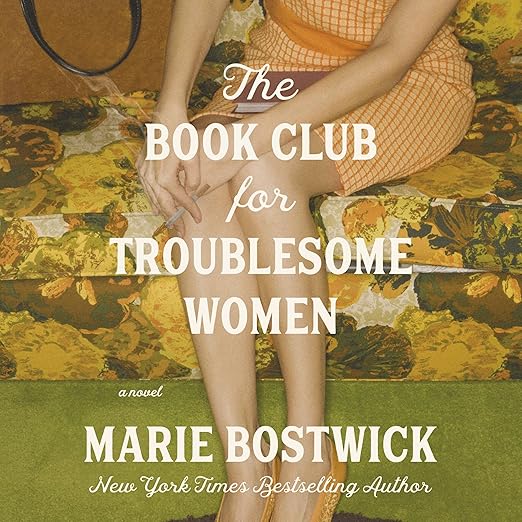
Margaret Ryan, the accidental revolutionary at the center of The Book Club for Troublesome Women, never intended to start anything. She was just trying to get close to Charlotte, the mysterious new neighbor. In Marie Bostwick's novel, narrated by Lisa Flanagan for this eleven-hour audiobook, that small social maneuver - a spontaneous book club invitation to two other neighborhood women in early 1960s Virginia - becomes the hinge on which four lives turn. The novel opens with the cheerful suffocation of its period: Margaret has the husband, the children, the station wagon, the subscription to a housewife magazine called A Woman's Place that tells her exactly who to be. Flanagan plays this opening with a dry, controlled irony that signals immediately that the story knows exactly what it is doing with the gap between the life Margaret is supposed to want and the one she has begun to quietly doubt.
Flanagan Plays Margaret as Warm and Serious
Bostwick situates her novel around Betty Friedan's The Feminine Mystique, the 1963 bestseller that named the unnamed problem of housewives who felt obscurely trapped by the very lives society told them to be grateful for. The four women - Margaret, Charlotte, Bitsy, and Viv - who form the Bettys (after Friedan) are each carrying a version of that unnamed problem. What Bostwick does well, and what reviewers have consistently praised, is that she grounds the feminist awakening in specific, comic, painful, and human terms rather than in polemic. These women cannot open a bank account without their husbands' signatures. They cannot get a prescription for birth control in their own names. The outrages are real and Bostwick documents them with a raised eyebrow rather than a raised fist, which makes them register more sharply. Flanagan's narration matches this register precisely: she is warm and ironic in equal measure, and her Margaret carries the weight of a woman who is genuinely funny about the situation even as she recognizes how serious it is.
The Lessons in Chemistry Comparison Holds Up
The comparison the Library Journal draws to Bonnie Garmus's Lessons in Chemistry is earned in specific ways: both novels use a female protagonist who is structurally blocked by the period's assumptions about women's roles, and both find their energy in the protagonist's refusal to fully internalize those assumptions. Bostwick is warmer and more communal than Garmus - this is a novel about what women can do together rather than what one exceptional woman can do alone - but the tonal kinship is real. Flanagan gives each of the four women a sufficiently distinct presence that the ensemble structure stays clear over eleven hours without requiring the listener to work to track whose perspective is whose. The historical tidbits that one reviewer praised are delivered in the narration as texture rather than didactic insert - moments when the novel pauses to acknowledge, almost incidentally, the legal and social realities of 1960s American womanhood that now read as staggering. Those passages are more affecting in audio than on the page, delivered by Flanagan in a register that trusts the listener to feel the weight without being told to.
Charlotte's Backstory Waits for Its Quiet Reveal
The novel covers a single pivotal year, and Bostwick is explicit that this year is consequential not because these four women become famous but because they change, quietly and irrevocably, in ways that the world outside Concordia never fully registers. That modest scale is a deliberate choice. Some readers looking for a grander sweep of historical narrative may find the intimate focus limiting; listeners who respond to novels about the interior lives of women who are not celebrated by official history will find it exactly sufficient. The Charlotte character - the mysterious neighbor whose backstory is the novel's central withholding - is handled with enough patience that her eventual revelation lands with emotional rather than merely plot-level impact. One reviewer expressed frustration that the novel is not straightforwardly feminist in its arguments; that ambiguity is accurate and is also, arguably, a more honest representation of how women negotiated those years: not through ideology but through small, daring acts of solidarity and self-determination.
Concordia's Comfortable Women Still Lack Full Autonomy
This audiobook is well suited to listeners who love historical fiction centered on female friendship and find pleasure in novels that are emotionally generous as well as politically aware. Those who enjoyed Lessons in Chemistry, The Women by Kristin Hannah, or any of the Bostwick backlist will find this among her more confident and layered works. Listeners who prefer their historical fiction with more plot-driven action than character study may find the domestic scale limiting. The novel makes no claims to epic scope, and that restraint is a strength rather than a limitation for the audience it is clearly written for.
The novel's particular attention to Concordia, the fictional exclusive suburb of Northern Virginia where the Bettys live, is worth noting as a setting choice. It is not accidental that these are women with education, relative financial comfort, and social access who nonetheless cannot function as independent legal or economic persons in 1963. The restrictions Bostwick documents apply up and down the class structure, but the gap between these women's education and their permitted autonomy is particularly sharp, and Flanagan plays that gap with a precision that makes the comedy feel pointed rather than merely charming. The novel does not argue that the feminist revolution began with four women in a suburban book club; it argues that it began exactly that way, in small rooms, over shared books and cocktails and the slow recognition that the unnamed problem had a name after all.
The novel's particular attention to Concordia, the fictional exclusive suburb of Northern Virginia where the Bettys live, is worth noting as a setting choice. It is not accidental that these are women with education, relative financial comfort, and social access who nonetheless cannot function as independent legal or economic persons in 1963. The restrictions Bostwick documents apply up and down the class structure, but the gap between these women's education and their permitted autonomy is particularly sharp, and Flanagan plays that gap with a precision that makes the comedy feel pointed rather than merely charming. The novel does not argue that the feminist revolution began with four women in a suburban book club; it argues that it began exactly that way, in small rooms, over shared books and cocktails and the slow recognition that the unnamed problem had a name after all.
Good to Know
Does the audiobook of The Book Club for Troublesome Women require familiarity with Betty Friedan's The Feminine Mystique?
No prior knowledge is required. Bostwick incorporates enough of Friedan's argument into the characters' discussions and reactions to orient listeners who have not read the original. Those who have read The Feminine Mystique will find additional layers of resonance in the characters' specific responses to its ideas, but the novel works fully without that background.
How does Lisa Flanagan handle the ensemble cast of four main characters in the audiobook?
Flanagan differentiates the women through tonal register and rhythmic variation rather than cartoonish vocal distinction. Margaret's voice has a wry, self-aware quality; Charlotte is more guarded; Bitsy and Viv are warmer and more immediately legible. The ensemble stays clear across eleven hours without requiring the listener to consciously track who is speaking.
Is this audiobook closer to light historical fiction or something with more serious ambitions?
Closer to the latter, despite its warmth and humor. Bostwick documents the specific legal and social constraints on women in 1960s America with accuracy and genuine anger, even as the surface tone is comedic. Reviewers have described it as both a feel-good read and a politically charged one, which reflects the novel's dual register: it is entertaining precisely because it is honest about what the characters are up against.