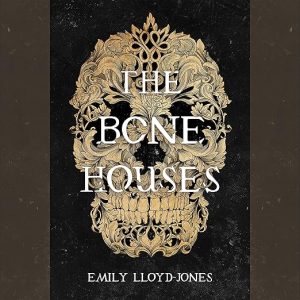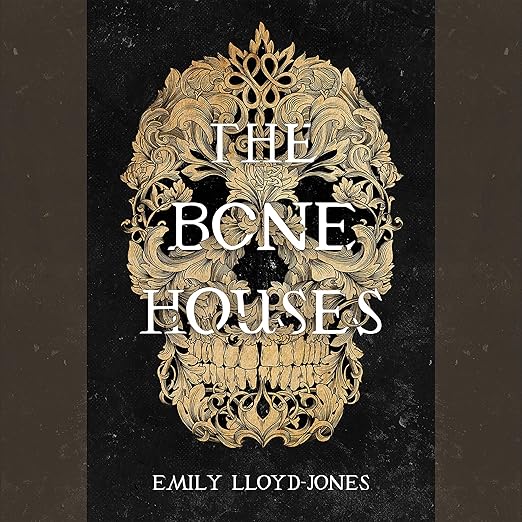
In Brief
- Narration: Moira Quirk brings an atmospheric, grounded Welsh-tinged quality that suits the remote village setting and the novel's folkloric tone beautifully.
- Themes: Grief and the refusal to let go, chronic illness representation, the cost of belonging to a cursed landscape
- Mood: Atmospheric and melancholy, with moments of dry wit that keep the horror grounded
- Verdict: A quietly exceptional YA dark fantasy that earns its emotional payoff through character depth rather than shock, with narration that makes the bleak landscape feel real.
I came to The Bone Houses with modest expectations. The comparison to Buffy the Vampire Slayer on the cover is the kind of hook that either signals genuine tonal intelligence or lazy marketing, and I have been burned by both. Within the first twenty minutes of Moira Quirk's narration, I knew which category this was. Emily Lloyd-Jones is doing something quieter and more genuinely strange than that comparison suggests, and the audiobook format brings it out beautifully.
The setup is deceptively simple: seventeen-year-old Ryn digs graves for a living in the remote Welsh-adjacent village of Colbren, where the dead have an unfortunate habit of not staying buried. When Ellis, an apprentice mapmaker with a mysteriously blank past, arrives and the bone houses begin attacking with unusual ferocity, the two are pulled into the mountains to find the source of the decades-old curse. Lloyd-Jones is not primarily interested in horror mechanics, though the risen corpses are rendered with genuine creepiness. She is interested in grief.
Our Take on The Bone Houses
The novel's emotional core is the relationship between living and loss, specifically how the people of Colbren have learned to co-exist with their walking dead rather than expunge them. Ryn understands bone houses as part of the landscape, not as monsters. That normalizing of horror is one of the book's most effective moves: it forces the reader to ask what it means to keep something dead near you because letting it go entirely is too final.
Ellis is the novel's other surprise. His chronic pain, from a condition that functions as an analogue to real-world invisible illness, is woven into who he is rather than treated as backstory or obstacle. One reviewer who lives with chronic pain described reading this as feeling genuinely seen in a way they rarely experience in fiction. That is not an accident. Lloyd-Jones is careful and specific about how Ellis manages his body, what he can and cannot do, and what it costs him to push through. It is the kind of representation that does not announce itself but that readers will recognize immediately.
Why Listen to The Bone Houses
Moira Quirk's narration is one of the genuine pleasures of this audiobook. She gives Colbren a grounded, rural quality that never tips into parody, and her reading of Ellis is particularly good: thoughtful and a little self-deprecating, with a dry wit that prevents his suffering from becoming maudlin. The horror sequences benefit from her restraint. Quirk does not lean into the uncanny for effect. She reads the bone houses with the same matter-of-fact tone Ryn would use, and that calm is far more unsettling than theatrical intensity would be.
At just over nine hours, the audiobook moves efficiently. The journey into the mountains that forms the second half of the book is paced like a fairy tale: purposeful, escalating, and not wasteful of time. A reviewer noted that the ending could have been stronger at the climax, and there is something to that. The resolution arrives quickly after a long buildup. But the emotional resolution between Ryn and Ellis is fully earned, and that matters more.
What to Watch For in The Bone Houses
Listeners coming primarily for horror content may find the gore relatively restrained. This is dark fantasy with horror elements rather than pure horror, and the scariest things in the book are emotional rather than visceral. The bone houses function more as symbols than as monsters, which is the point, but readers who want something more aggressively frightening should know this going in.
The book also sits in a somewhat unusual space for YA: the romance is present but not the dominant engine. Ryn and Ellis are companions before they are anything else, and the slow build of their relationship is more quietly effective for it. If you come expecting a swoony YA love story, you will find something more patient and more interesting than that.
Who Should Listen to The Bone Houses
This is a strong pick for fans of Holly Black and V.E. Schwab who want something in a similar register but with a more rural, folklore-adjacent setting. It is also well suited to listeners who appreciate YA that takes grief seriously, or who want a fantasy novel where chronic illness is represented with honesty and care. Those who need their horror explicit or their romance front-and-center will need to adjust their expectations, but patient listeners will find a genuinely affecting book.
How scary is The Bone Houses? Is it appropriate for younger teens?
The horror is atmospheric rather than graphic. The bone houses are unsettling and there is death in the story, but the violence is not explicit. Most YA readers comfortable with dark fantasy will handle it well. Very sensitive younger readers may find some scenes disturbing.
How well does Moira Quirk handle the Welsh-flavored setting and character names?
Very well. Quirk's reading gives the village of Colbren and its characters a grounded authenticity without over-performing a specific regional accent. The audio actually smooths over what some print readers flagged as an initially confusing setting.
Is the chronic pain representation in Ellis's character accurate or stereotyped?
Multiple readers, including at least one who lives with chronic pain, described Ellis's condition as unusually well observed. Lloyd-Jones integrates it into his daily reality and his decisions without making it a defining tragedy or a plot convenience.
Do I need to read other Emily Lloyd-Jones books before The Bone Houses?
No. The Bone Houses is a fully standalone novel with its own complete world and arc. It shares Lloyd-Jones's interest in folklore-inflected fantasy but has no narrative connection to her other work.