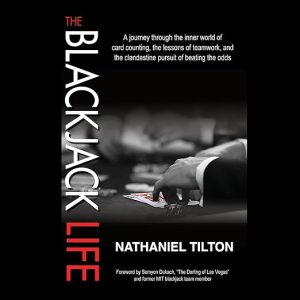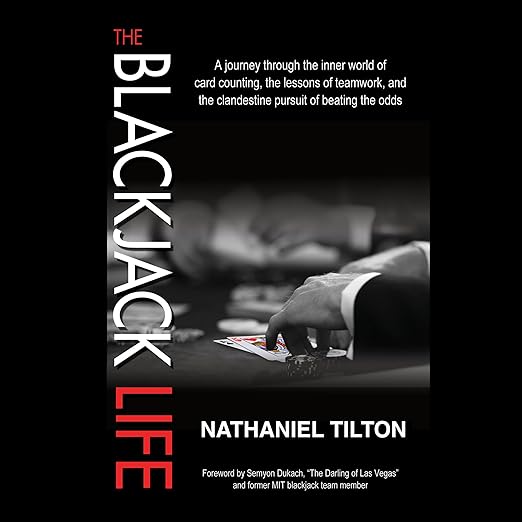
Nathaniel Tilton was a financial advisor in Boston in his early 30s - employed, stable, and by his own account leading an ordinary existence - when a meeting with Semyon Dukach, a member of the famed MIT blackjack team, redirected the trajectory of what came next. The Blackjack Life, an 8-hour-and-16-minute audiobook narrated by Joseph Bevilacqua, is the account of that redirection: Tilton's progression from curious amateur to a world-class card counter, his development alongside partner D.A. of a small-team counting system designed to be virtually undetectable, and the life they built and eventually had to navigate out of - high-roller suites, gourmet restaurants, top-shelf entertainment, and the casino backrooms that represented the endpoint of exposure. What distinguishes this book from the broader gambling memoir genre is its position between technical instruction and personal narrative, managing to deliver both without either one cannibalizing the other across the full runtime.
Where This One Lands
Tilton's central technical contribution is the small-team system itself. He notes that existing blackjack strategy literature at the time of his entry into the world covered large teams and solo practitioners but left a specific gap in the middle - the space where two people working together could achieve undetectable precision at a level no solo counter could sustain and no large team could manage without revealing itself through visible coordination. The audiobook describes that system in genuine operational detail, not as a tutorial but as an integral component of the story. Readers who describe themselves as blackjack enthusiasts call the technical content "very sound technically," which is meaningful praise from an audience equipped to assess it. Bevilacqua's narration handles the technical passages with clarity, giving the card-counting mechanics the same pace and attention he gives the narrative sections. He does not rush through the math or dramatize it artificially - he reads it with the same self-assurance he brings to the casino scenes, which is the right choice for material where the technical competence and the lived experience are both part of the same story. One reviewer describes being "captivated from cover to cover," and the pacing Bevilacqua maintains is a significant part of why.
The casino world Tilton describes is rendered with enough specific operational detail to feel real rather than constructed. High-roller suites and gourmet meals appear not as symbols of success but as the specific logistics of a life built around moving through gambling establishments without triggering detection. The deception required to maintain cover as a professional counter, the personal risks that accumulate over time as casinos build their surveillance intelligence, and the backroom encounters that represent the consequences of exposure are all handled with the honesty of someone who has experienced them rather than someone who has researched them. Reviewers who came to the book specifically for the behind-the-scenes picture of professional gambling life cite the balance between the glamour and the dark side as the book's distinguishing quality. One describes it as a character-driven story that takes the listener through the full experience, which is accurate but understates how unusual it is to find a gambling memoir that is simultaneously rigorous about technique and genuinely interested in the personal development arc of the person doing the counting. Tilton's account of who he was before blackjack, what the practice gave him in terms of identity and direction, and who he became through it provides the emotional core that makes the technical content matter beyond its practical application.
What to Watch For in The Blackjack Life
Listeners who want a step-by-step card-counting training protocol will find this book informative but not directly instructional in that sense. The system is described conceptually and narratively rather than as a structured training sequence, which means you understand how Tilton and D.A. thought about the work without receiving instructions you could apply directly. The casino industry context has shifted since the book's events - surveillance technology has advanced considerably, and some of the specific detection-avoidance tactics described are likely harder to execute in the current environment. As a historical document of a specific professional subculture at a specific point in the ongoing contest between counters and casino security, this temporal quality is part of the book's interest. The personal development arc is handled without false sentimentality. Tilton is honest about the costs of the life - the strains on relationships and personal integrity that sustained professional deception produces - and the ending does not adopt the triumphalist posture that similar gambling narratives often cannot resist.
Recommended For
Listeners interested in professional gambling, applied mathematics in high-stakes environments, and unconventional self-discovery memoir will find Tilton's account rewarding across all three dimensions. Blackjack enthusiasts who want technical depth delivered with narrative momentum will find this considerably more engaging than most strategy-focused books, which provide instruction without the human context that makes the skill feel meaningful beyond the table. General readers who want the story of how someone builds an unusual life from an unlikely foundation, and what it costs and what it genuinely gives in return, will find the personal arc compelling without needing any prior interest in cards or casinos. Those who want a purely technical manual, or who prefer a triumph narrative without moral complexity or acknowledged cost, will find Tilton's more honest account requires more of them than either conventional format typically does. That is not a limitation. It is what makes the audiobook worth hearing.
Does The Blackjack Life audiobook teach you how to count cards yourself?
It describes the concepts and logic of Tilton's small-team counting system in real detail, but as narrative rather than protocol. You will understand how and why the system works without receiving step-by-step instructions you could directly implement.
Is The Blackjack Life audiobook primarily a memoir or a blackjack strategy guide?
Genuinely both, which is unusual for the genre. Tilton delivers technical specificity alongside the personal narrative without either cannibalizing the other. Bevilacqua's narration holds both registers with equal effectiveness.
How does Joseph Bevilacqua's narration handle the technical card-counting sections of the audiobook?
Bevilacqua delivers the technical sections with clarity and controlled pacing, giving the concepts room to land without rushing or dramatizing them. He maintains the narrative's momentum through both the strategic explanations and the story-driven sections.
Is the casino world in The Blackjack Life audiobook presented honestly about the costs, or is it primarily glamorized?
Reviewers consistently describe it as honest. Tilton covers the high-roller lifestyle alongside the deception, personal risk, and backroom confrontations with equal candor. The book does not present the professional gambling life as uncomplicated excitement.