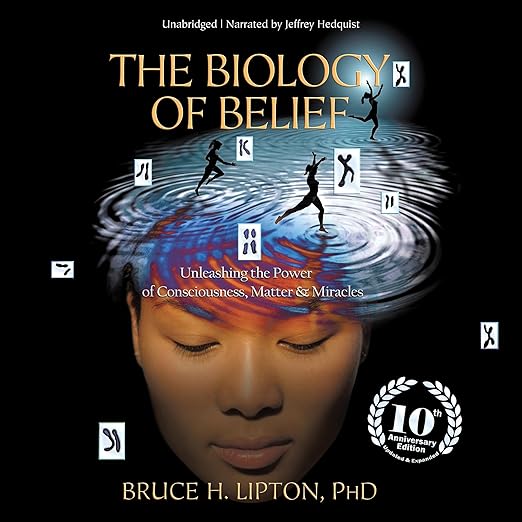
Bruce Lipton's central claim in The Biology of Belief is that genes take orders rather than give them, and Jeffrey Hedquist's narration treats that reversal as the spine of the whole audiobook instead of a single startling fact tossed in for effect. Lipton spends most of his case on epigenetics, the idea that signals arriving from outside the cell, including the ones generated by our own thoughts, shape gene expression far more than DNA does acting alone. More than fifteen years have passed since the original book's publication, and this unabridged audio edition folds in a decade of additional research that Lipton argues has only reinforced his original experiments.
Written by Bruce H. Lipton PhD and narrated by Jeffrey Hedquist, this 10-hour-and-24-minute audiobook holds a 4.6 rating from 9 ratings, a modest number for a title whose print original has sold widely for two decades. Hedquist reads with the patience of someone who has explained cell biology to skeptical rooms before, never rushing past the science to reach the inspirational payoff, and that restraint keeps the denser stretches from ever feeling like a lecture.
Our Take on The Biology of Belief
The book's engine is a fairly radical claim for a working cell biologist to make in public: that the nucleus is not the cell's command center, and that the membrane, constantly reading environmental signals, does more of the real decision-making than the genome itself. Lipton walks through his own laboratory experiments alongside newer studies in quantum physics and cell biology to build that case methodically rather than simply asserting it. A listener identified as Rural ID.nurse put it well, noting that the bulk of the material is scientifically solidly grounded before Lipton pivots, toward the end, into his own broader hypothesis about consciousness and human potential, a shift worth knowing about going in rather than discovering halfway through disc nine.
A reviewer using the name M.Biblioswine compared the book directly to Maxwell Maltz's 'The New Psycho-Cybernetics,' noting that Lipton's version arrives with updated resources Maltz's text, written a decade earlier, simply did not have access to. That comparison is useful context for anyone weighing whether to add this to an already crowded mind-body shelf: this sits squarely in that self-improvement lineage, dressed in the vocabulary of modern cell biology rather than mid-century psychology, and listeners familiar with the older tradition will recognize the shape of the argument even as the science underneath it has visibly moved on since that earlier book.
Because Lipton does not narrate the book himself, unlike a fair number of authors in the mind-body wellness space, Hedquist functions as an intermediary voice rather than the author's own testimony, which shifts the listening experience slightly toward the register of a briefing rather than a personal confession. That distance actually helps the denser opening chapters land with more clarity, even if it costs the book some of the raw, first-person conviction a self-narrated wellness title usually trades on.
Why Listen to The Biology of Belief
Lipton writes in plain language on purpose, leaning on humor and everyday examples rather than dense jargon, and Hedquist's narration honors that choice instead of overcorrecting into either false gravity or forced enthusiasm. The result suits listeners who want the emotional payoff of a self-help book paired with the vocabulary of a science lecture, a narrower lane than either genre usually occupies on its own, and one this audiobook occupies comfortably across its full runtime.
The synthesis Lipton builds between quantum physics and cell biology gives the material real intellectual ambition beyond a simple positive-thinking message. He is explicit that transforming conscious and subconscious thought patterns is the actual mechanism at work, not a metaphor for it, and that specificity separates the book from vaguer wellness content that gestures at science without doing the work. Reviewer Lauren k called the book both scientific and spiritual in the same breath, which is exactly the balance Lipton is aiming for and, across most of this listen, genuinely achieves.
Because Lipton builds each idea on real-life examples before moving to the next concept, individual chapters function reasonably well as standalone listens rather than demanding a single unbroken sitting. That structure suits the audiobook format specifically, letting a listener return to the signal-transduction material, for instance, without needing to reload an entire argument built across many earlier hours.
What to Watch For in The Biology of Belief
Skeptics of anything adjacent to New Age wellness language should know upfront that Lipton's warmer passages, about the power of belief to reshape biology, go further than a strictly peer-reviewed textbook would. Rural ID.nurse's review draws a clear line between the well-supported early chapters and Lipton's own concluding hypothesis, and that line is worth remembering while listening, since the tone shifts noticeably once the book moves past its laboratory evidence and into speculation about where that evidence might eventually lead.
A rating count of only 9 on this particular audio listing looks thin next to the book's long publishing history, and it more likely reflects how recently this specific unabridged edition went up than any real reception problem. Buyers should weigh the print edition's two decades of steady sales and Hedquist's own unhurried, non-theatrical delivery more heavily than the small number currently attached to this audio listing.
It is also worth remembering how far the word epigenetics has traveled since this book's original 2005 publication. What felt like a genuinely fringe argument two decades ago is now closer to mainstream biology, and Lipton's updated research references throughout this edition help the audiobook avoid feeling dated even as the surrounding scientific conversation has caught up to some of his original claims.
Who Should Listen to The Biology of Belief
Nurses and other health professionals curious about the biological mechanics behind mind-body medicine, readers of Deepak Chopra-adjacent wellness writing who want more hard science woven in, and anyone who has genuinely wondered whether stress and belief can shape physical health at the cellular level will find plenty here worth sitting with. Hedquist's steady delivery suits repeated listening, since this is the kind of audiobook people tend to revisit for specific chapters rather than absorb in one straight pass.
Listeners who have since encountered similar mind-body arguments in more recent, better-known bestsellers will recognize this as one of the earlier works that helped popularize the underlying science in the first place, which gives it a kind of foundational-text status even for readers arriving after the fact.
Hardcore skeptics of anything framed as spiritual will bump against Lipton's warmer passages, and anyone who needs heavy citation on every single claim should treat the later chapters as Lipton's own theory rather than settled consensus science. Listeners strictly after a dry, purely clinical biology lecture with zero personal-transformation framing would do better elsewhere on the epigenetics shelf, since that framing is not incidental here, it is the whole point of the book.
At a Glance
- Performance: Jeffrey Hedquist reads with patient, unhurried clarity that lets Lipton's denser science land without tipping into lecture-hall dryness.
- What it covers: epigenetics and cell biology, the mind-body connection, belief as a biological mechanism
- Feel: Curious and quietly hopeful
- Our call: A genuinely science-grounded case for how belief shapes biology, best for listeners comfortable with its more speculative closing chapters.