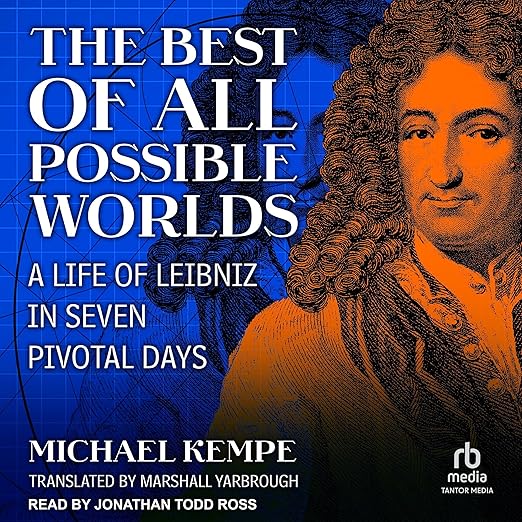
Gottfried Wilhelm Leibniz invented calculus, independently of Newton and ahead of him in publication, conceptualized the binary number system that underlies every modern computer, and developed the philosophical claim that this existing world is the best possible one God could have created. He did all of this while working as a court diplomat, running mining operations, corresponding with scholars across Europe, and drafting plans for everything from submarine navigation to a proto-European union. The Best of All Possible Worlds, translated from German and narrated by Jonathan Todd Ross, is historian Michael Kempe's attempt to get inside a mind that ranged this widely, and the audiobook's structural conceit, seven specific days in Leibniz's life each examined closely, gives it a biographical texture that chronological overviews cannot match.
First, the Big Picture
Kempe chooses his seven days carefully. October 29, 1675 finds Leibniz in Paris, working in bed among a sea of notes, committing the integral symbol to paper for the first time. April 17, 1703 has him in Berlin, writing a letter about a Jesuit priest in China who has decoded how Leibniz's binary system maps onto an ancient Chinese writing scheme. August 1714 shows him in Vienna with a coffee, drawing connections between ontology, biology, and mathematics in a way that sounds like the work of several different specialists happening to think simultaneously. These moments are specific enough to function as windows into how Leibniz actually worked, and Kempe constructs the context around each one so that the significance of the moment is clear even to listeners unfamiliar with the broader scientific debates of the period.
The book is a translation from German, and reviewer Ken G3UDA specifically praised the translation as "crisp," noting that Leibniz "got involved in many important concepts." What Kempe achieves across the seven-day structure is not a conventional biography but something closer to a phenomenology of intellectual work: how does a mind that can hold calculus and diplomacy and theology and binary arithmetic simultaneously actually move through a day? The answer, reconstructed from Leibniz's own letters and notebooks, is that it moves restlessly, associating freely across disciplines and finding structural connections that specialists within any single field would miss. The Jesuit-China correspondence in particular captures this vividly: Leibniz reading a Chinese system through the lens of his own mathematical innovation, and finding the connection plausible enough to report seriously.
Jonathan Todd Ross is a reliable narrator for intellectual nonfiction, and this material requires someone who can sustain engagement across eight and a half hours of content that alternates between mathematical history, philosophical argument, and biographical narrative. Ross manages those transitions without jarring the listener, and the audiobook benefits from his ability to make abstract content feel like a conversation rather than a lecture. The calculus sections, where Kempe explains what Leibniz actually achieved and why it differed from Newton's approach, are accessible without being condescending, and Ross's pacing in those passages is steady enough to let the ideas land.
The philosophical sections, particularly Kempe's treatment of Leibniz's optimism thesis, are where the audiobook does its most distinctive work. The claim that this world is the best of all possible worlds is philosophically rich and has been both defended and satirized for three centuries, most famously by Voltaire in Candide. Kempe places Leibniz's thesis within the rational optimism of the Enlightenment and makes a case that the thesis is more sophisticated than Voltaire's parody allowed. Whether or not that case is fully persuasive, the argument is substantive and worth the attention it receives across multiple chapters.
Weak Spots in The Best of All Possible Worlds
The seven-day structure, which is the book's central innovation, also creates a slight artificiality in the biographical texture. Leibniz's life between those seven days is necessarily compressed into context-setting passages that lack the specificity of the key moments themselves. Listeners who want a full chronological biography will feel those gaps. The structure is justified by what it achieves in the selected moments, but it is an unusual choice that not every biography reader will find satisfying. Those who come expecting the comprehensive sweep of a conventional intellectual biography may need to adjust their expectations before the first chapter.
The Newton-Leibniz priority dispute over calculus is present but not the focus of the book. Kempe is more interested in what Leibniz was doing with calculus than in the historical and personal ugliness of the controversy. Listeners who come to this primarily hoping for a detailed account of that dispute will find it addressed but not dwelt upon. The book's interest is in Leibniz's mind rather than his conflicts, and the seven-day structure reflects that priority throughout, keeping the focus on the creative and intellectual act rather than the professional competition.
Is This One for You?
Listeners who are curious about the history of mathematics and philosophy but want a biographical entry point rather than a technical treatment will find this audiobook exactly calibrated for that interest. Readers who have enjoyed intellectual biographies in the tradition of Walter Isaacson or David Berlinski will find the approach familiar and the subject matter fresh. Those expecting a comprehensive account of Leibniz's life and work will want to supplement this with a more standard biographical treatment, but as an unconventional portrait of a singular mind at work, this audiobook does something specific and unusual well. At under nine hours, it makes Leibniz's way of thinking legible and interesting to a general listener without requiring any prior philosophical or mathematical background.
Do I need a background in mathematics or philosophy to follow this audiobook?
No. Kempe writes for a general audience and Jonathan Todd Ross's narration is well-paced for listeners approaching Leibniz without prior knowledge. The calculus and philosophical sections are explained clearly enough to follow without specialist background.
Is The Best of All Possible Worlds audiobook a translation from German, and does that affect the listening experience?
Yes, it is translated from German. Reviewer Ken G3UDA specifically praised the translation as crisp, and the prose in the audiobook does not feel stilted. Jonathan Todd Ross handles the English text with the same ease he would bring to a text written originally in the language.