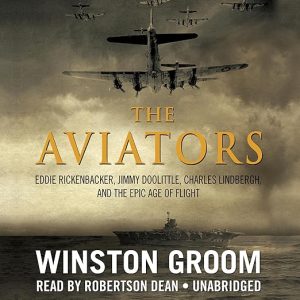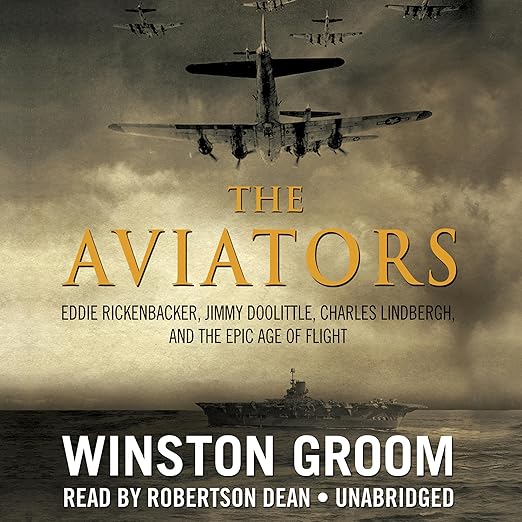
- Performance: Robertson Dean's measured, authoritative delivery suits Groom's narrative history style well, keeping 17-plus hours from feeling heavy.
- What it covers: The golden age of American aviation, heroism and survival under wartime pressure, legacy and character
- Feel: Epic and propulsive, with the texture of well-researched popular history
- Our call: A deeply satisfying listen for anyone drawn to the intersection of military history and biography, with Rickenbacker's story in particular emerging as a genuine revelation.
I came to The Aviators knowing Lindbergh and Doolittle in the way most people do: outline knowledge, famous moments, names from textbooks. Eddie Rickenbacker I knew even less about. By the time Robertson Dean finished reading the section where Rickenbacker and his crew drifted for weeks in the Pacific, circled by sharks, rationing the occasional albatross, I had developed a conviction that Rickenbacker might be the most compelling figure of the three. That reorientation is one of the reliable pleasures of Winston Groom's book, and it's a good sign when a 17-hour listen reshapes what you thought you knew before you started.
Groom, who most people still associate with Forrest Gump, has spent the second half of his career doing serious popular history, and The Aviators is among his best work in that mode. He's not an academic historian and he doesn't write like one. His prose moves. His research is evident but never displayed as an end in itself. What he is, is a gifted storyteller who knows that three intertwined lives across half a century of American aviation history is better served by narrative momentum than by comprehensive footnotes.
A Closer Look at The Aviators
The structural decision to weave three biographies together rather than give each man a discrete section is what makes this book work so well as an audio experience. Groom finds the right moments to cut between Lindbergh's postwar combat missions in the South Pacific, Doolittle's planning of the Tokyo Raid, and Rickenbacker's survival story. Each is remarkable on its own. Together they build something that functions almost like a novel, three very different men shaped by the same violent century, all of them returning to the skies when they could have stayed home.
The reviewer Ken Keller notes that Groom's writing "already excellent, improves" with age, and there's something to that. The research in this book is genuinely impressive. One reviewer highlights a detail I hadn't known: that Jimmy Doolittle held a PhD in aeronautical engineering from MIT, a fact that sits oddly but fascinatingly beside his reputation as a daredevil pilot. Rickenbacker's trajectory from world-class race car driver before WWI to World War I flying ace to founder of Eastern Airlines to Pacific survival story is the kind of life that seems invented. It wasn't.
Robertson Dean narrates this in a style that matches the material perfectly: steady, unshowy, capable of conveying the weight of historical consequence without over-dramatizing it. At 17 hours and 23 minutes, this is a significant time investment, and Dean's consistent tone is part of what makes it manageable. He doesn't attempt to distinguish the three men's voices with performative choices that would draw attention to themselves. Instead he lets Groom's prose carry the differentiation, which is the right call for a book that moves fluidly between biography, military history, and survival narrative.
Listeners who came up on popular history like Laura Hillenbrand's Unbroken will recognize the approach here, and the book's marketing positions it alongside Flyboys and The Greatest Generation with good reason. Those comparisons aren't reach. Groom is working in the same vein of accessible, deeply researched narrative history aimed at a general audience that respects both the facts and the story.
Things to Know Before Starting The Aviators
One honest caveat: this is a book about three men who were, by any measure, great, and Groom's admiration for all three is evident throughout. This is not a revisionist history or a critical biography. Lindbergh's controversial politics in the late 1930s are addressed but not dwelt upon. Readers looking for a more complicated accounting of any of these figures, particularly Lindbergh's public opposition to US involvement in WWII, may find the treatment insufficient. The book's interest is in their courage and their character as demonstrated in action, and it largely stays there.
That's a legitimate choice, and it's part of what makes this good popular history rather than a difficult one. Just know what you're getting: an honest admiration for these three men and the age they helped define, rather than an attempt to locate their full contradictions.
Who Winston Groom Is Writing For
Recommended for listeners with an established interest in WWII history, American aviation, or military biography. It's equally suited for anyone who has already read Unbroken or Flyboys and is looking for something comparable in quality and approach. The Rickenbacker sections in particular are worth the full runtime even if the other two men's stories are already familiar to you.
This is less well-suited for listeners who want a critical or psychologically probing biography. Groom's approach is admiring and narrative-forward. If you want Lindbergh's full complexity or a reassessment of Doolittle's strategic decisions, you'll need a different book alongside this one. But as an entry point to this era and these three lives, The Aviators earns its 4.6 rating and then some.
Do you need prior knowledge of WWII aviation history to enjoy The Aviators?
No. Groom writes for a general audience and provides enough context that newcomers to this period can follow without prior knowledge. Readers who already know the broad outlines of Lindbergh, Doolittle, and Rickenbacker will find their understanding enriched rather than duplicated.
Which of the three aviators' stories does Groom spend the most time on?
The three receive roughly balanced treatment, though multiple readers and reviewers note that Rickenbacker emerges as the most surprising and compelling of the three, partly because his story is less widely known. His Pacific survival ordeal in particular gets extended and harrowing coverage.
Is Robertson Dean's narration suited for a book this long, at over 17 hours?
Yes. Dean's style is measured and consistent rather than theatrical, which serves a long-form narrative history well. He doesn't tire across the runtime, and his approach lets Groom's prose lead rather than competing with it.
How does The Aviators handle Lindbergh's prewar political views and his opposition to US entry into WWII?
Groom addresses this period but doesn't dwell on it. The book's primary interest is in the aviators' wartime courage and personal character. Readers wanting a full examination of Lindbergh's America First involvement and its implications will need to supplement this with a dedicated Lindbergh biography.