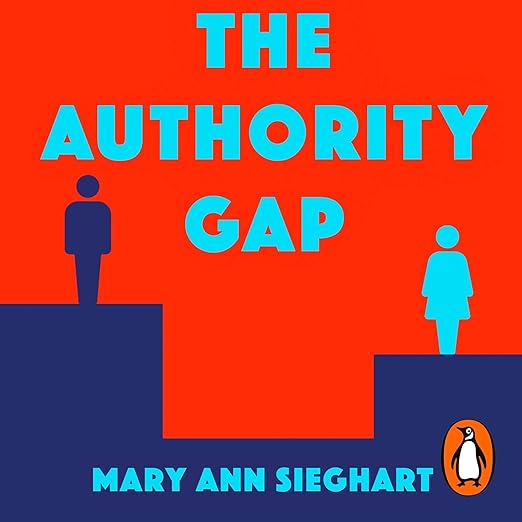
Quick Take
- Narration: Mary Ann Sieghart narrates her own work, and the effect is significant: her measured, wry self-awareness about being a woman who is frequently underestimated gives every data point an author’s embodied authority.
- Themes: Gender bias in perceived expertise, unconscious sexism in professional and public life, the cost of the authority gap to organizations and society
- Mood: Precise and unflinching, with a dry wit that keeps the argument from becoming a grievance
- Verdict: A meticulously evidenced case for a bias that most people don’t notice because it operates beneath the threshold of conscious awareness, narrated with exactly the kind of measured authority the subject requires.
There’s a particular kind of book that arrives with a simple premise and proceeds to do the work of proving it so thoroughly that by the end you can’t imagine how you didn’t see it before. I listened to The Authority Gap over two rainy days, and the experience was consistently arresting in the way that good social science writing can be: not because the argument is outlandish, but because the evidence is so carefully marshaled that you feel slightly embarrassed for having needed it spelled out.
Mary Ann Sieghart is a British journalist, former assistant editor of The Times, and chair of several public institutions. She has spent decades navigating environments where women’s expertise is routinely underestimated, and The Authority Gap is her account of that phenomenon backed by data. The book grew from a column she wrote about studies showing that women are interrupted more, cited less, and trusted with less authority than men of equivalent credentials, and it became a project of assembling the evidence that this is systematic rather than anecdotal.
The Inversion That Opens the Book
Sieghart’s opening move, asking readers to imagine a world where men experience what women experience in professional contexts, is rhetorically clever and substantively productive. By flipping the gender of every scenario, she forces the implicit normality of male authority into visibility. It’s not a trick. It’s the kind of mental rotation that makes visible what perspective has normalized.
The empirical core of the book is strong. Sieghart draws on studies from psychology, economics, linguistics, and organizational behavior, and she’s careful about how she presents the evidence. The rate of interruption in mixed-gender meetings, the difference in citation rates for female academics, the way seniority affects how women are perceived by subordinates of both genders: these are not cherry-picked findings. They’re consistent across different methodologies and different institutional settings, and Sieghart presents them with the precision of someone who knows that the argument needs to be bulletproof.
The Interviews With Pioneering Women
The book’s interviews, with figures like Baroness Hale, the former President of the Supreme Court, Mary Beard, the classicist and public intellectual, and Booker Prize-winning novelist Bernadine Evaristo, are among its most valuable passages. These are not anecdotes deployed to make data feel human. They’re extended conversations with women who have spent decades navigating the specific dynamics Sieghart is describing, and their observations add texture and specificity that purely quantitative accounts miss.
Reviewer RebeccaGH’s experience of buying the print edition after the audiobook to annotate it is telling. Sieghart’s narration of her own work is genuinely excellent. She reads with the calm authority of someone who has spent a career at senior levels of British journalism, and there’s a particular quality to her voice when she cites a study that contradicts male expertise or describes an incident from her own career that no hired narrator could replicate. The text is hers, and you feel it.
The Data on Social Media and Online Spaces
The book covers online dynamics, including the way women who express opinions publicly are disproportionately trolled and threatened, with the same methodological care it brings to workplace research. This section is important because it extends the authority gap concept beyond formal professional settings into the informal public sphere. The mechanisms are different from those operating in a conference room, but the underlying dynamic, the default skepticism about women’s right to be taken seriously, is recognizable across both contexts.
Where the book is deliberately light is in its prescriptions. Sieghart offers suggestions in the final chapters, including specific behaviors for men to adopt and ways to design meetings and institutions that counteract the bias, but she’s careful not to reduce the argument to a self-help framework. The problem is structural, and structural problems require structural responses that individual behavior change, while useful, can’t fully address.
Who Should Listen, Who Should Skip
Listen regardless of gender if you work in any professional environment where credibility, expertise, and authority are allocated. The evidence is meticulous and the self-narration gives it an authority that transcends the data alone.
Skip if you want a prescriptive guide to organizational culture change or a policy analysis of gender equity interventions. This is a diagnostic book, and its power is in the diagnosis.
Frequently Asked Questions
Does the book apply only to women in professional settings, or does it address other contexts?
It covers professional settings in depth but also addresses public intellectual life, social media, and domestic contexts. The authority gap concept is applied broadly, and some of the most striking data comes from research on everyday social interactions rather than workplace behavior specifically.
How does Sieghart handle cases where women underestimate other women’s authority?
This is addressed directly and with statistical rigor. Sieghart makes clear that the bias is not exclusively male: studies show that women also default to male authority in many contexts. This is one of the book’s most important and uncomfortable findings, and it’s handled with care.
Is this primarily a UK-focused book, given Sieghart’s background and the interview subjects?
The research is drawn from international sources, and the core argument applies across cultural contexts. The UK frame is more visible in the interview subjects and some of the institutional examples, but the empirical evidence is not UK-specific, and American listeners will recognize the dynamics immediately.
Does narrating her own work help or hurt Sieghart’s case?
It helps, significantly. Part of the book’s argument is that women’s expertise is routinely discounted in ways that operate beneath conscious awareness. Hearing Sieghart cite that evidence in her own measured, authoritative voice adds a dimension that professional narration would flatten. This is one of those cases where self-narration is genuinely the right choice for the material.