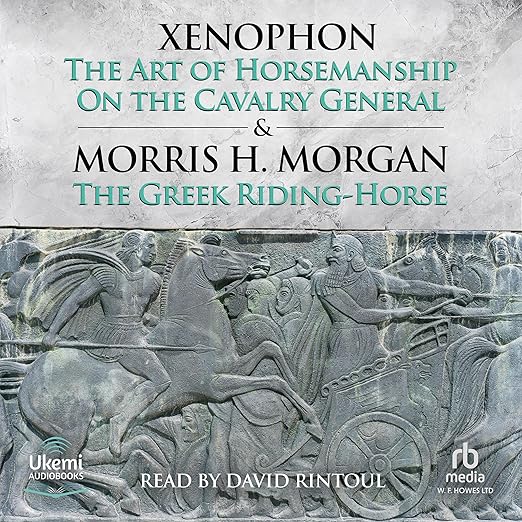
Mounting a horse without stirrups or a saddle was routine business for the Athenian cavalry officer who wrote this two-thousand-three-hundred-year-old training manual, and large parts of his advice still hold up today. The Art of Horsemanship is Xenophon's practical guide to choosing, training, and riding a horse, written around the fifth century BCE by a soldier who also happened to be a friend of Socrates, and this audiobook pairs it with his shorter companion piece, On the Cavalry General. At two hours and forty-five minutes, it's one of the shortest listens in recent memory, and that brevity turns out to be exactly right for what the text actually is.
Rintoul's Classical Pedigree for Hands-On Advice
What makes this text unusual in the corpus of classical Greek literature, as the synopsis rightly points out, is how specific and hands-on it is. Xenophon isn't building an argument or telling a story; he's walking a reader through what to look for in a horse's chest, nostrils, eyes, knees, and hooves, then explaining how to approach, mount, and train the animal without provoking it. Reviewer Howard Schulman, who read Morris H. Morgan's 1893 translation, calls it unusually easy to follow compared with most ancient Greek translations he's encountered, and that accessibility is a big reason this short audiobook works as well as it does.
David Rintoul narrates, and while this specific title has no confirmed listener feedback on his performance yet, he has a documented history reading classical Greek material, including Socratic dialogues billed specifically for reading with authority. That's a reasonable genre-fit signal for a text this old and this technical: horsemanship instruction needs a voice that treats the material seriously without turning two thousand years of practical wisdom into a dry recitation.
Classical antiquity buffs working through the wider Greek canon in audio form will find this a genuinely efficient addition to that project: at under three hours, it's a low-cost way to round out familiarity with Xenophon beyond the Anabasis, without the time investment a full translated history or philosophical dialogue usually demands.
Ancient Checklist, Modern Translation Notes
The specific advice holds up remarkably well: broad chest, wide nostrils, a prominent eye, supple knees, and a calm temperament are still things a modern rider or buyer checks for, and the detail about sound hooves indicating good feet reflects real, still-relevant horsemanship knowledge from a period before the Greeks even shod their horses. Michelle Hurni's review calls it an outstanding short read covering all aspects of the topic simply and with real care, and that combination of brevity and thoroughness is a genuinely rare one for a technical text this old.
Morris Morgan's translation work goes well beyond a simple word-for-word rendering. His extensive notes cover technical questions like mounting without stirrups or a saddle, and his own essay, The Greek Riding-Horse, extends Xenophon's observations with additional scholarly context. Listeners get both Xenophon's original voice and a knowledgeable translator's running commentary on it, which adds real depth to what could otherwise be a very thin listen.
Soldier's Register, Written Without Any Stirrups
Xenophon's own biography adds context worth knowing before starting: beyond horsemanship, he was a professional soldier best known for the Anabasis, his account of a failed military expedition into Persia, and a documented friend of Socrates. That background explains why On the Cavalry General, the second, shorter treatise included here, reads less like a hobbyist's manual and more like a working officer's field guide to leading mounted troops, a genuinely different register from the horse-care material that opens the recording.
Xenophon's specific tips on approach and handling go well beyond generic advice: he covers how to avoid startling a horse, how to read its temperament before mounting, and how varied terrain changes both training approach and what to watch for underfoot. That level of hands-on specificity, closer to a working trainer's field notes than a philosopher's abstraction, is exactly what reviewers single out as surprisingly durable across twenty-three centuries.
Riding without stirrups, standard practice in Xenophon's Greece since the technology hadn't reached the Mediterranean world yet at that point, also explains why so much of his advice concerns the rider's own balance, seat, and grip rather than equipment. Modern riders working bareback or in minimalist tack will find that emphasis genuinely more relevant than a listener might expect walking in.
Compact by Design, Sculptures Better Seen Than Heard
At under three hours, this is a short, focused listen rather than a comprehensive history or narrative, and that brevity is a function of the source material, not an abridgment; Xenophon's original text is simply a compact practical guide, not a novel-length work being trimmed down. Anyone expecting a dramatic narrative alongside the horse care instruction should adjust expectations accordingly.
Morgan's essay compares Xenophon's descriptions against surviving ancient sculptures, pointing out where artists took creative license over anatomical reality, and that kind of visual cross-referencing is naturally harder to follow by ear than on the page, where a reader can flip back and forth between text and image. Listeners who want the full benefit of that comparison may want the print or ebook edition alongside the audio for that specific section.
On the Cavalry General shifts register from personal horse care to command-level tactics, covering how a leader should select, train, and deploy mounted troops rather than how an individual rider should treat one horse. Listeners expecting a single continuous topic across the full two hours and forty-five minutes should know the back half pivots toward military leadership specifically, a genuinely different, though related, body of practical advice.
One practical structural question worth flagging for anyone choosing between formats: Morgan's notes and essay are extensive enough in print that a reader can skim past them or dig in selectively, while an audio narration typically presents everything in the same continuous sequence. Whether the recording separates Xenophon's original text clearly from Morgan's added commentary, or blends them into one continuous listen, will shape how easily a listener can tell ancient source from modern scholarly gloss, and that structural detail isn't confirmed in the listing itself.
Practical Handbook, Too Slight for Some
Horse owners, riders, and anyone who works with animals professionally will find genuine, still-applicable instruction here, and classical literature fans curious about a less commonly read corner of the Greek canon get an accessible, surprisingly quick entry point into Xenophon's writing. Reviewer Mike's description of it as a nice little handbook with easy legibility captures the tone well: this is a practical reference, not a chore.
Skip this one if you want a narrative history or a dramatic story rather than a technical manual, or if two hours and forty-five minutes feels too slight to be worth a full audiobook credit on its own.
Common Questions
Is this audiobook still useful for modern horse owners, or is it only a historical curiosity?
Both, according to listener reviews. Xenophon's advice on choosing and handling a horse is described as genuinely relevant to modern riders, not just an artifact of ancient Greek life.
Does the audiobook include Xenophon's On the Cavalry General as well as The Art of Horsemanship?
Yes, both treatises are included on the same recording, giving listeners Xenophon's horse-care advice alongside his shorter guide to leading a cavalry unit.
How long is The Art of Horsemanship audiobook, and is the short runtime a sign it's abridged?
It runs two hours and forty-five minutes, which reflects the length of Xenophon's original text rather than any cutting or abridgment.
Does David Rintoul's narration make a 2,300-year-old Greek text easy to follow in audio?
No confirmed listener feedback exists yet on this specific recording, but Rintoul has a track record reading other classical Greek material with the kind of authority this text calls for.