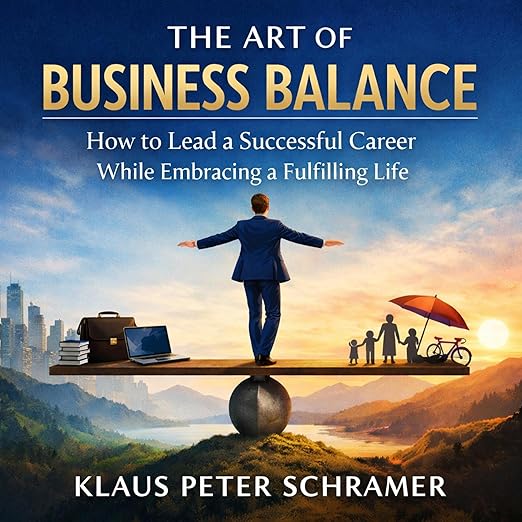
Klaus Peter Schramer begins The Art of Business Balance from a premise that the career development genre rarely acknowledges with this directness: burnout is not a failure of motivation or a temporary condition to push through with the right morning routine. It is the structural outcome of an approach to ambition that treats personal cost as irrelevant to the calculation of success. This audiobook, narrated by Genevra Lupa Catalano and running at eighty-three minutes, does not spend much time validating that premise before it starts building the alternative, which is the appropriate choice for content aimed at people who are already living the problem it is describing.
Schramer's framework is organized around practices he frames as adaptive rather than prescriptive. The distinction matters because the most common failure mode in work-life balance writing is the rigid schedule: the morning routine that will save your career, the productivity system that eliminates decision fatigue, the boundary-setting protocol that assumes your professional environment will cooperate with your personal wellbeing objectives. Schramer sidesteps this by building flexibility into the framework itself, acknowledging that balance is not a static state you achieve and maintain but a dynamic process of continuous recalibration. That framing makes the guidance more honest than most of its genre neighbors and more applicable across the variety of professional contexts the book is addressing.
The emotional resilience section is the book's most substantial contribution to its field. Schramer is specific about what resilience means in high-pressure professional environments: not the ability to withstand more before breaking, but the ability to detect the early signals of depletion and respond before the depletion becomes structural. That distinction is genuinely useful and is not as common in career wellness literature as it should be. The sections on boundary-setting and relationship management are more familiar territory, but handled with enough concision that they do not overstay their welcome in an audiobook this length. Schramer is disciplined about not expanding any section beyond what the framework needs, which is its own form of balance in practice.
Catalano Sounds Like a Mentor, Not a Speaker
Catalano's narration carries the book's practical register effectively. Her delivery has the quality of a thoughtful mentor rather than a motivational speaker, which suits a text that is making measured and sometimes uncomfortable arguments about the cost of how many professionals have organized their working lives. She does not amp up urgency or add emotional weight where the text has not placed it, which is the correct choice for content that is asking listeners to think clearly rather than feel motivated. The audiobook format works particularly well for material like this because the structure, a sequence of habit and mindset shifts rather than a narrative arc, benefits from audio's natural ability to guide a listener through the content at a consistent pace rather than allowing the browsing and skipping that ebook formats invite.
Comparable titles include Greg McKeown's Essentialism for the priority-clarity dimension and Cal Newport's Deep Work for the energy management framing, though Schramer's approach is more explicitly oriented toward emotional sustainability and relationship resilience than either of those. The eighty-three-minute runtime is well-matched to the content's scope. Schramer is not attempting a comprehensive professional wellness manual. He is making a targeted argument about the conditions under which sustainable ambition becomes possible and providing specific, actionable practices for moving toward those conditions. The section on leading with clarity, empathy, and flexibility is one of the audiobook's more interesting structural moves: Schramer positions this not as a standalone leadership development chapter but as an extension of the personal balance framework itself, arguing that leaders who have not developed their own sustainability practices tend to create environments that demand the same unsustainable patterns from their teams.
Protecting Time Is Not the Same as Protecting Energy
Watch for the distinction Schramer draws between protecting energy and protecting time. The two are related but not identical, and the confusion between them is responsible for many work-life balance strategies that appear sensible on paper but do not actually change the conditions producing exhaustion. A person can protect their time ruthlessly and still run out of energy because the activities filling that protected time are themselves depleting. Schramer is careful to separate the two concepts and address them as distinct rather than treating time management as a proxy for energy management, which is a more analytically rigorous approach than many wellness-oriented business books manage.
The sections on strengthening relationships while growing professionally are handled with unusual honesty about the trade-offs involved. Schramer acknowledges that career acceleration does cost relational bandwidth and that managing that cost requires active attention rather than optimism or the assumption that the people in your personal life will simply absorb the deficit. That willingness to name the trade-off rather than paper over it with positive framing is one of the places where the book earns the trust it is asking listeners to extend to its prescriptions. The conclusion section reinforces the adaptive framework principle: rather than offering a maintenance checklist, it returns to the idea that balance requires ongoing attention rather than a one-time optimization.
Not a Memoir of Professional Struggle
This audiobook suits mid-career professionals, entrepreneurs, and team leaders who are experiencing the early signs of burnout and want a practical rather than inspirational framework for addressing it. The length makes it a realistic single-session commitment for anyone with an afternoon or a long drive, and the actionable orientation means the listening leaves practical tools behind rather than simply motivation that fades within days. Skip it if you are looking for sector-specific career advice, detailed case studies drawn from named companies or executives, or an extended memoir-style exploration of professional struggle. The Art of Business Balance is a framework guide, and its value is in the framework's applicability across different professional contexts rather than the depth of any single concept's treatment or the inspiration of any individual story.
The Short Version
- Narrator: Genevra Lupa Catalano brings a warm coaching-style delivery to Klaus Peter Schramer's framework-based content, maintaining a practical and encouraging tone that suits a book aimed at professionals navigating burnout.
- Subjects: Burnout prevention, sustainable career ambition, work-life integration as adaptive practice
- Tone: Calm and constructive, like advice from a mentor who has actually lived the problem
- Bottom line: A brief but practical audiobook on professional sustainability that skips the productivity genre's worst tendencies in favor of honest habit and mindset guidance.
Questions Listeners Ask
Is this audiobook aimed at people already experiencing burnout or those trying to prevent it?
Both. Schramer's framework is designed to be applicable whether you are in early-stage depletion or are actively managing burnout symptoms. The adaptive structure he advocates is presented as relevant to both recovery and prevention, not as a linear program that requires a specific starting condition.
At just over 80 minutes, does The Art of Business Balance audiobook have enough substance to justify the time?
Within its chosen scope, yes. Schramer's approach is to build a focused framework rather than survey a broad topic. The audiobook is not attempting to be comprehensive but to be precise, and listeners who engage the material with the intention of applying it will find the specific practices clearly stated and immediately usable.
How does Genevra Lupa Catalano's narration suit this type of professional development audiobook?
Her delivery is calm and mentoring in tone rather than motivational, which matches the book's measured approach. She does not heighten emotional moments artificially, which allows the practical content to land without competition from performative urgency that would undermine the material's credibility.
Is this audiobook relevant for someone who works independently or runs their own business rather than in a corporate environment?
Yes. Schramer explicitly addresses entrepreneurs alongside professionals and leaders. The framework's emphasis on adaptive balance rather than organizational policy makes it applicable across work structures, including self-employment contexts where the absence of external boundaries is often its own distinct burnout risk.