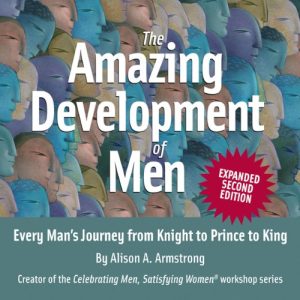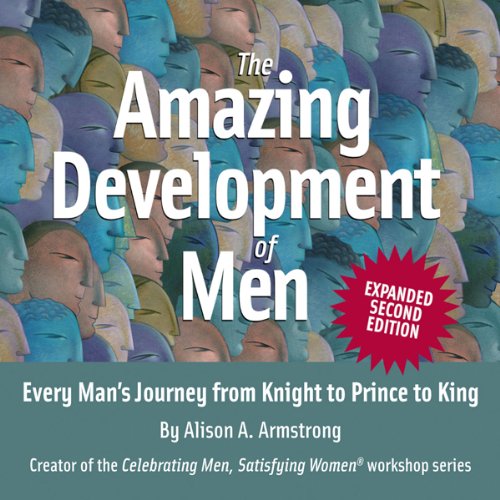
I came to Alison A. Armstrong's work through a recommendation from a friend who had been trying to explain her husband to herself for most of a decade. She described Armstrong's framework as the first thing that made certain patterns feel legible rather than inexplicable. That's a specific kind of endorsement, not "this book is great" but "this book explained something I needed explained", and it's the kind that made me curious enough to spend three and a half hours with The Amazing Development of Men.
Armstrong describes what she calls the stages through which a man's sense of self evolves across a lifetime: the knight, driven by proving himself; the prince, beginning to develop toward stability and partnership; the king, settled into purpose and able to give rather than constantly seek. These stages, she argues, are predictable and unavoidable, and understanding them is critical to success in romantic relationships, in raising sons, and in working effectively with men in professional contexts. The framework is built from years of research Armstrong conducted through her PAX Programs work, which has involved thousands of men and women in structured dialogue about gender difference.
The Verdict, Briefly
The most useful element of Armstrong's framework is its insistence that male behavior at various life stages is not arbitrary or malicious, it emerges from a developmental logic that has its own internal consistency. The knight's need to prove himself, which can manifest as restlessness, risk-taking, and difficulty committing, is not a character flaw in this account. It's a stage with its own requirements and its own timeline. Understanding the difference between a man at the knight stage and a man at the prince stage changes what questions you ask and what expectations are reasonable.
One reviewer notes that male listeners have found the framework validating in a specific way, being seen accurately by a woman, being described from the outside in terms that match the internal experience. Another reviewer, who grew up without her father or brothers, describes the material as filling in a gap she didn't know how to address. These testimonials point to what the book does well: it takes men's experience seriously as an object of study rather than a problem to be managed.
Why The Amazing Development of Men, Expanded 2nd Edition Works as an Audiobook
Armstrong's treatment of what gets popularly called the mid-life crisis is one of the book's more interesting sections. She reframes it as a stage transition rather than a breakdown, a man moving from one developmental phase to the next, which involves disruption precisely because the person he was at the previous stage is genuinely changing. This reframe doesn't trivialize the difficulty that such transitions cause in families and relationships, but it does offer a way of understanding the pattern that is less pathologizing than the standard cultural account.
The sections on adventure and its importance to men at all life stages, on what makes a man "ready" for marriage and fatherhood, on what women tend to misread in male behavior, these are presented through the lens of a woman who has spent years studying men with genuine intellectual curiosity rather than frustration or grievance. Armstrong's tone is consistently warm and interested, which is part of why the material lands differently than it might from a more adversarial framing.
Points to Consider
Self-narration is a mixed proposition. Authors know their material with an intimacy no one else can replicate, but the skills of narration and the skills of research and writing don't automatically overlap. Armstrong is an exception: she is clearly an experienced public speaker and teacher, and her delivery has the pacing and emphasis of someone who has given this material in live settings. The audio version feels like a privileged seat at a seminar rather than a book being read aloud. At three hours and twenty-three minutes, it's dense enough to reward full attention but compact enough to revisit.
The book is at its most valuable when listened to actively, pausing to sit with specific claims, applying the framework to people you know, noting where it matches and where it doesn't. Armstrong isn't offering a diagnostic tool with clinical precision. She's offering a framework, a way of organizing observations about male behavior that many listeners find clarifying. The appropriate engagement is interested skepticism rather than either dismissal or uncritical adoption.
Should You Listen to The Amazing Development of Men, Expanded 2nd Edition?
The primary audience for The Amazing Development of Men is women who want to understand the men in their lives more accurately, and it works for that purpose. Male listeners have found the material validating in ways they didn't anticipate. Listeners coming from a perspective that's skeptical of categorical gender frameworks will want to hold the model loosely and test it against their own experience rather than accepting it wholesale. The framework has genuine explanatory power for some relationship and family dynamics, and like any psychological model, it has limits that aren't always acknowledged in the presentation. Worth three and a half hours of engaged listening for the questions it raises, regardless of how completely you adopt the answers.
Questions Listeners Ask
How academic or research-based is Armstrong's framework?
The framework emerges from Armstrong's years of structured research through her PAX Programs, which involved large-scale dialogues between men and women. It's empirically grounded in that practical sense but is presented accessibly rather than in academic style.
At three and a half hours, is the audiobook substantially abridged compared to a full reading?
The audio edition is complete; the brief runtime reflects the book's actual length. It's a focused, seminar-style work rather than a lengthy volume. The density of the material rewards active listening rather than background listening.