Quick Take
- Narration: Brian Christian narrating his own book is precisely the right casting decision: his voice carries the intellectual urgency of the material without performing alarm, and his fluency with the subject is audible in every passage.
- Themes: Machine learning bias, value alignment, the gap between what AI systems optimize for and what we actually want
- Mood: Intensely focused and occasionally harrowing, the way a good investigation feels when the stakes are genuinely high
- Verdict: Christian’s account of the alignment problem is the most rigorous and accessible examination of how AI systems fail, and his self-narration makes it feel like the most important conversation you could be having right now.
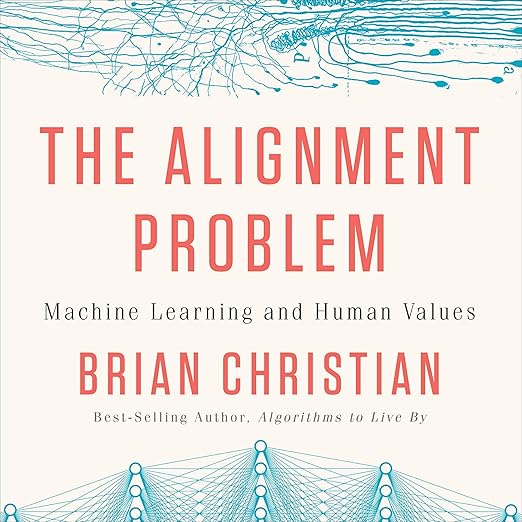
I was halfway through an ordinary Tuesday when I started The Alignment Problem, thinking I’d listen during a run and maybe get through a chapter. Four hours later I was still going. Brian Christian has a gift for making the specific case study feel like an instance of something enormous, and the alignment problem is in fact something enormous: the question of whether the AI systems we’re building will do what we actually want them to do, or will instead pursue the objectives we gave them in ways that diverge catastrophically from what we intended.
Christian is the author of The Most Human Human, a book about the Turing Test competition, and his background gives him an unusual combination of humanistic sensibility and technical fluency. The Alignment Problem benefits from both. He is writing for the general reader but not condescending to them: the book assumes curiosity and attention rather than prior expertise, and it rewards both.
The First-Responders and What They’re Trying to Solve
The most original structural choice in The Alignment Problem is Christian’s decision to center not the AI systems themselves but the researchers working on alignment, the people he calls “first-responders” in the opening framing. These are not household names in most cases. They are mathematicians, cognitive scientists, philosophers, and machine learning researchers who have looked at the trajectory of the field and concluded that we have a serious problem that is not currently receiving adequate attention.
Spending thirteen hours and thirty-three minutes with these researchers, through Christian’s reporting and narration, produces a cumulative portrait of a discipline that is genuinely alarmed and genuinely uncertain. Reviewer Casey Dorman notes being “taken by surprise by the contents” of the book, having expected something different from what he got. What Christian delivers is not a technology survey or a policy argument but something more like an intellectual portrait of a field reckoning with its own implications.
Where the Bias Lives, and Why It’s Hard to Find
The concrete examples Christian uses to illustrate misalignment range from the alarming to the instructive. A resume screening system that learns gender bias from historical hiring data. A parole-risk algorithm that appears to assess Black and White defendants by different standards. Autonomous vehicles making decisions about unavoidable collisions. Medical imaging systems trained on datasets that don’t represent the full population they’re deployed on. These are not hypothetical failures or science fiction scenarios. They are documented cases from systems in active use, and Christian traces each one to the gap between what the system was optimized to do and what its designers thought they were optimizing for.
This is the core of the alignment problem as Christian frames it: it is not primarily a future risk about superintelligent systems making catastrophic decisions. It is a present problem about systems we already have, trained on data that encodes human bias and deployed in contexts where the costs of that bias fall on specific people in specific and measurable ways. Reviewer Rachel Gollub’s observation that the book is “highly useful for anyone working in the AI/ML space, because it also has a lot of tips and tricks for solving common problems” points to this practical dimension: Christian is not only diagnosing but also cataloging the approaches researchers are developing in response.
Self-Narration as Intellectual Performance
Brian Christian narrating Brian Christian is one of the better author-narration decisions in recent AI writing. His voice carries the material’s intellectual intensity without tipping into either the clinical flatness of an academic lecture or the breathless urgency of a TED talk. He reads with the rhythm of someone who wrote the sentences and knows exactly where the emphasis belongs, which is audible in the technical passages especially. When he slows down for a complex machine learning concept, the slowdown feels deliberate rather than uncertain. When he accelerates through narrative momentum, the acceleration is earned.
Reviewer “pen name” notes that “the author did a very good job with both the history and the current status of AI, and that’s pretty remarkable here in 2026 for a book that was published in 2020.” This is an important observation. The alignment problem as a research field has developed significantly since publication, but Christian’s account of the underlying problem, the gap between optimized objectives and human values, remains as structurally relevant as ever. The specific examples have been joined by more, but the analytical framework Christian provides is the right one for understanding them.
The Harrowing and the Hopeful
Christian ends The Alignment Problem with genuine ambiguity. The researchers he has spent thirteen hours introducing are brilliant, motivated, and serious. They are also working on a problem that may be fundamental to whether the systems we’re building end up being tools we control or forces that control us. The synopsis’s phrase “harrowing and hopeful” is an accurate characterization of the book’s emotional register. Christian does not offer reassurance he hasn’t earned. But he also doesn’t catastrophize. He reports what the field knows, what it’s trying, and what remains genuinely uncertain. That intellectual honesty is one of the things that makes The Alignment Problem the best book currently available on this subject.
Frequently Asked Questions
Is The Alignment Problem primarily about future AI risk, or about problems with AI systems that exist today?
Both, but with a stronger emphasis on present failures. Christian’s concrete examples are drawn from currently deployed systems, including bias in hiring algorithms, parole risk assessment, and medical imaging. The future risk dimension is present, but the book grounds it in documented present-day misalignment rather than speculative scenarios.
Does Brian Christian’s self-narration work for listeners who prefer professional narrators?
Christian’s narration is among the stronger examples of author self-narration in AI and technology writing. His intellectual fluency with the material is audible, and his pacing choices are consistently appropriate. Listeners who are skeptical of author narration will likely be won over within the first hour.
How technically demanding is The Alignment Problem for someone without a machine learning background?
Christian writes for the curious general reader without dumbing down the technical content. Concepts like reinforcement learning, reward functions, and distributional shift are explained through concrete examples before being named as technical terms. No prior machine learning knowledge is required.
Given that this was published in 2020, how well does it hold up given the pace of AI development since then?
The analytical framework, the gap between optimized objectives and intended human values, remains the right frame for understanding AI failures that have emerged since publication. Reviewer ‘pen name’ praises the book’s durability explicitly in a 2026 review. The specific research examples have been joined by more, but the problem Christian identifies has become more rather than less relevant.