Quick Take
- Narration: Caleb Steele brings a calm, tutorial-friendly delivery that suits the accessible tone Milo Foster established in prose, approachable without being condescending.
- Themes: Prompt engineering fundamentals, AI tool literacy, practical workflow integration
- Mood: Encouraging and practical, the equivalent of a confident instructor in a community college continuing-ed class
- Verdict: A solid structured entry point for genuine beginners, though the bundled prompt library and video course companion do more practical work than the 4-hour audio alone.
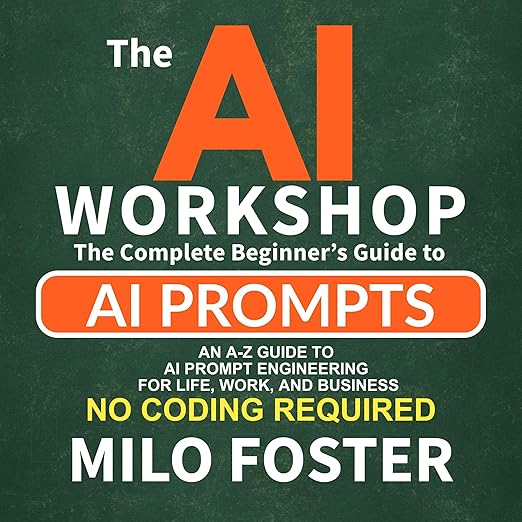
I finished this one on a Saturday morning when I was testing prompt engineering resources for a friend who runs a small consulting practice and had never typed a word into ChatGPT. She wanted something she could actually listen to on her commute, no jargon walls, no assumption of technical background. The AI Workshop is built for exactly that person, and it largely delivers what it promises within a format that has real structural advantages and one clear limitation.
At four hours and seventeen minutes, this isn’t trying to be comprehensive in the way that technical textbooks are. It’s trying to install a framework, the proprietary DRASTIC Framework that Milo Foster built the book around, and give listeners enough repeated practice hooks that the framework sticks. Whether audio is the right delivery mechanism for that goal is worth thinking through before you commit.
What the DRASTIC Framework Actually Does
The acronym isn’t explained prominently in the synopsis, but its elements shape every chapter: Define, Role, Audience, Style, Task, Iterate, and Constraints, or some close variation on that construction. The point isn’t the specific letters; it’s that prompt engineering becomes less a matter of luck and more a matter of deliberate decision-making when you have a checklist to run through before you submit. Foster’s treatment of this framework across ChatGPT, Claude, and Gemini is the most cross-platform feature of the book, and listeners who’ve only ever used one AI tool will appreciate the comparative grounding.
The “Try It Yourself” activities referenced in the synopsis present the obvious audio limitation: you can hear the prompt templates being described, but you can’t pause a narrated audiobook mid-activity the way you’d pause a YouTube tutorial. Reviewers who found the book most valuable appear to have used it alongside a laptop, treating the audio as a guided walkthrough rather than pure commute listening. That’s a legitimate use case, but it’s worth knowing before you start.
The Companion Materials Question
The book bundles two significant companion resources: a prompt library with over 300 ready-to-use prompts organized by profession, and an online video course that covers both the book content and advanced topics. The audio is, by the author’s own framing, the gateway to these materials rather than a standalone product. One reviewer described it as giving an immediate boost to AI results by clarifying what you actually want from the tool, that clarity is the audio’s contribution. The prompt library is where the daily-use value lives.
This isn’t a criticism so much as a design feature to understand. Listeners who download the audiobook expecting four hours of content that fully replaces the companion materials will feel shortchanged. Listeners who treat the audio as the conceptual layer over which the prompt library provides practical application will find the combination genuinely useful. Foster is clear about this structure; the synopsis spells out both companion tools explicitly.
Steele’s Narration and the Accessible Prose
Caleb Steele reads with a pace that never rushes the examples and never lingers so long that attention drifts. Foster writes in plain language, “everyday language” is his own claim in the synopsis, and it’s accurate, so Steele’s task is to maintain warmth and clarity rather than manage technical density. He succeeds. The chapter structure, with each section building from concept to example to practice activity, gives the narration natural rhythm. One reviewer captured it well: the book felt written for someone who’d been hearing how powerful AI tools are without ever being shown how to use them without feeling stupid. Steele’s delivery reinforces that welcoming register.
The rating of 4.6 across 162 listeners suggests consistent satisfaction, not a polarized response. The four-star review in the sample data flagged approachability as the primary strength, and that tracks with what the book actually does: it makes the entry point to prompt engineering feel navigable rather than intimidating.
Who Should Queue This Up First
If you’ve never written a structured AI prompt and want a framework you can describe out loud, to yourself, to a colleague, to a client, this audiobook installs that framework efficiently. Business owners who want AI to assist with content, analysis, or summarization without hiring a developer will find the use-case coverage useful. Students and creative professionals who’ve been meaning to engage with these tools but kept deferring will get traction here.
If you’re already comfortable with prompt engineering and want to push into system prompts, fine-tuning, or API integration, this material will feel introductory. For that audience, the video course companion might offer more value than the audio alone. And if you’re someone who genuinely cannot make time to access the companion prompt library and video course, temper expectations accordingly, the audio on its own is a 4-hour framework overview, not a complete skill curriculum.
Frequently Asked Questions
Does the DRASTIC Framework work across different AI tools or just ChatGPT?
Foster specifically covers ChatGPT, Claude, and Gemini, and the framework is designed to be tool-agnostic. The core logic of defining context, role, audience, and constraints applies regardless of which AI platform you’re using.
Can I use this audiobook without the companion prompt library and video course?
You can, but the audio is explicitly designed as the conceptual layer that unlocks the companion materials. The prompt library with over 300 profession-organized prompts and the video masterclass are where ongoing practical value lives. Budget time for both.
Is this suitable for someone who has never opened ChatGPT, or do you need some prior experience?
Genuinely suitable for complete beginners. The synopsis specifies no tech skills required, and the reviewers who found it most useful describe themselves as people who felt behind on AI tools and wanted a clear starting point rather than technical deep-dives.
How does the ‘Try It Yourself’ activity format work in audio versus reading the print version?
In audio, the activities are described rather than interactive. Most listeners use the audio alongside their laptop, pausing to try each prompt in a live AI tool before continuing. If you plan to listen while commuting without device access, save the activities for a second pass with a screen in front of you.