Quick Take
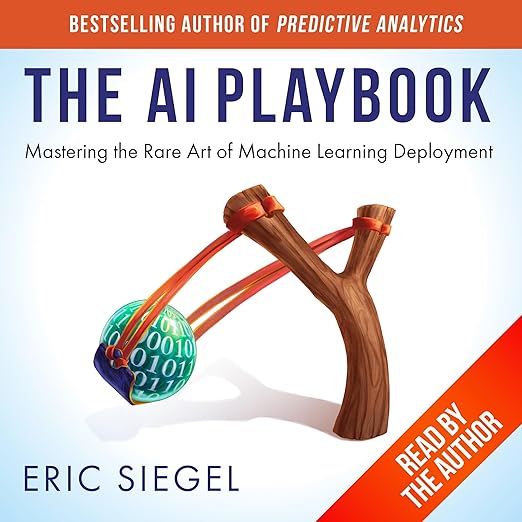
- Narration: Eric Siegel narrates his own book, and the result is the kind of performance you only get when the author genuinely understands what they’re saying. His delivery is measured, precise, and occasionally wry, matching the book’s tone exactly.
- Themes: Machine learning deployment, predictive AI project management, bridging business and data science
- Mood: Authoritative and demystifying, grounded in documented case studies
- Verdict: The strongest practical guide to deploying machine learning in business contexts currently available in audio, and Siegel’s self-narration makes it more authoritative than most alternatives.
Eric Siegel has a particular skill I find rare among technical authors: he writes about machine learning the way a good doctor explains a diagnosis. He doesn’t oversimplify to the point of uselessness, he doesn’t perform complexity to establish authority, and he doesn’t protect his expertise by obscuring how things actually work. The AI Playbook is the application of that same discipline to the problem most organizations actually have: not understanding machine learning, but deploying it.
I listened to about three hours of this on a long flight and found myself taking notes, which I almost never do with business audio. Siegel is the author of Predictive Analytics, which did for that concept what Malcolm Gladwell does for social science ideas: made them genuinely accessible without flattening them. The AI Playbook assumes you’ve absorbed something like that foundation and asks the harder follow-on question: now what?
The Six-Step Deployment Practice
The book’s central contribution is a structured six-step practice for machine learning initiatives that Siegel calls the gold standard for wide adoption. The steps address the full lifecycle from conception to deployment, and what distinguishes this treatment from other ML implementation guides is where it locates the failure points. Most ML initiatives don’t fail because the models are bad. They fail because the business context is underspecified, because the people who will act on predictions don’t understand what the predictions mean, or because the connection between model output and operational change was never clearly defined.
Siegel’s six steps are designed to force this specificity before the technical work begins. He is explicit that the business professionals, not just the data scientists, need to understand enough about machine learning to participate meaningfully in these conversations. This is the book’s genuine innovation: it upskills non-technical stakeholders just enough to make them useful collaborators rather than passive recipients of model outputs.
The UPS, FICO, and Dot-Com Case Studies
The case studies are the book’s strongest material. The UPS example tracks how predictive routing decisions were modeled, validated, and connected to operational change in a way that created measurable value. The FICO examples show how credit scoring, one of the oldest and most widely deployed forms of machine learning, still runs into deployment problems when the connection between score and decision is not clearly established. The dot-com cases are more cautionary: they illustrate how organizations built sophisticated models that never translated to operational impact because the business translation step was never completed.
Reviewer Dwthink’s observation that most people talking about AI haven’t absorbed the precision that Siegel brings is accurate. This book is one of the most useful correctives to the ambient hype around AI deployment precisely because it insists on specificity. It asks: what exactly are you predicting, how well does your model predict it, and what will change in your operations if predictions are acted upon? Those three questions, answered honestly, would eliminate a large proportion of failed ML initiatives.
Siegel’s Self-Narration as a Feature
Siegel narrates his own book, and I want to be specific about why this works. He is not a professional narrator, and there are moments where his pacing is slightly deliberate in a way that a trained voice actor might smooth. But his command of the material means he naturally emphasizes the right words and phrases in technical explanations, places the appropriate weight on qualifications, and delivers the case study conclusions with the kind of restrained satisfaction that earns its confidence. Reviewer Pat Faulhaber’s summary, that Siegel offers six steps and addresses both the strengths and the communication weaknesses of ML deployment, captures the book accurately.
The PDF companion included with the Audible edition is worth downloading. Siegel uses frameworks and process diagrams that he refers to repeatedly throughout the book, and having the visual representation alongside the audio explanation is useful for the sections on deployment architecture.
Frequently Asked Questions
How does The AI Playbook differ from Siegel’s earlier book Predictive Analytics?
Predictive Analytics explains how machine learning works conceptually, targeting a general business audience that wants to understand what the technology does. The AI Playbook assumes that foundational understanding and addresses the harder problem: how to take a machine learning initiative from idea to deployed, value-generating operation. The audience is people who need to manage, sponsor, or participate in ML projects, not just understand what the technology is.
Is this book relevant for data scientists and ML engineers, or is it primarily for business professionals?
Siegel explicitly targets both audiences. For data scientists, the value is in the business translation framework: the book gives them language and process to work more effectively with non-technical stakeholders. For business professionals, it provides the semi-technical foundation needed to participate meaningfully in ML project decisions. The MIT Management on the Cutting Edge series framing reflects the intended mixed audience.
The book focuses on predictive AI specifically. Does it cover generative AI or large language models?
The book’s focus is on predictive machine learning, which refers to models that predict specific outcomes from data, such as customer churn, fraud risk, or equipment failure. Generative AI and large language models are a different technical paradigm with different deployment considerations. Siegel’s frameworks are most directly applicable to the predictive use case, though the project management principles translate to some extent across ML types.
How does the six-step deployment practice handle the question of model bias and fairness?
Siegel treats fairness and bias as operational considerations within the deployment practice rather than separate ethical add-ons. The conscience dimension of his framework asks who is affected by model predictions and how those effects should be evaluated before deployment. He is not dismissive of these concerns, but he frames them as problems that the structured deployment practice is designed to surface and address, rather than issues that only ethicists need to consider.