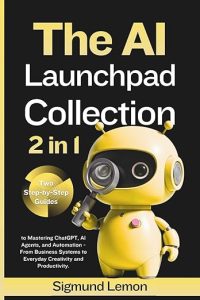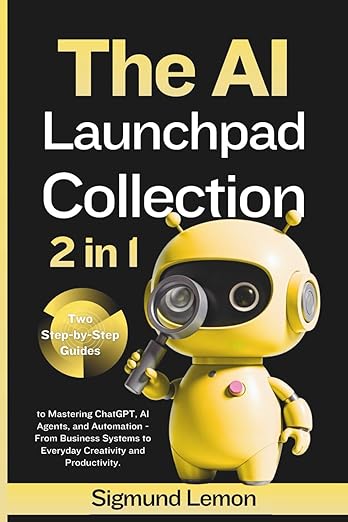
Sixteen people scored this bundle and not one of them wrote a sentence about it. That is the entire public record for an audiobook running seven hours and forty minutes, released at the start of 2026, and the figure they settled on, 3.8, is low enough that you badly want the explanation nobody supplied. This review therefore has to be built from what the listing itself says, which proves considerably more informative than it first appears.
Two Guides Sold as One Listing
Two books are sold here as one package. The first, presented as The AI Business Guide, covers prompt construction, marketing copy that avoids sounding generated, competitor research, sales outreach, proposals and decks, customer support routing, and choosing tools without overspending. The second, AI for Business, Health, and Life, widens out to money habits, career growth, physical and mental well-being, skill acquisition, household automation and creative output. The listing gives no per-book breakdown, but an even split would put a little under four hours behind each of those lists.
Before any of that, the page itself needs a word. It carries a narrator credit and a runtime, both of which describe a recording, alongside an ISBN, a page count of 254 and a cover price, all of which describe a printed object. The publisher is listed as independently published. The description signs off by telling you to order your copy now. Print details and audio details are plainly sitting on the same listing, and it is worth confirming which format those other details actually attach to.
The same doubling is a clue about register, too. The description is retail sales copy and reads exactly like it: a stack of pain-point questions about falling behind, a reassurance that it is not your fault, then two bulleted lists of outcomes. Nothing in it is dishonest. It is simply written to be scanned on a product page rather than heard, and knowing which voice the marketing uses is useful context before you decide what the recording will sound like.
A Company Credit, No Voice to Sample
Goldenwithin Productions is a company name rather than a person's, and that is what the listing gives in place of a reader. This is a factual property of the listing, and it changes what you can find out in advance. An individual reader can be looked up, sampled across other titles and judged on a body of work; a house credit cannot, in either direction. No prior performance attaches to any specific voice here, so the product sample is not one input among several. It is effectively the only one.
What the text asks of any reading is legible from the description alone. This is enumerated instructional content: numbered structures, bulleted outcomes, tool comparisons, workflows laid out as steps. Spoken aloud, a bulleted list is simply a run of sentences unless the reading puts a real beat between items and lets the hierarchy show through. That is the one craft demand this material makes, it recurs throughout the description, and it is where an instructional recording either works or quietly stops working.
Prompt construction is the most concrete promise in the whole description: a four-part structure, offered with no jargon and no coding. That is a genuinely teachable frame rather than a tour of tools that will be obsolete within a year, and it is the sort of thing audio carries well, because a four-part frame is memorable by design and can be rehearsed while you are doing something else entirely. If the bundle delivers on that single item, the recording has earned its place regardless of what the rest of it does.
Sixteen Ratings and Not One Written Review
The score itself deserves a second look. Sixteen ratings produced a 3.8 and not one of them came with a sentence attached. Sixteen is a small base, small enough that two or three disappointed listeners move the average visibly, and a January 2026 release has had only a few months to accumulate any. What the figure cannot tell you is which half of the bundle disappointed people, or whether the objection was to the content, to the reading, or to the overlap between two books sold together.
Not one written review exists on this listing. That is unusual enough to state plainly rather than work around: nobody has publicly described what this recording sounds like, how the two books relate to each other, or whether the second repeats the first. Every claim in this review is drawn from the publisher's description and from what the page itself displays. Treat the preview as mandatory rather than optional, and read the bulleted promises in the description closely before buying.
Bundling two books in one package carries a specific risk the description never addresses. Book one is about using AI inside a business; book two opens on using AI to grow a career or a business, then widens to health, money and household tasks. The overlap between those two openings is not obviously small, and a listener who cannot skim forward easily will hear any repetition at full length. The milder second risk is shelf life, since named tools and current model behavior date faster than the frameworks built around them.
Complete Beginners Get a Starter Listen
Complete beginners are the audience the description names and the audience it is genuinely built for. Somebody who has typed one prompt, received something generic and concluded the problem was them will find the entire book pitched at exactly that person. The promise is a starting structure rather than mastery, and for a listener at that stage a compact, plainly worded pass across both business and personal applications is a reasonable way in.
Small-business owners and solo operators are the second group, particularly the ones whose only alternative is hiring. Proposals, decks, case studies, competitor research and support routing are all named explicitly, and all of them are tasks a one-person business typically does badly or skips entirely. Whether the specific workflows hold up is the open question, but the task list itself is well chosen and matches the real bottlenecks of running something alone.
Look elsewhere if you already write prompts competently, because a four-part beginner structure and a tour of tool categories will tell you nothing you have not already worked out. Look elsewhere too if you want implementation detail you can follow along with, since copyable prompt text and tool configuration are precisely what a recording cannot hand you. Honestly, I read this as a starter listen with an unusually thin public record behind it, and the sample carries more weight here than the star rating ever could.
Who narrates The AI Launchpad Collection audiobook?
The listing credits Goldenwithin Productions, which is a company rather than a person. Nothing about a house credit can be sampled or compared the way a named reader's other work can, leaving no way to form an expectation in advance. With no written reviews on the page either, the product preview is the only thing left to go on.
Are the two books in this audiobook bundle different enough to be worth it?
The description separates them clearly: the first covers business applications, the second widens to finances, career, health, learning and household tasks. Both open on business use, so some overlap looks likely. No reviewer has confirmed how much, which is one of several questions the silent rating pool leaves unanswered.