Quick Take
- Narration: Marissa DuBois delivers the material with warmth and a conversational ease that suits the empathetic tone perfectly, no clinical distance, just a voice that feels like a knowledgeable friend.
- Themes: ADHD-friendly systems design, executive dysfunction, sustainable home routines
- Mood: Encouraging and practical, with a strong undercurrent of emotional validation
- Verdict: If you have tried every generic organizing system and watched each one collapse within a week, this ADHD-specific blueprint offers something different enough to be worth the four hours.
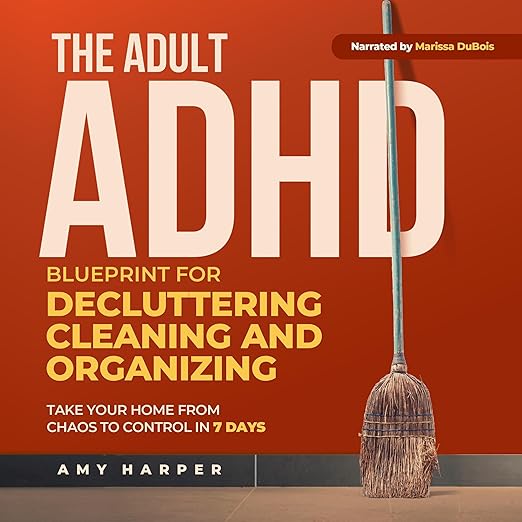
Our Take on The Adult ADHD Blueprint for Decluttering, Cleaning and Organizing
I picked this one up on a rainy Thursday afternoon, half out of professional curiosity and half because my own relationship with household systems has always been precarious. Within the first twenty minutes I had three different browser tabs open looking up the dopamine-friendly organizing hacks the book mentions in passing. That feels like the right way to describe the experience: it hooks you on specifics rather than grand promises, and it keeps pulling you forward.
Amy Harper writes from lived experience with ADHD, and that distinction matters more than almost any credential a self-help author can claim. The book does not feel like someone synthesizing research at arm’s length. It reads like someone who has genuinely lost a Tuesday morning to reorganizing a junk drawer only to find the whole project abandoned by noon, and who has spent years figuring out why that happens and what to do instead. That specificity of experience is what separates this from the broader self-help shelf.
Why Listen to The Adult ADHD Blueprint for Decluttering, Cleaning and Organizing
The core argument here is deceptively simple: most organizing systems fail ADHD brains not because the people using them lack discipline, but because the systems were never designed for how those brains actually process tasks and motivation. Harper does not just state this once and move on. She builds the book around it, returning to energy fluctuations, motivation dips, and distractibility at each stage of her framework so that the advice stays grounded in the actual problem rather than in idealized behavior.
The 7-day challenge structure is one of the more useful design decisions in the book. It imposes a specific shape on what could otherwise become an overwhelming list of changes. Reviewer Michal Sobolewski captured this well: the plan builds momentum without triggering the paralysis that comes with larger commitments. For a book targeting ADHD readers, the irony of an organizing guide that itself spirals into complexity would be particularly damaging. Harper avoids that trap consistently.
The reset rituals the book describes are genuinely novel framing. Rather than treating mess as a moral failure requiring willpower, Harper treats it as an information problem, the home is not set up in a way that makes the right action feel good. The solution is to redesign the environment, not reform the person. That reframing is where the book earns its audience, and it is where the narration adds particular value: Marissa DuBois delivers these moments with a gentleness that reinforces the message rather than undercutting it with false cheerfulness.
What to Watch For in The Adult ADHD Blueprint for Decluttering, Cleaning and Organizing
A few caveats are worth naming. At under five hours, the audiobook moves quickly through some of the more nuanced territory, the sections on blended households and situations where multiple people share a space get compressed in ways that leave practical questions unanswered. Listeners who live alone or have uncomplicated domestic situations will likely get more out of it than those navigating shared spaces with different organizational styles.
The book also leans heavily on the author’s own experience, which is simultaneously its strength and its limitation. Harper’s solutions are calibrated to her version of ADHD and her living situation. Several reviewers noted the strategies worked remarkably well for them too, while one noted it felt primarily oriented toward one kind of experience. The PDF companion that ships with the Audible version helps fill some gaps with worksheets and structured prompts, but listeners should know that depth is traded for accessibility throughout. One reviewer without ADHD found the systems genuinely useful during a home move, which suggests the underlying principles translate across a wider audience than the title alone implies.
Marissa DuBois’s narration is genuinely well-suited to the material. The tone stays warm and encouraging without tipping into cheerfulness that might feel patronizing. One reviewer specifically noted that the Audible version elevated the book, and I would agree, there is something about hearing Harper’s encouragement delivered in a voice that never sounds impatient that reinforces the book’s central message about working with your brain rather than against it. The audio format is the right format for this one.
Who Should Listen to The Adult ADHD Blueprint for Decluttering, Cleaning and Organizing
This is most valuable for adults with ADHD who have cycled through multiple organizing systems and walked away feeling like the failure was theirs rather than the system’s. The book takes direct aim at that shame and replaces it with a practical framework that acknowledges cognitive variability rather than ignoring it. It is also accessible enough that one reviewer without ADHD found it useful during a move, the principles travel. Skip it if you are looking for deep coverage of specific organizational methodologies or if you need strategies designed for shared living situations with competing styles. At under five hours it is a low commitment, and the PDF companion adds genuine practical weight to the listening experience.
Frequently Asked Questions
Does the book explain the neuroscience behind why ADHD makes organizing harder, or does it skip straight to tactics?
Harper covers the why briefly but focuses most of the runtime on actionable strategies. She explains concepts like dopamine reward cycles and executive dysfunction in accessible terms, but this is not a deep dive into neuroscience, it is a practical toolkit grounded in that understanding.
Is the 7-day challenge structured as daily audio segments or is it presented all at once?
The challenge is introduced as a framework within the audiobook rather than as separate daily episodes. You get the full blueprint in one listen and can choose to pace it across seven days using the accompanying PDF worksheets, which are available in your Audible library.
Can someone without ADHD get value from this book?
Yes, based on reviewer feedback. At least one reviewer with no ADHD diagnosis found the systems genuinely useful during a home move. The strategies are flexible and designed for variable energy levels, which translates across a wider audience than the title suggests.
How does this compare to other ADHD organizing books and resources?
Harper’s approach is more narrowly focused on the home environment rather than ADHD life management broadly. It is practical and specific rather than motivational in tone, and the 7-day structure makes it more immediately actionable than many broader ADHD life-management books. The lived-experience authorship distinguishes it from guides written by researchers or clinicians.