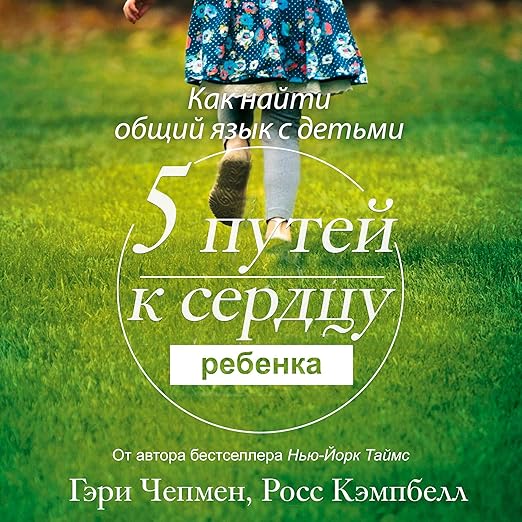
Quick Take
- Voice: The listed edition is narrated in Russian; English-language listeners should seek the English production of this Gary Chapman and Ross Campbell title.
- Big ideas: Parental emotional attunement, love language theory applied to children, family communication across developmental stages
- Atmosphere: Warm and practical, accessible and encouraging throughout
- Worth it?: The extension of Chapman's Love Languages framework to parent-child relationships has genuinely helped a large number of families, and the audiobook format suits perfectly how busy parents absorb practical guidance.
A note at the outset: the edition of this audiobook associated with this listing is narrated in Russian, serving the Russian-language market. The review below addresses the book and its content, drawing on the widely available English-language audiobook, which has earned a 4.8 rating across 3,625 listeners through the practical utility readers have found in the material. If you are seeking the Russian-language edition specifically, you are in the right place. English-language listeners should confirm the production language before purchasing.
The 5 Love Languages of Children by Gary Chapman and Ross Campbell arrived in the wake of Chapman's original The 5 Love Languages, which spent extraordinary time on bestseller lists by articulating a framework that resonated with couples trying to understand why they felt unloved despite their partner's apparent efforts. The core idea is simple and productively elastic: people give and receive love through different primary modes, physical touch, words of affirmation, quality time, acts of service, and receiving gifts, and mismatches between a giver's and receiver's primary language explain a significant proportion of relational difficulty.
Children Lack the Vocabulary Adults Have
The move from couple relationships to parent-child relationships is not merely a marketing extension. Chapman and Campbell make a genuine case that the stakes of the children's application are actually higher in some ways than the adult application. A partner who feels chronically unloved has the adult vocabulary and agency to raise the problem or leave the relationship. A child who feels unloved by a parent, even one who is actively trying to love well, has neither that vocabulary nor that agency. The consequences, as Campbell's clinical background in child psychiatry allows him to document, can be significant and lasting.
The book works most effectively as a diagnostic tool. Chapman and Campbell offer practical guidance for identifying a child's primary love language from their behavior: what do they ask for? What do they complain about not getting? What do they do spontaneously to show love to others? These observations give parents actionable entry points rather than leaving them with theory alone. That practical bent is what distinguishes the Love Languages books from more abstract parenting frameworks and explains the enduring readership the series maintains.
Seven Hours Consumable Across a Week of Commutes
Parenting books work particularly well as audiobooks for the obvious reason that parents of young children have limited time for sitting still with a text. The 5 Love Languages of Children, at just over seven hours, is consumable across a week of commutes or household tasks, which is exactly how a book of practical guidance gets absorbed most effectively: incrementally, with time between sessions to observe and try things. The framework is not complex, and the audio format suits that simplicity well. You do not need to take notes. You need to listen with your own child in mind and notice what fits.
The book covers not just the five languages themselves but their applications across different situations: discipline, learning, single-parent households, and the specific challenge that a child's love language can shift across developmental stages. Chapman and Campbell are careful not to present the framework as solving all parenting difficulties, which is a useful restraint. It is a tool for improving emotional communication, not a complete theory of parenting or a substitute for professional support when that is needed.
Reflecting Utility More Than Simple Enthusiasm
The 4.8 rating across 3,625 listeners reflects utility rather than enthusiasm alone. Parenting books attract readers with specific needs, and readers who find a framework genuinely useful tend to rate it highly while readers who find it unhelpful tend to move on without rating. That pattern suggests the book has done what it promised for a significant proportion of its audience.
Where the Love Languages framework has faced criticism, it is usually for oversimplification: reducing complex relational dynamics to five categories and suggesting that identifying a primary language is sufficient guidance. That critique has some merit. But for parents who are genuinely trying to understand why their child does not seem to receive the love they are offering, a simplified framework that opens observation and conversation is more useful than comprehensive psychological complexity. Chapman and Campbell know their audience and have written the right book for it, giving parents tools they can actually use in the middle of ordinary days rather than frameworks that require specialized training to apply.
Grandparents, Stepparents, and Any Caregiving Adult
The book is written primarily for parents but applies to any adult in a sustained caregiving relationship with a child. Teachers in particular have found the framework useful for understanding classroom dynamics. Grandparents, foster parents, and stepparents working to build relationships with children they did not raise from infancy will find the identification tools especially valuable, since they cannot rely on accumulated observation the way biological parents can. The seven-hour runtime makes it an accessible commitment for any caregiver willing to take the practical diagnostic work seriously.
One additional observation about the audiobook format for this particular text: the practical exercises and diagnostic guidance that Chapman and Campbell offer throughout the book are perhaps better absorbed incrementally than in a single sitting. The format suits a reader who is actively trying things between listening sessions, observing their own child with the framework in mind and returning to the material with specific questions. That pattern of use is how the book seems to have worked best for the listeners who have rated it most highly.
Before You Listen
Is this audiobook in English?
The specific edition associated with this listing is in Russian, with narration by Viktor Babkov. English-language listeners should search for the English-language production of The 5 Love Languages of Children, which is widely available.
Do I need to have read the original 5 Love Languages before this book?
No. Chapman and Campbell introduce the five love languages clearly within the children's book itself. Some familiarity with the framework may help you move faster through the foundational material, but the book is designed to be complete as a standalone read.
Is this book useful for teachers and other caregivers, or is it specifically for parents?
While written primarily for parents, the framework applies to any adult in a sustained caregiving relationship with a child. Teachers in particular have found the framework useful for understanding classroom dynamics and why certain students respond differently to recognition and encouragement.