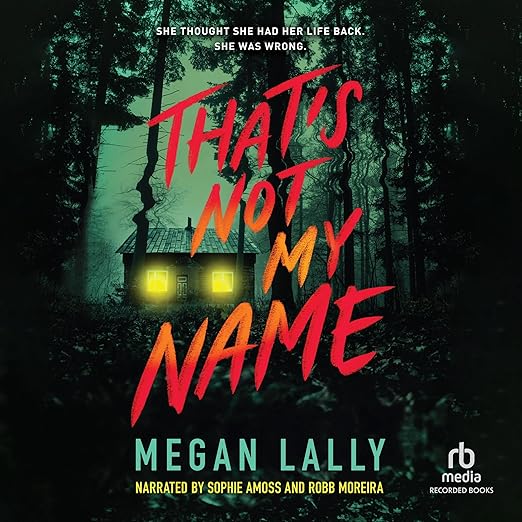
Whose word do you take when a girl has no memory and a man with documents arrives to claim her? That is the engine of this audiobook, and Megan Lally sets it running immediately. A teenager wakes on a dirt road, bruised and shivering, holding nothing. A frantic man turns up at the police station with her school ID, her birth certificate and family photographs. He says he is her father and her name is Mary. Nine hours later you will know whether either statement was true. Sophie Amoss reads it for Recorded Books, and the second strand belongs to a boy named Drew whom an entire town has already convicted.
Two Strands, One Girl Who Can't Verify Herself
One headline on this page reads Twisty, eerie, and kept me guessing the whole time, and the five-star entry beneath it, filed in January 2026, describes feeling uneasy from the first chapter in the best possible way, then watching the tension build as the story peels back one layer after another. Every time that reader thought the situation had resolved into something recognizable, it shifted. I would put the source of the discomfort slightly differently. It is not in the twists but in the premise: a girl with no memory has no way to contradict a man holding her paperwork, and Lally keeps you inside that helplessness a long time before offering any leverage against it.
The two-strand design is why it works. One thread runs in the present tense with a girl who cannot verify a single fact about herself. The other runs with Drew, the boyfriend his friends, the sheriff and the whole town have already tried and convicted, searching for a person the listener suspects is sitting in a police station answering to a different name. The gap between what each strand knows is where all the pressure lives, and the book is disciplined about refusing to close it early. Nine hours and one minute is well judged for that structure. Much longer and the withholding would begin to read as a stunt rather than a design.
Amoss Carries Two Voices in Alternation
A separate January 2026 five-star, filed eleven days after that one, makes the strongest case for the book as construction. Its argument is that nothing is overexplained and nothing is spoon-fed, that the gaps are purposeful rather than careless, and that the story trusts you to notice what feels wrong and to sit with unanswered questions until they matter. That is an unusually precise compliment for a young adult thriller, a category where the temptation to reassure is enormous. It is also the entry this record has treated worst: its text begins mid-sentence, its opening words missing, so a browser meets the argument already in progress.
Withholding suits audio better than it suits print, because a listener cannot flick back four chapters to re-check a detail that has suddenly acquired weight. The uncertainty stays uncertain, which is precisely what the book wants from you. Sophie Amoss handles the delivery, and the assignment is harder than a single credited name suggests: two first-person voices in alternation, one belonging to a girl who does not know her own name and one to a boy being hunted for something he did not do. Those registers cannot blur into each other or the structure fails, and no white space or chapter heading exists to help. April Henry, quoted on the record, says the book begs to be read in a single adrenaline-fueled sitting, and the length makes that a realistic ambition.
Three and a Half Stars Rounded to Three
The most interesting response on this page is also the one the record has mangled. Its headline announces a grade somewhere between three and a half and four stars. The rating attached to it reads a bare three. No half-step exists in the system, so a reader who deliberately landed between two values had the difference rounded away, and the page now displays a verdict its author did not choose. Filed in March 2025, it is the only entry here sitting below four, which means the single number dragging that 4.3 average down is a number nobody actually awarded.
What it objects to is worth hearing anyway. It finds the book very much a young adult read, with several characters trying to be funny and missing, while still crediting Lally with dropping the breadcrumbs of the final twist fairly rather than conjuring an answer from nowhere. What nobody on the page addresses at all is the recording. Seventy-two ratings, five written responses, and not one of them reaches for anything but the vocabulary of reading. For a book carried by two alternating voices, that is a real hole in the available evidence, and it is the one thing a sample settles instantly.
No Content Advisory for a Captivity Plot
Pick it up if you enjoy being kept off balance and do not mind a book that knows exactly how old its characters are. A four-star from March 2026 calls it entertaining and twisted, praises the writing, singles out an ending that avoids the standard shape, and admits to guessing the outline within the first few chapters while enjoying the ride regardless. It also notes that the story feels a little young, on the grounds that it is about high school students. That is the correct calibration. Teenagers are the target and will be well served, and adults who read across into young adult thrillers will find the machinery satisfying and the emotional register simpler than the plotting.
Readers who solve puzzles fast will get less out of the second half, because once the central switch becomes visible the remaining hours are spent watching characters catch up to something you already hold. The book is unsparing about the situation it puts a girl in, and this record carries no content advisory of any kind, so anyone who avoids stories of coercion and captivity should check elsewhere before buying. Nor is it a procedural. The sheriff exists to be wrong, the town exists to be certain, and the investigation is scenery around two young people trying to establish who they are.