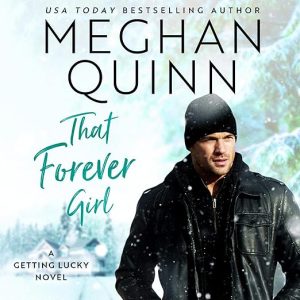
Port Snow is a small town in Maine with a curse attached to it, and this audiobook spends eleven hours and thirty-two minutes inside its limits. That Forever Girl is the second entry in Getting Lucky, released on August 27, 2019 by Brilliance Audio, written by Meghan Quinn and read by William LeRoy. The premise arrives in the description as two words every man in that town supposedly dreads hearing, which is an efficient way of telling you that the ex-girlfriend has come home for good.
A Closer Look at That Forever Girl
Harper Sanders is the one who came back, and the man telling the story is the one who pushed her out. The description is first person and unusually candid about blame: tragedy struck, he threw the future away, and the town decided he was cursed while he privately concluded that he had done all of it to himself. That is a stronger starting position than most second-chance romances allow themselves, because the obstacle is not a misunderstanding waiting to be cleared up. It is something he actually did.
William LeRoy is the single credited reader, and that is worth knowing before you buy, because one of the responses tells you the novel runs on dual point of view. Both halves of the couple, in the present and in teenage flashback, reach you through one voice. Romances built this way are frequently issued with two narrators trading chapters, and the decision not to do that changes the texture considerably: you get one consistent storytelling register instead of two performances arguing with each other.
Rogan and Harper as teenagers occupy an entire second timeline. The four-star response from September 2019 lays the structure out clearly: dual point of view, past and present running in parallel, decent pacing, banter, heartbreak, and the family scenes the series is built on. That entry is truncated on the page exactly where it arrives at the family material, which is a genuine loss, because the family is what every other response circles back to. Half a dozen siblings, a shop, and a curse the town takes more seriously than anyone in it does.
What Makes That Forever Girl Worth Hearing
Meghan Quinn writes the town as an ensemble rather than a backdrop, and the responses confirm it repeatedly. The January 2026 entry says the appeal is the full backstory handed to every character, and wants the next two volumes immediately. The February 2024 response opens on the prologue, the brotherly antics, a missing bottle of lotion, and a purple popsicle, which tells you everything you need to know about the comic register before you commit half a day of listening to it.
Twenty votes back the 4.5 printed here, five of them left text, and the spread inside those five entries is where the useful information sits. Four of them are enthusiastic without reservation. One is a three, and the reason for the three has nothing to do with plot, pacing, characters, or the reading. It comes down to a single word, and the reviewer is explicit that its presence is the only reason the score dropped at all.
Amanda Bettis filed that three in December 2024, calling the book a cute love story with the right amount of spice and then docking it for one specific vulgarity, referred to in the response by a widely understood euphemism rather than written out. Whether that matters to you is a personal question, but it is a genuinely useful data point about the edition: this is a romance with explicit content and coarse language, and at least one reader met a word that ended the good will on the spot.
Things to Know Before Starting That Forever Girl
Military is the tag attached to this listing. Nothing in the description, and nothing in any of the five written responses, involves the armed forces in any way. The story is a small-town Maine romance about a family business, an inherited curse, and a returning girlfriend. Miscategorization at this scale is not an editorial judgment you can argue with, it is a filing error, and the practical result is that browsers of that category find this book while browsers of romance may never reach it.
AMG's January 2026 response is the most enthusiastic on the page, and it happens to be the one that spells the author as Megan Quinn, a letter short of the byline printed directly above it. Small, but worth noticing on a listing where the author name doubles as the series brand. That same response is already impatient for the next two volumes, which is the clearest indication available that this works as a series rather than as a set of interchangeable standalone romances.
Kindle Customer, writing in February 2024, is the one respondent who arrives with the first book already finished, and that entry is the most useful for placing this one. It refers back to That Second Chance and to having met Rogan there before he was handed his own volume. Reading in order is not mandatory the way it would be for a plot-driven series, but the emotional shorthand pays off visibly for the people who have it, and the flashback timeline assumes some of it.
Who Meghan Quinn Is Writing For
Romance listeners who want a small town with a large family attached, and who like the second-chance setup with real fault sitting on one side of it, are the audience here. The dual timeline gives the teenage version of the relationship actual weight instead of treating it as backstory to be summarized. The heat level is present and, by one reader's account, well judged. Eleven and a half hours in one warm voice is an undemanding way to fill a week of chores. Listeners who came to the series for the comedy rather than the ache will find the ratio here tilted slightly toward the ache, which the flashback structure more or less guarantees.
Steer clear if coarse language pulls you out of a love story, because one reader stopped dead at a single word and never recovered from it. Skip it as well if you need dual point of view delivered by two separate readers, since one voice carries both here. And if this family is new to you, the first book supplies the context that makes an inherited small-town curse funny rather than arbitrary. Port Snow will still be waiting whenever you decide to come back to it.
Good to Know
Do I need the first Getting Lucky book before starting this audiobook?
Not strictly. The plot stands on its own, but one reviewer who had read That Second Chance clearly got more from recognizing Rogan and the wider family. The flashback timeline also assumes a certain familiarity with the town, so the emotional shorthand rewards anyone who arrives in order.
Does a single narrator handle both points of view in the audiobook?
Yes. One reader is credited, and one response confirms the novel alternates between the two leads across a past and present structure. Anyone who prefers a dual-cast production, with separate voices for each perspective, should know that this edition does not offer that arrangement.