
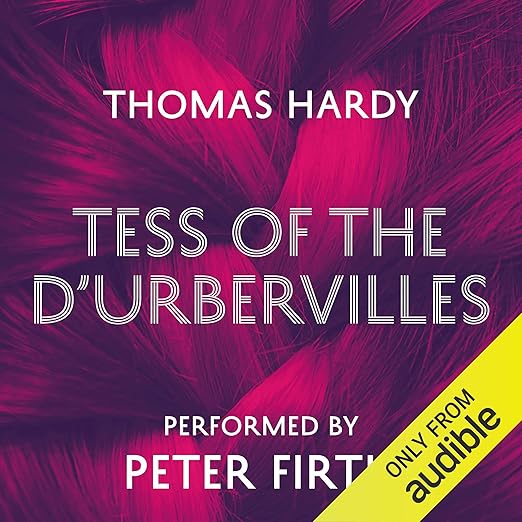
- Narrator: Peter Firth takes the whole of a novel whose social argument runs on the gap between country speech and educated speech.
- Subjects: Personal worth against the right of birth, class marked by how people speak, the machinery of nineteenth-century English life.
- Tone: Slow, pitiless, and unmistakably Victorian.
- Bottom line: The novel earns its fourteen hours; the listing does nothing to help you decide, and its rating panel is partly grading a bookstore.
Whoever built this listing left the description field empty. A fourteen-and-a-half-hour audiobook of a canonical Thomas Hardy novel sits here with no synopsis at all, no summary line, not one sentence about what happens or to whom. A title, an author, a Classics tag, a runtime and a narrator credit are the whole of it. Everything a browser needs in order to decide has to come from the review column instead, and the review column is having a different conversation entirely.
What We Made of It
Nothing on this record tells a first-time listener what the book is about. That matters more for a classic than for a new release, because the people most likely to buy fourteen hours of Hardy split into two groups with opposite needs: readers coming back to a novel they once studied, who want edition details, and readers approaching it cold, who want to know what they are committing an evening a week to for the next month. This page serves neither. Publisher, runtime, narrator and a star average are the extent of it, which reduces a major novel to a set of specifications and leaves the buying decision to strangers. Set it beside a new release in the same catalog, where a publisher supplies three paragraphs of copy, a comparison title and a content note, and the shape of the problem shows: the older the book, the less the record bothers, which exactly inverts how much context a listener is likely to want.
Peter Firth is the voice on this 2008 production, credited alone across the full fourteen hours and twenty-seven minutes. Not one of the five written responses mentions the reading, the pacing, the voice or the audio edition in any form, so anything stated here about the performance would be invention. What can be stated is what the material asks for. A novel this long, carried by one reader, turns on how the descriptive stretches are handled and on how much separation the voices keep over a fourteen-hour arc. Anyone who cares about that will have to listen and find out, because the record offers no help whatsoever.
What Makes Tess of the D'Urbervilles Worth Hearing
Dialect is the reason this novel rewards hearing rather than reading, and one response on the page understands that better than the listing does. A five-star filed in October 2001, seven years before this recording existed, describes the contrast Hardy builds between a crude, colloquial variety of the English then actually spoken and the stuffy, self-satisfied register of the educated classes. On a page that difference is spelling. In a voice it becomes class, and a reader has to carry it in the mouth from the first chapter to the last. The same entry notes that the book struck British readers of its own moment as risque, and that a century of distance has not stopped the heroine from drawing extreme sympathy, which reframes the tragedy as a provocation rather than as a period piece.
Reading the other usable response takes about ten seconds and still leaves you with something. A March 2015 five-star reduces the novel to a single line about the shift toward valuing a person for who they are rather than for the right of birth, which is a fair summary of the argument even though it gives away nothing about the story. Set that sentence beside the handful of words elsewhere in the column and this page carries roughly one paragraph of genuine criticism attached to a fourteen-hour commitment. For a title this canonical, sitting in a catalog since 2008, the shortage is remarkable.
What Might Not Land
Sort the five written responses by what they are actually about and the picture turns strange. The most recent, filed in March 2026, reads in full as praise for a truly excellent bookstore and for some wonderful books received. That is a review of a seller. A November 2019 five-star consists of the two words great product. Neither concerns Thomas Hardy, this recording, or any particular book, and both carry the maximum grade, which the average then absorbs as enthusiasm for the audio edition. Anyone reading the badge as a verdict on the reading is reading a verdict on shipping.
Ten ratings averaging 4.3 admits exactly one total, forty-three stars, and the only deduction visible anywhere in the column arrives from a February 2023 two-star that complains about the quality of this edition, compliments the cover, and stops there. A cover is not something a recording has. That response is grading a physical object, and it is the largest single downward pull on a badge attached to an audio product. The remaining five ratings left no words at all, which means twenty-one of those forty-three stars come from people the page never lets you hear.
Should You Listen to Tess of the D'Urbervilles?
Listeners returning to Hardy after school or university are the natural buyers, since they need no plot summary and the empty description costs them nothing at all. Fourteen and a half hours works out to about a month of evening sessions, and the unhurried build suits that rhythm far better than it suits a weekend. Anyone who works through the classics by ear will find the length ordinary for a nineteenth-century novel, and the form has a real advantage here: spoken, the class distinctions in the dialogue stop being a matter of apostrophes and start being a matter of people. The practical case is just as strong. Fourteen hours by ear costs you attention and nothing else, while the same novel in print asks for a chair and a free month, and plenty of people who mean to read Hardy never quite arrange either.
Newcomers should think harder, and not because of the book. Buying a fourteen-hour tragedy from a page with no description, no content note and no editorial apparatus means starting with no idea what the story holds, and nothing on this record will fix that before you press play. Anyone who wants an introduction or annotations is in the wrong format regardless of the edition. Format buyers get nothing here at all: five written responses, and not one of them acknowledges that a voice is involved.
Good to Know
Why does this audiobook listing carry no description?
Nothing on the page explains it. The record holds a title, an author, a Classics tag, a runtime and a narrator credit, and the synopsis field sits blank. Older catalog entries lose their copy this way, and a 2008 release is old enough for it. Either way, you buy without a summary.
How long is the Tess of the D'Urbervilles audiobook, and how should I pace it?
Fourteen hours and twenty-seven minutes. Hardy builds slowly and rewards patience, so hour-long sessions serve the novel better than long stretches do. At an hour a night it runs roughly two weeks. Attempting it across a single weekend flattens exactly the pacing the book depends on.
How many voices are on this 2008 recording?
One. Peter Firth carries all fourteen hours and twenty-seven minutes, which is standard practice for a single-voice classic reading. The production dates from September 2008 and comes from a studio imprint, and no other reader is mentioned anywhere on the page.
Should I start with Tess if I have never read Thomas Hardy?
It is among the two or three Hardy novels most readers begin with, and the length is typical for the author rather than exceptional. What this record will not give you is framing: no introduction, no notes, no summary. Find your context somewhere else before you press play.







