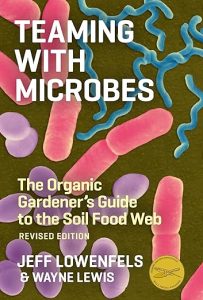
I do not have a large garden. I have a small urban balcony and a persistent failure with container tomatoes that I have been blaming on the wrong things for years. I picked up Teaming with Microbes after a conversation with a friend who grows vegetables with an almost alarming success rate, and who described this book as the thing that finally explained why her approach worked. Three hours in, I understood what she meant, and I also understood why my tomatoes keep dying.
Jeff Lowenfels and Wayne Lewis make an argument that is simple in outline and rich in implication: healthy soil is not a passive growing medium, it is an ecosystem. The soil food web, the complex network of bacteria, fungi, nematodes, protozoa, and other organisms that inhabit a healthy garden, is what actually feeds plants, cycling nutrients into forms roots can absorb. When you apply synthetic fertilizers, you bypass and eventually disrupt that web. When you apply compost, compost teas, and the right kinds of mulch, you support it. The difference in plant health over time is substantial.
Bacterial Soils for Vegetables, Fungal Soils for Trees
The book is divided into two sections. The first is explicitly scientific, the authors acknowledge in the preface that it will be challenging and encourage listeners not to skip it. The science here covers soil bacteria, fungi, and the specific roles each organism plays in the food web. It is dense. One reviewer, who fell asleep during an afternoon reading session, recommends pushing through anyway, and I would agree. The second section translates all of that science into practical gardening guidance: how to compost, which mulches support which types of plants, how to brew compost tea, how to identify gaps in your soil food web.
The practical section is genuinely excellent. Lowenfels writes with the clarity of someone who has applied these ideas in real gardens for years, and the specificity is useful in a way that general organic gardening advice often is not. The distinction between bacterial-dominated soils (better for annuals and vegetables) and fungal-dominated soils (better for shrubs and trees) alone is worth the listening time, because it explains why the same gardening approach can work brilliantly in one part of a garden and produce mediocre results in another.
Barkley's Clear Delivery, Dense Enough to Revisit
Lily Barkley is a competent narrator who handles the scientific content without stumbling over terminology, which is no small thing in a book that moves between mycorrhizal fungi, nematode predation cycles, and protozoan grazing without pausing to simplify. Her pacing in the practical sections is well calibrated, giving the listener time to absorb specific recommendations before moving on. She is not a particularly expressive narrator, and the book does not require expressiveness. It requires clarity, and she delivers it.
At just over eight hours, this is a substantial but manageable listen. The density of the first section means you will likely want to revisit certain passages, the audiobook format makes that slightly awkward compared to a print reference, but reviewers who have used the book for years clearly manage to internalize the key principles across repeated listens.
Front-Loaded Science, Awkward at Balcony Scale
The first part of the book is described by multiple reviewers, and acknowledged by the authors themselves, as difficult to get through. If you are looking for immediately actionable gardening advice, the front-loaded science will test your patience. The authors argue, correctly, that understanding why the soil food web works is what allows you to make intelligent decisions rather than simply following recipes. But if you are an impatient listener, be aware that the practical payoff is in the second half.
This is also fundamentally a book about outdoor gardens with soil. Container gardeners and urban growers will find the principles applicable but the specifics require translation, the book assumes you have access to actual ground and the ability to build or modify beds. The compost tea guidance in particular is most useful at garden scale rather than balcony scale, though the underlying principles remain relevant.
Understanding Why Instead of Just Following Rules
Anyone who is serious about organic gardening and wants to understand the science rather than just follow rules will find this indispensable. If you have been applying organic practices without fully understanding why they work, or why they sometimes do not, this book will give you a framework that actually explains the variability. If you are a weekend gardener who wants healthier plants without chemicals but does not want to spend time on soil microbiology, the second half of the book will still give you actionable guidance even if you find the first half slow going. If you are content with synthetic fertilizers and are not interested in changing that approach, this book will not convert you, it is written for people who already want an alternative.
Before You Press Play
- Narration: Lily Barkley handles the scientific terminology competently and keeps the instructional sections from feeling like a lecture, though her performance is workmanlike rather than distinctive.
- Themes: Soil food web biology, organic gardening philosophy, chemical-free alternatives
- Mood: Dense in places but consistently rewarding for anyone who actually wants to understand what is happening underfoot
- Verdict: The most scientifically grounded organic gardening book available in audio, essential for anyone committed to chemical-free growing.
Is this audiobook useful for container gardening, or is it primarily for in-ground gardens?
The principles apply to both, but the specific guidance, particularly around compost tea brewing and mulching regimes, is written with in-ground gardening in mind. Container growers will need to adapt the recommendations, but the underlying soil food web concepts remain valid.
Should I push through the difficult first section even if I find it slow?
Yes. The authors themselves flag it as challenging in the preface, and multiple reviewers who pushed through report that the second section is significantly more useful for having understood the science first. The first section explains why the second section's recommendations work, which changes how you apply them.
Does Lily Barkley handle the scientific terminology competently?
Yes. She reads the microbiology content clearly and without stumbling, which is important given how much technical vocabulary this book contains. The narration does not make the science feel more intimidating than it already is.
Is this a book I will need to revisit, or is one listen sufficient?
Most serious gardeners who use this book return to it repeatedly. The audiobook format is somewhat less convenient for reference use than print, but the core concepts are memorable enough that one thorough listen gives you a working framework. You can always re-listen to specific sections when applying particular techniques.