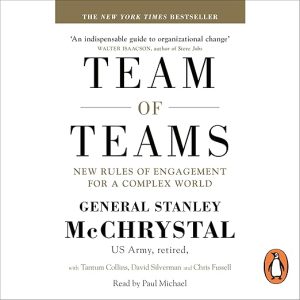
McChrystal's account of transforming the Joint Special Operations Task Force in Iraq is one of the more honest assessments of institutional failure and institutional learning that military leadership literature has produced. Team of Teams, the audiobook narrated by Paul Michael, does not waste time establishing its thesis: conventional military hierarchy, optimized for efficiency and predictable threats, proved structurally unable to counter al-Qaeda's networked, decentralized operations in 2003. The solution McChrystal and his colleagues developed, what they called a team of teams, is the subject of the remaining twelve hours.
That runtime is where this audiobook earns both its strongest praise and its most legitimate criticism. One reviewer fairly noted that the central idea does not require an entire book to explain and that the chapter titled "Team of Teams" contains the conceptual core in concentrated form. That is accurate. The value proposition of the full listening experience is not the originality of the central concept but the accumulated weight of case studies and historical context that McChrystal uses to demonstrate why the idea required such radical departure from established doctrine. Listeners who come for the framework and are prepared to do the work of extracting it from twelve hours will leave with something more durable than the summary version.
More Self-Critical Than Military Triumphalism Suggests
McChrystal is a more self-critical narrator than readers expecting military triumphalism might anticipate. He is explicit about the failures of his early command, the ways in which his own instincts toward control were part of the problem he was trying to solve, and the resistance that the new model encountered from people whose authority it implicitly threatened. This honesty gives the book credibility it would otherwise lack. A reviewer notes that the book contains insights into "the modern practice of leadership and management required to navigate and succeed in this complex world" and that it is told through "entertaining stories." That characterization is accurate; the storytelling is engaging enough that the twelve-hour length rarely feels punishing.
The organizational framework McChrystal develops centers on two requirements: extreme transparency in information sharing, which he calls shared consciousness, and the delegation of decision-making authority to the people closest to the action, which he calls empowered execution. Neither concept is original, but the combination, and the specific mechanisms his team built to achieve it within a military bureaucracy, is where the book makes its genuine contribution. The sections on the daily operations briefings that McChrystal redesigned to include the full task force rather than a select command group are particularly detailed and instructive; these briefings became the practical mechanism through which shared consciousness was built, and the description of how they worked gives the abstract principle concrete form.
The practical case studies from hospital emergency rooms and NASA that extend the model beyond military contexts are where most corporate listeners will find the most directly applicable material. McChrystal draws the hospital comparison carefully, noting that emergency medicine operates in the same kind of rapidly changing, high-stakes environment that the task force faced in Iraq, where the cost of hierarchy-induced delay is measured in lives. The NASA sections address the specific failure modes of highly expert organizations whose knowledge is distributed but not shared.
Michael Adds No Affect the Text Doesn't Call For
Paul Michael's narration gives the audiobook a steady forward momentum that helps listeners through the denser analytical passages. His delivery is measured and precise, which suits the material; McChrystal's prose is not flowery, and Michael does not attempt to add affect where the text does not call for it. The military storytelling sections have particular energy in his reading; the reconstructed operational sequences in Iraq benefit from the control he brings to the pacing.
Charles Duhigg's endorsement of it as "a bold argument that leaders can help teams become greater than the sum of their parts" and Walter Isaacson's description of it as "an indispensable guide to organizational change" reflect genuine engagement with what the book is doing. At twelve hours and six minutes, the investment is substantial, but the payoff is proportional for listeners who bring a real organizational problem to the material.
Complicated Problems and Complex Ones Are Not the Same
The sections on complexity theory and the limits of reductionist management thinking are the philosophical foundation for everything that follows. McChrystal spends time distinguishing between complicated problems, which can be solved through sufficient expertise and process, and complex ones, which cannot. That distinction is the key that unlocks why the task force's initial approach failed; they were applying complicated-problem tools to a complex-problem environment. Understanding this before the organizational solutions are introduced makes those solutions more legible and more durable as mental models.
The chapter on NASA is particularly instructive for listeners from non-military organizations because it demonstrates that the team-of-teams problem is not a feature of war but a feature of any large organization operating in a rapidly changing environment. These examples are worth revisiting after the full listening is complete, since their implications become clearer once the full framework is assembled.
Better Heard in Full Than Summarized
Leaders of organizations facing the specific challenge of maintaining responsiveness at scale will find this audiobook directly useful. It is better heard in full than summarized; the case for the model depends on the accumulated historical evidence, not just the framework itself. Listeners who already work within flat, decentralized structures may find the first half of the book more historically interesting than prescriptively relevant, but the second half on building shared consciousness has practical application regardless of organizational starting point. Those wanting a quick conceptual overview would be well served by the mid-book chapter the critical reviewer identified; those willing to hear the full argument will find their time well spent.
Before You Press Play
- Narrator: Paul Michael handles McChrystal's dense organizational analysis with crisp authority; the military storytelling sections have particular momentum in his delivery.
- Subjects: Decentralized decision-making, organizational adaptability, transparency as strategic infrastructure
- Tone: Intellectually rigorous and propulsive, with military history as the vehicle for management theory
- Bottom line: McChrystal's central argument is genuinely powerful, and the Iraq context gives it urgency that purely corporate case studies rarely achieve.
Frequently Asked Questions
Is the Team of Teams audiobook aimed at military leaders specifically, or does it apply to corporate organizations?
McChrystal explicitly extends the framework beyond military contexts. He uses case studies from hospital emergency rooms, NASA, and private companies to demonstrate that the team-of-teams model addresses organizational challenges common to any complex operating environment. Military readers will find additional resonance, but the book is designed for broad leadership application.
Does the Team of Teams audiobook require prior knowledge of the Iraq War to follow the argument?
No. McChrystal provides sufficient context within the audiobook to make the operational scenarios legible to listeners without military background. The Iraq sections function primarily as a case study for organizational theory rather than as military history, so prior familiarity with the conflict is helpful but not necessary.
At twelve hours, is the audiobook significantly longer than the content requires?
One reviewer fairly noted that the central concept can be understood from a single chapter. The full twelve hours are built around the accumulated case studies and historical context that support the argument. Whether that length feels justified will depend on how much weight a listener places on the evidence versus the framework itself.
How does the audiobook compare to other organizational leadership titles like The Power of Habit or Steve Jobs?
McChrystal's book operates at a more structural and less biographical level than Isaacson's Steve Jobs. It shares Duhigg's interest in institutional behavior but applies that interest to the specific problem of scale and complexity rather than habit formation. The three authors occupy adjacent intellectual territory; readers who responded to either would likely find Team of Teams worthwhile.