Quick Take
- Narration: Brittany Kaiser narrates her own story, and the result is one of those self-narration experiences where the author’s presence transforms what might otherwise be a political chronicle into something that feels like genuine testimony.
- Themes: Data privacy and weaponization, the intersection of tech and democratic manipulation, whistleblower identity and consequence
- Mood: Urgent and unsettling, with a confessional undertow
- Verdict: Kaiser’s firsthand account of Cambridge Analytica remains one of the most important data-industry memoirs available in audio, and her narration makes it more, not less, essential.
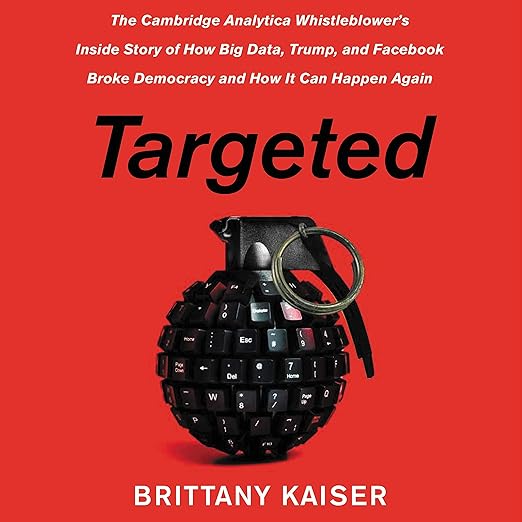
I listened to most of Targeted during a week when data privacy legislation was again making headlines in Brussels. That timing was probably not ideal for my sleep, but it was clarifying in a way that purely abstract policy discussions rarely are. Kaiser isn’t writing about regulation frameworks. She’s writing about what happens in the rooms where data gets bought, sold, and deployed to shift elections, and she was in those rooms.
The Cambridge Analytica story broke publicly in 2018, and by the time Targeted was published, many listeners already had some outline of the scandal: the harvesting of Facebook user data, the targeting models built to influence voters, the connections to the Trump campaign and the Brexit vote. What Kaiser’s memoir provides is the interior view, the granular account of how a person with genuine idealism, a background in human rights law and Barack Obama’s 2008 campaign, found herself selling data-driven voter manipulation as a commercial product.
The Self-Narrator Question
Kaiser narrating her own memoir is the right call, and not for sentimental reasons. This is a book where credibility is everything. Kaiser is a whistleblower who testified before Parliament and cooperated with Robert Mueller’s investigation. She’s also someone who worked at Cambridge Analytica for more than three years and was deeply involved in the commercial practices she later exposed. That tension requires a narrator who can hold both truths in the same voice, and Kaiser does. She doesn’t perform innocence she hasn’t earned. When she describes the moment she recognized the scope of what Cambridge Analytica had done, the weight in her voice is not manufactured.
Self-narration also brings a level of specificity to names, places, and conversations that a professional narrator reading from a script couldn’t match. Kaiser has detailed memory for the conversations she describes, and the narration feels like she’s drawing on that memory rather than performing it.
What the Memoir Reveals About Data as Weapon
The technical material in Targeted is accessible in a way that most data science literature isn’t. Kaiser explains psychographic profiling not as an algorithm but as a sales tool, describing how Cambridge Analytica presented its targeting capabilities to political clients using the language of precision and inevitability. The OCEAN model, the five personality traits that the company claimed to map from Facebook data and use to tailor political messaging, gets explained from the inside: what clients believed it could do, what the actual evidence for its efficacy was, and how the gap between those two things was papered over in sales presentations.
The reviewer who noted the importance of Kaiser’s account for understanding microtargeting was identifying the book’s most durable contribution. The specific elections are historical now, but the mechanisms she describes, lax platform data policies, unregulated commercial use of behavioral data, targeted disinformation as a service, remain active. The 2020 election warning she issues in the original text has been overtaken by events, but the structural critique has not.
The Limits of the Insider Account
This is Kaiser’s story, told from Kaiser’s perspective, and that creates real limitations. She is sympathetic to herself in the way that anyone narrating their own whistleblower arc is going to be. The critics of Targeted, and there were some, noted that her account of her motivations and her level of awareness about what the company was doing can be inconsistent, and that she benefited financially from Cambridge Analytica’s work before she turned against it. Those criticisms exist and the fair listener should hold them in mind.
Reading Targeted alongside Christopher Wylie’s Mindf*ck, another Cambridge Analytica insider account, gives a more complete and contested picture. They don’t tell the same story, and the discrepancies are informative. Kaiser’s audiobook is most valuable as one perspective on a documented historical event, not as a definitive account.
Why This Belongs in the Data Science Conversation
This audiobook is categorized under computers and technology with a data science tag, and that categorization is defensible. The underlying subject matter, the commercial data industry, the use of behavioral analytics for political persuasion, the governance vacuum that made it possible, is genuinely a data science subject. But it’s a data science subject told through human stakes and personal consequence, which makes it accessible to listeners who would never pick up a technical manual.
Who Should Listen, Who Should Skip
Listen if you care about data privacy and want to understand not just the policy failure but the human decisions that created it. Listen if you’re working in data or technology and want a ground-level account of what commercial data exploitation looks like from inside the machine. Kaiser’s narration makes this an essential, not just educational, experience.
Skip if you’re looking for a neutral journalistic account. This is a memoir and a whistleblower’s testimony, with all the subjectivity that implies. Supplement it rather than treat it as complete.
Frequently Asked Questions
How does Brittany Kaiser’s self-narration compare to having a professional narrator read this material?
It’s significantly better in this case. The memoir covers conversations, negotiations, and moments of realization that Kaiser experienced directly, and her narration carries an authenticity that no professional narrator could replicate. The credibility of her account depends partly on her voice, and the self-narration delivers that.
Does this audiobook require any prior knowledge of the Cambridge Analytica scandal?
No, though listeners who followed the story as it broke in 2018 will find the interior detail and the timeline of Kaiser’s decision-making particularly illuminating. The book provides enough context to orient a listener who only has a general sense of the scandal.
How does Targeted compare to Christopher Wylie’s Mindf*ck as an account of Cambridge Analytica?
They’re complementary but don’t tell the same story, and the discrepancies between them are part of what makes both valuable. Wylie writes as a technical architect who claims to have built the underlying system; Kaiser writes as a commercial operator who sold it to clients. Reading or listening to both gives a more complete and contested picture than either alone.
Is this audiobook technically dated given that it focuses on the 2016 US election?
The specific election context is historical, but the mechanisms Kaiser describes remain active. The commercial data industry has not fundamentally reformed since 2018, and the regulatory vacuum she identifies has only been partially addressed. The book’s core argument about what unregulated behavioral data enables is not dated.