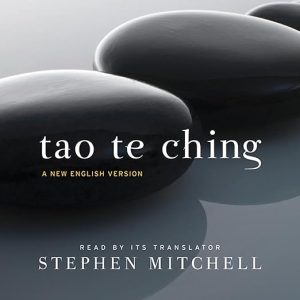
- Read by: Jeffrey Ito reads with deliberate restraint, treating each verse as something to be heard rather than performed.
- At its heart: Non-attachment, the nature of the Tao, yielding as strength
- Vibe: Still, contemplative, paradoxical
- Short version: A clean audio encounter with one of humanity's most enduring texts, best heard without expectations of resolution.
Eighty-one chapters. Roughly five thousand Chinese characters. And twenty-five centuries of readers still unable to fully agree on what Laozi intended by any of it. I came to this audiobook version of the Tao Te Ching, narrated by Jeffrey Ito, during a period when I had grown impatient with books that promised transformation through a numbered list of steps. The Tao Te Ching offers nothing so reassuring. It gives you paradoxes and asks you to sit with them, which, as it turns out, is exactly the kind of discomfort a commuter with too many podcasts needs.
Jeffrey Ito's Restraint Lets Each Verse Speak
The Tao Te Ching is not a book in any conventional sense. Written around the 4th century BC and traditionally attributed to the sage Laozi, it is a collection of poems and aphorisms that form the foundational text of philosophical Taoism and, by extension, shaped Confucianism, Chinese Buddhism, Legalism, and centuries of Chinese art and calligraphy. The word "Tao" resists translation: it is sometimes rendered as "the Way," sometimes as "the Path," sometimes left untranslated because any English equivalent flattens what the original preserves in ambiguity. At 1 hour and 26 minutes, this audio edition is one of the shorter encounters you can have with a text that has occupied scholars for millennia.
Jeffrey Ito narrates with a quality that the text demands and that many narrators of classical texts fail to supply: restraint. He does not dramatize. He does not editorialize with his voice. He reads each verse as if it might speak for itself, which is the correct instinct. Reviewer Linn C. described buying this to learn to "let go" more, having been told by an acupuncturist she needed exactly that practice. Ito's delivery supports that use case. This is audio as meditation prompt rather than as performance.
The philosophical tradition that this text generated is vast, but the text itself is compact. Its influence spread into Legalism, into the development of Chinese Buddhism when it was first introduced to China, and into the artistic practices of poets, painters, calligraphers, and garden designers across the centuries. Hearing it narrated in English without scholarly interruption restores something of the text's original quality: it arrives as a whole rather than as a series of interpretive puzzles to be solved section by section.
Audio Strips Away the Urge to Re-Read
The auditory format suits classical verse in a specific way: it strips out the temptation to re-read and second-guess. With a print edition of the Tao Te Ching, the tendency is to pause on a verse, flip to footnotes, cross-reference translations, and lose the whole. In audio, the verse passes through and what remains is what struck you, which is probably closer to how this material was originally transmitted in an oral culture. Listener Hubert Drake mentioned playing this on a CD player in bed, and that mode of reception makes complete sense for a text this contemplative. The audiobook format favors surrender over analysis.
This version also benefits from the brevity of the text itself. At under ninety minutes, it is the kind of audiobook you can absorb in a single sitting and then return to in fragments over months. The Tao Te Ching is one of the most translated texts in world literature precisely because each translation surfaces different aspects of the original. Hearing a specific English rendering via Ito's voice adds another interpretive layer, and awareness of that layering is part of what makes this a rewarding listen.
Riddles by Design, Never a Translation Error
Some verses in the Tao Te Ching are genuinely bewildering on first listen, and this is by design rather than by translation failure. Reviewer Tessa Skinner noted that the book "was written in a kind of riddle," and that observation is accurate and not a criticism. The Taoist tradition values the productive confusion of a koan over the false clarity of an explanation. If you approach this audiobook expecting sequential argument or doctrinal clarity, you will be frustrated. If you approach it as a collection of images and instructions that resist systematic interpretation, you will find something that accumulates rather than resolves.
The short runtime also means this audio edition offers no additional commentary, introduction, or scholarly apparatus. Listeners unfamiliar with the broad outlines of Taoist thought may benefit from reading a brief overview before listening, not to decode the text but to give the verses somewhere to land contextually. The philosophical and religious Taoism distinction, and the relationship between this text and the Zhuangzi, is worth knowing at a basic level before you sit down with Ito's narration. These are not barriers to entry, just useful preparation for what the text asks of you.
Suited to Readers With a Meditation Practice
Listeners who are already practicing some form of mindfulness, meditation, or contemplative reading will find this audiobook fits naturally into those routines. For complete newcomers to Eastern philosophy, this version works as an introduction but should be followed up with context, since the text does not explain itself and Ito's narration does not attempt to fill that gap. Those who want a guided philosophical tour will be better served by an edition with commentary. Those who want the verses themselves, unmediated and read with quiet respect, will find exactly that here. The Tao Te Ching has survived twenty-five centuries because it adapts to whatever the reader brings. The same holds for the audiobook.
A Few Questions About Tao Te Ching
Which translation of the Tao Te Ching is used in this audiobook?
The synopsis does not specify the translator. Listeners who have strong preferences among the many available English translations should check the product details for that information before purchasing.
At under 90 minutes, does this audiobook feel complete?
The text itself is complete, all 81 chapters. The brevity is a feature of the source material, not an abridgement. Many listeners return to it repeatedly rather than expecting a single listen to exhaust it.
How does hearing the Tao Te Ching as an audiobook compare to reading a print edition?
Audio removes the urge to re-read and annotate, which paradoxically suits a text about releasing attachment. What lands on listening tends to be what resonates, not what can be analyzed, which aligns with the Taoist spirit of the material.