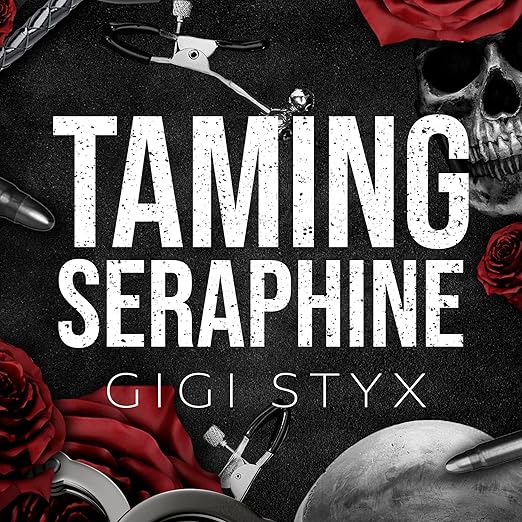
- Performance: Xander Stone brings appropriate menace and restraint to Leroi's chapters, and captures enough of Seraphine's volatility to make the dynamic between them feel genuinely dangerous.
- What it covers: Trauma recovery under extreme circumstances, the complexity of trust after systematic betrayal, revenge as identity
- Feel: Dark and tense, with a slow-building romantic warmth
- Our call: A dark romance that takes its disturbing premise seriously rather than using it as pure aesthetic, though readers expecting maximum intensity should calibrate expectations based on the actual content level.
Dark romance as a genre has a problem with honest self-description, and Taming Seraphine is both a victim of that problem and, in some ways, a corrective to it. The book carries content warnings, has been placed in the same conversations as texts like Haunting Adeline, and markets itself in the vocabulary of extreme darkness. What it actually is turns out to be something more interesting: a dark romance where the darkness is primarily about what has been done to the female protagonist before the story begins, and where the central emotional project is something as complicated as allowing trust to exist after comprehensive betrayal.
Seraphine was taken. She was trained to kill and to seduce. She was used and then abandoned to a basement. When Leroi finds her and brings her home, he is not the force that broke her. But he is now responsible for the consequences of what others did. Gigi Styx builds the romantic tension from this asymmetry: Seraphine's instinct toward violence is not villainous. It is adaptive. It is what kept her alive. And Leroi is the person who needs to figure out what it means to build something with someone for whom self-protection has always required the option of lethal response.
How Taming Seraphine Holds Up
Xander Stone handles the dual perspective well. Leroi's voice carries a controlled authority that never tips into the kind of domineering posture that would make his attraction to Seraphine seem like a possession plot. Stone renders the character's internal conflict between professional instinct, which says Seraphine is a liability, and emotional pull, which keeps overriding that calculation, with enough texture to make Leroi's eventual softening feel inevitable rather than convenient.
Seraphine herself is the book's real achievement. One reviewer compared her to a character named Sibby, which will mean something to readers of dark romance who know that reference. The quality they are pointing to is a protagonist whose survival instincts have become part of her personality rather than something she is trying to overcome: she is funny and terrifying and genuinely attached to the people she decides to protect, and her moral framework, while not one most readers would choose, is internally consistent. She is not chaotic. She is precise, in a way that happens to include extreme violence.
Why Taming Seraphine Works as an Audiobook
The revenge plot gives the second half of the book a structural urgency that the first half's setup earns. A dark figure from Seraphine's past resurfaces, wanting to reclaim what was taken from her. This threat is what forces her and Leroi into genuine cooperation rather than mutual wariness, and the shift in their dynamic under that external pressure is convincing. Styx avoids the common dark romance error of generating all tension from within the romantic pair at the expense of external narrative stakes.
At fourteen hours and forty minutes, the runtime is substantial, and the pacing reflects that ambition. This is not a compressed dark romance. The slow burn is genuinely slow. Leroi's process of understanding what Seraphine needs, which is not protection in any conventional sense but something more like witness, takes enough time that when the intimacy arrives it has been built rather than assumed. One reviewer described the ending as a happy conclusion worth the emotional investment of everything that preceded it, which is as close to a structural guarantee as dark romance endorsements get.
Weak Spots in Taming Seraphine
At least one reviewer noted a gap in the plot's internal logic that bothered them without being specific enough to constitute a spoiler. The book does have moments where Seraphine's extremely specific skill set and its origins raise questions that the narrative addresses only partially. Readers who need their worldbuilding to account for every implication of a character's backstory may find this frustrating. Readers who are more interested in the emotional architecture will likely not notice it.
The content level is lower than the marketing context suggests. Multiple reviewers specifically noted this. The intimate scenes are present but not at the intensity level associated with the darkest titles in the genre. The disturbing content is primarily in Seraphine's history and in certain scene descriptions of violence, not in the romantic or explicit content itself. If you are entering this expecting extreme darkness in the style of specific other titles, you should recalibrate.
The Right Listener for Taming Seraphine
This is for dark romance listeners who want a genuinely complicated female protagonist whose damage is treated with narrative respect rather than as atmosphere, for readers who appreciate revenge plots that are motivated by character interiority rather than external plotting, and for listeners who can tolerate disturbing thematic content in exchange for a romance that earns its resolution. Skip it if you need high explicit intensity and cannot adjust your expectations, or if protagonist violence against secondary characters is a dealbreaker regardless of narrative context.
How does Taming Seraphine compare to other dark romance titles like Haunting Adeline in terms of content intensity?
Multiple readers explicitly flagged that the comparison to Haunting Adeline overstates the intensity level. The disturbing content is primarily in Seraphine's backstory and in certain violent scenes, while the explicit romantic content is notably less intense than the genre's most extreme titles. Expectations should be calibrated accordingly.
How does Xander Stone's narration handle the shift between Seraphine's volatile, darkly comic chapters and Leroi's more controlled, strategic perspective?
The tonal differentiation is clear. Stone's Leroi carries controlled authority, while Seraphine's sections have a sharper, more unpredictable quality. The contrast serves the book's dynamic well, and the narrative tension in their shared scenes comes through in how Stone modulates between both registers.