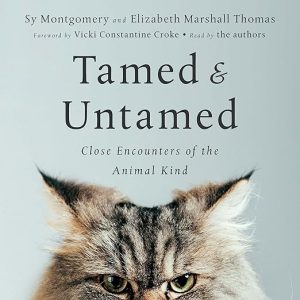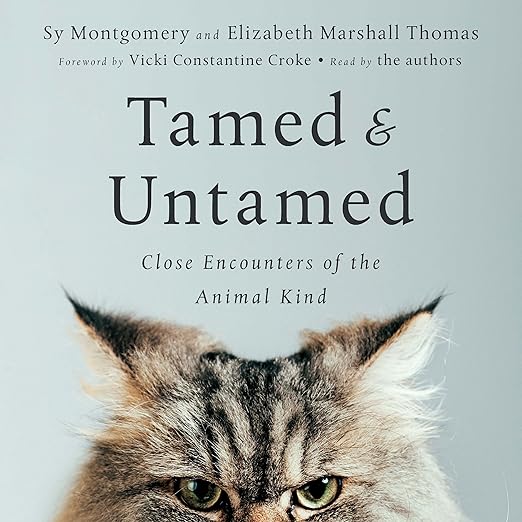
Sy Montgomery reads the audiobook of Tamed and Untamed: Close Encounters of the Animal Kind, a collection she co-authored with Elizabeth Marshall Thomas, and the fact that she narrates her own words makes an already intimate book feel like a private conversation. Montgomery has written about octopuses, pigs, snow leopards, and pink river dolphins. She has earned her authority through years of fieldwork and careful observation. Hearing her voice wrap around these essays, many of them her own, brings a kind of completeness that a professional narrator could not replicate. At just under six hours, the audiobook is not a long commitment, but it carries a surprising amount of weight.
Two Authors Dismantling the Human-Animal Divide
The premise of this collection sounds deceptively simple: two celebrated animal writers compile short essays on creatures ranging from snails and house cats to great white sharks and octopuses. But what Montgomery and Thomas are really doing is dismantling a very old assumption, the idea that humans occupy a category of being categorically apart from other animals. Montgomery quotes herself early in the collection: the list of attributes once thought unique to humans, from using tools to waging war, is not only shrinking but starting to sound less impressive when placed alongside other animals' capabilities. That line lands differently in audio than it might on the page, because Montgomery delivers it with the quiet confidence of someone who has watched an octopus solve a puzzle firsthand.
Elizabeth Marshall Thomas, who built her reputation through groundbreaking work on dog cognition and the hidden lives of deer, brings an equally grounded sensibility. Her essays tend toward observation rather than argument, she shows rather than tells, trusting the evidence of animal behavior to carry the philosophical weight. The two authors have different prose rhythms, and the alternation between their voices gives the collection a pleasant conversational texture, as though you're sitting with two friends who have very different but equally compelling stories to tell about the same subject.
Montgomery's Narration Carries a Wide-Ranging Essay Collection
Montgomery's narration is the primary reason to choose audio over print here. She doesn't perform the essays so much as inhabit them, and the subtle shifts in her voice when she moves from describing a feral cat's territorial logic to recounting a meeting with a shark capture the tonal range that makes her writing so appealing on the page. The collection's essay format also suits the listening format particularly well, each piece is self-contained, which means you can put the audiobook down between chapters without losing narrative thread, and each time you return you're rewarded with something complete in itself.
Reviewers have consistently noted the book's balance of humor, empathy, and introspection, qualities that are easier to convey in spoken form than in text. When Thomas writes about a beloved dog or Montgomery describes the sensory world of a shark, the combination of precise language and personal warmth becomes something close to companionship. One reviewer called it "lovely and fun, entertaining and educational", which sounds like faint praise but is actually an accurate description of what the book accomplishes. It doesn't lecture. It doesn't moralize. It puts you in the presence of creatures and asks you to pay attention.
The subject range is genuinely broad. The snail chapters alone challenge assumptions about slowness and sensory experience in ways that stay with you. The dog and cat essays carry the familiar affection of writers who have shared their lives with domestic animals, but they're grounded in observation rather than sentimentality. And the chapters on wild predators, lions, sharks, hawks, resist the tendency to either romanticize or fear these animals, offering instead a careful account of what they actually do and why.
Short Essays Building Toward a Challenging Idea
The collection's greatest strength is also its potential limitation. Because it is composed of shorter essays rather than a sustained argument or narrative, it can feel episodic to listeners who prefer their audiobooks to build toward something. There is no third-act revelation, no central mystery resolved. The accumulation of insight is the point, and some listeners may need to adjust expectations accordingly. If you approach this as you might a collection of long-form journalism, each piece complete, each contribution adding to a larger picture without being subordinate to one, you'll find the format satisfying rather than frustrating.
Also worth noting: the book's intellectual core is genuinely challenging despite its accessible tone. Montgomery's observation that the qualities we use to distinguish ourselves from other animals are "not only rapidly shrinking" but perhaps not as impressive as advertised is not a comfortable idea. Thomas's work on dog cognition has been controversial in some academic circles precisely because she takes animal interiority seriously in ways that resist easy measurement. Listeners looking for a breezy nature book will find this collection has more edge than the gentle cover might suggest.
Best for Fans of Serious Nature Writing
This audiobook is an ideal companion for anyone already drawn to writers like Barbara Kingsolver, Peter Wohlleben, or Frans de Waal, people who treat animal consciousness as a serious subject without abandoning wonder. It works well for dog and cat owners who want their affection for their animals grounded in something more than projection. It will also appeal to readers of Thomas's earlier books, particularly "The Hidden Life of Deer" and "The Social Lives of Dogs," who want to hear her voice alongside a writer of equal range and warmth.
Skip this one if you need narrative momentum or a book organized around a central argument. Those who prefer deep dives into single species, an entire book on just octopuses, say, or just hawks, may find the breadth here trades depth for variety. But for the right listener, that variety is precisely the appeal.
Does Sy Montgomery narrating her own audiobook essays feel different from a professional narrator?
Yes, meaningfully so. Montgomery's voice carries the specific authority of someone who has physically been present with the animals she describes, and she has a naturalist's precision in her speech. Her co-author Elizabeth Marshall Thomas's sections are also read by Montgomery, which creates a consistent tone, but the essays Montgomery wrote herself have a particular intensity in her delivery that a third-party narrator would struggle to match.
Is this audiobook accessible to someone without a scientific background in animal behavior?
Completely. Neither Montgomery nor Thomas writes for specialists. The essays are grounded in observation and personal experience, and any technical concepts are explained through concrete examples rather than jargon. The collection is designed to be read by curious general listeners, not ecologists.