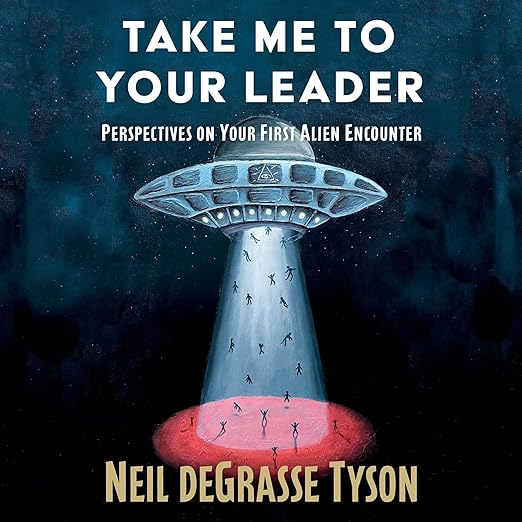
Neil deGrasse Tyson begins Take Me To Your Leader with a confession that reframes everything: since childhood, he has wanted to be abducted by aliens. The opening of this audiobook signals immediately that you are not in for a dry astrophysics lecture or a sober policy analysis of UAP disclosures. What Tyson delivers is something he has spent a career building toward, a treatment of extraterrestrial speculation that applies genuine physics with genuine wit, neither sacrificing the science for the entertainment nor the entertainment for the science.
Tyson's catalog of science communication books has covered cosmology, StarTalk companion material, and the history of humanity's relationship with the cosmos. Take Me To Your Leader is different in tone and scope from those projects. This is less the scientist explaining what we know and more the scientist permitting himself to speculate at full force, using the real laws of physics as the constraint within which the speculation operates. The result is the most purely enjoyable book he has written, which is probably why he describes it as the most entertaining and universally appealing of his career.
First, the Big Picture
The book's central project is applying universal physical laws to questions that popular culture has always answered through pure imagination. What would aliens actually look like, given the constraints of biological evolution and the range of environments that could sustain complex life? How would any civilization travel through the universe to reach Earth, and what would the timescales involved mean for the civilization doing the traveling? What would they think of us upon arrival, having observed our planet's electromagnetic signature for however long it took them to cross the distance?
These are not rhetorical questions for Tyson. He works through them systematically, drawing on evolutionary biology, the physics of interstellar travel, and the range of what chemistry permits in biological systems. The answers are more constrained than science fiction has traditionally allowed, and the constraints themselves are more interesting than the unconstrained version of the question. There is a reason convergent evolution produces eyes independently dozens of times on Earth. There is a reason certain body plans appear repeatedly across unrelated organisms. Those constraints likely apply to intelligence wherever it arises, and Tyson's exploration of what that means for what aliens might actually look like is one of the more genuinely surprising sections of the audiobook.
What Makes Take Me To Your Leader Worth Hearing
Tyson self-narrates with the timing of someone who has been delivering this kind of content to live audiences for decades, from Hayden Planetarium shows to stadium science events to documentary voice work. His pauses are calibrated. His emphasis lands correctly. The comedic beats, which are frequent and genuine rather than forced, work in audio in a way that printed text cannot fully capture, because timing is everything in comedy and timing is exactly what Tyson controls in his own narration. The etiquette tips for first contact are one of the funniest sustained passages in any recent popular science production, and hearing Tyson deliver them with the same measured authority he applies to actual astrophysics is the joke.
At four hours the audiobook is short enough to complete in a single engaged listening session, which suits the material. This is not a dense textbook that requires chapter-by-chapter absorption. It is more like an extended essay by someone who has been thinking about these questions for a lifetime and has finally been given permission to lay out the full argument with appropriate humor. The brevity means the coverage is selective rather than comprehensive, and the sections chosen reflect what Tyson finds genuinely interesting rather than what a comprehensive survey would require.
A Few Reservations
The cultural history dimension is where the book becomes something beyond popular science alone. Tyson draws extensively on how humans have depicted aliens throughout history, literature, film, and pop culture, and that accumulation of depiction reveals something interesting about human psychology over time. What a culture imagines aliens to be reflects what that culture fears and what it hopes for, and the pattern across centuries is more revealing than any individual depiction. The question of why UFO sightings cluster in the patterns they do gets similar treatment, applying sociological and psychological reasoning rather than dismissive debunking or credulous acceptance.
The physics-based discussion of what alien biology might actually look like is one of the more substantive scientific sections and worth particular attention for listeners who want concrete reasoning to hold onto. The interstellar travel section addresses the actual physics of crossing the distances involved and what those distances mean for the timescales of any civilization advanced enough to make the attempt. Tyson does not treat these as settled questions. He treats them as genuinely open problems that current physics can constrain but not answer, which is the honest position and more interesting than false certainty in either direction.
The Right Listener for Take Me To Your Leader
Anyone who has ever looked at a clear night sky and wondered with genuine curiosity whether something out there has looked back will find Tyson's treatment both satisfying and amusing. Science communication fans who follow Tyson's work already know what they're getting and will find this among his most purely entertaining releases. The four-hour runtime makes it an easy audiobook for long drives, solo afternoon walks, or any situation where you want something that makes you smarter and makes you laugh in roughly equal measure.
Listeners looking for a serious scientific treatment of astrobiology with comprehensive literature review will find the scope too selective, as this is more cultural meditation than technical review. Those expecting detailed analysis of specific recent UAP evidence will similarly find the approach more physics-and-speculation than investigative. This is Tyson thinking out loud about one of the universe's most interesting open questions, using the best tools available, and having an excellent time doing it. The audiobook format, with his self-narration, is the ideal way to experience that process.