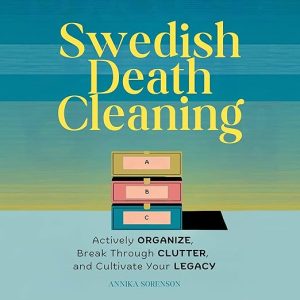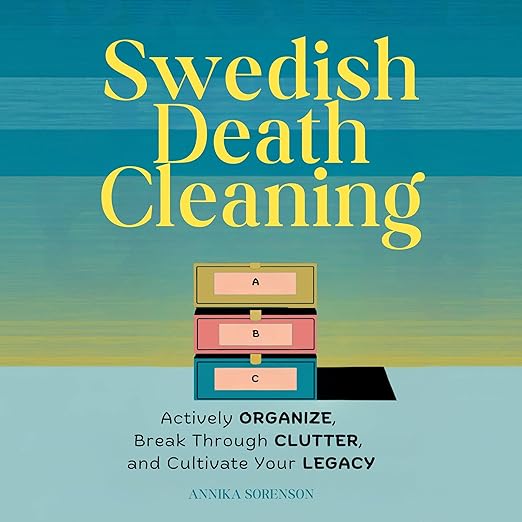
I listened to Swedish Death Cleaning on a Sunday afternoon when I had already spent two hours staring at a closet full of things I have not touched in three years. There is something almost absurd about that timing, the universe delivering the right audiobook at the right moment. At three hours and forty minutes, Kris Hambrick had me through the entire thing before dinner, and I came out the other side having actually made a bag for donation rather than just thinking about it. That, to be direct about it, is the only benchmark that matters for a book in this space.
Annika Sorenson's audiobook takes the Scandinavian concept of dostadning, the practice of decluttering your home so that your loved ones do not have to deal with your accumulated possessions after you are gone, and frames it as an act of love rather than an act of mortality. The word "death" in the title, as one reviewer pointed out, sounds grimmer than the practice actually is. What Sorenson delivers is a structured, practical guide wrapped in warmth.
Hambrick Turns Checklists Into Something Comforting
The audiobook works precisely because Hambrick's narration never lets it feel clinical. There is a temptation, with how-to content, to strip the emotion out in favor of bullet points, and this book does contain practical lists and step-by-step thinking. But Hambrick reads them with genuine care, and the effect is that you feel accompanied rather than instructed. One reviewer described the book as "comforting," and that word keeps surfacing across the listener responses because it is the right one.
Sorenson introduces several frameworks that are worth sitting with: the distinction between releasing clutter through guilt versus releasing it through genuine evaluation of what matters; the Lagom philosophy of "just enough" as a governing principle rather than a minimalist extreme; and the particular challenge of sentimental objects, which she addresses with more nuance than most books in this category. She acknowledges that letting go of things tied to memory is not simply a matter of clearing shelf space, it is an emotional process that requires time and honesty.
Talking to Aging Parents Without Sounding Morbid
The audio format is well-suited to this material. Because the book is organized around discrete concepts and practices rather than a linear argument, it is easy to listen reflectively, pausing to think, returning to sections that land particularly hard. Hambrick's calm pacing encourages that kind of engagement. At under four hours, it is also genuinely manageable: you can complete it in a single session or spread it across a few commutes.
Several reviewers noted that the book is clearer and more actionable than others they had read on the subject. That clarity is real. Sorenson does not pad the content or spiral into philosophical tangents, she makes a point, illustrates it, and moves forward. For listeners who have bounced off denser decluttering books, this economy of language is a genuine virtue. One reviewer's dilemma, how to get aging parents to read this without implying they are near death, is also, refreshingly, something Sorenson addresses directly, offering language for these conversations that is tactful rather than morbid.
Overlapping Ground With Magnusson's Original Book
The book's brevity is both its strength and its limitation. At three hours and forty minutes, there is not a great deal of depth in any one section. Readers who are already familiar with Margareta Magnusson's original The Gentle Art of Swedish Death Cleaning, the book that introduced this concept to English-speaking audiences in 2017, will find some conceptual overlap and may want to weigh whether this adds enough to justify the time. Sorenson covers the territory capably, but she is working in an established space rather than breaking new ground.
There is also very little case study material, no extended profiles of people who have gone through this process, no narrative depth. If you process ideas best through story rather than instruction, you may want to supplement this with a memoir that covers similar emotional territory.
Life Transitions Make the Timing Newly Urgent
Ideal for listeners who have been circling a decluttering project without a clear emotional framework to guide it. Also excellent for anyone entering a life transition, retirement, a move, a significant loss, where the question of what to keep and what to let go becomes newly urgent. Less necessary for those already deeply versed in minimalism literature, though even experienced listeners may find Hambrick's warm delivery worth the short running time.
- Voice: Kris Hambrick reads with calm, unhurried sincerity that matches the book's tone of gentle encouragement, the right voice for this subject.
- Big ideas: Intentional downsizing, legacy and memory, the philosophy of Lagom (just enough)
- Atmosphere: Quietly reassuring, like a conversation with a practical and kind older friend
- Worth it?: A short, accessible listen that offers genuine emotional reframing of decluttering, though those already versed in Margareta Magnusson's original book may find less that is new.