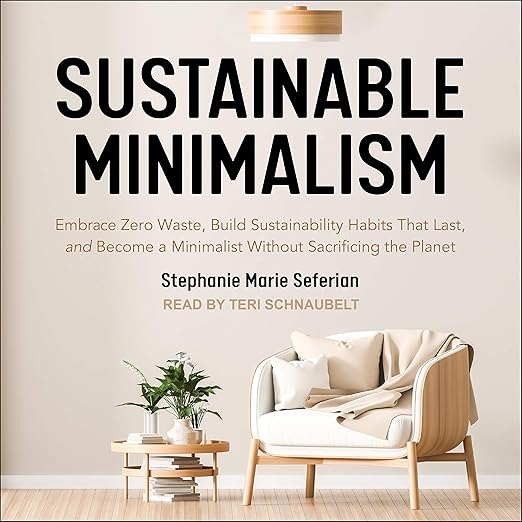
- Narrator: Teri Schnaubelt delivers Stephanie Seferian's material with clarity and warmth, an ideal narrator for this kind of practical lifestyle guide, making the listen feel encouraging rather than prescriptive.
- Subjects: Eco-minimalism as gradual practice, consumption habits and environmental impact, sustainable living with children
- Tone: Supportive and grounded, like a conversation with someone who has genuinely worked through these changes and is not judging your starting point
- Bottom line: A practical, non-guilt-driven guide to starting a more sustainable life that rewards the audio format because Schnaubelt makes the incremental approach feel genuinely achievable.
I started this audiobook after a particularly dispiriting Saturday spent trying to declutter a closet and ending up, somehow, with more things in it than I started with. I was looking for something that would reframe the problem rather than lecture me about it, and Sustainable Minimalism arrived at exactly the right moment. I finished it over two early morning walks and found myself making a list of small changes before I had even gotten to the author's own suggested lists.
Stephanie Seferian wrote this book during a specific cultural moment, early 2021, when eco-anxiety had reached a particular pitch and people were newly conscious of what their consumption habits were actually costing. But the book's incremental, non-shame-based approach has kept it relevant well past that moment.
Sustainability and Minimalism Reinforce Each Other
Seferian's core insight is that sustainable living and minimalism are not the same thing and are often taught in isolation from each other, when in fact they reinforce each other in ways that make both more achievable. She is not asking you to become a zero-waste extremist or to transform your home in a weekend. The book is structured to begin with the easiest changes and build on each success, a scaffolded approach that one reviewer described as a "realistic road map" rather than an aspirational fantasy.
The content covers territory that is broad by design: purchasing habits, what happens to things you discard, kitchen waste, clothing consumption, habits around travel and commuting, and, notably, how to maintain this approach when you have children, which is where most sustainability aspirations go to die. Seferian writes from her own experience of sustainable living with a family, which grounds the advice in conditions that feel like real life rather than a curated social media version of it.
Teri Schnaubelt's Warm, Non-Judgmental Delivery
Teri Schnaubelt is the right narrator for this material. Her delivery is warm and measured without being either saccharine or clinical, and she suits the non-judgmental tone Seferian has worked to maintain throughout. Several reviewers noted that the book's absence of guilt and shame is one of its most valuable features, it describes a problem without making you feel terrible for being part of it, and then offers concrete ways forward. Schnaubelt's narration amplifies that quality. She sounds like someone sharing a practice she finds genuinely workable, not someone performing eco-virtue at you.
The podcast background that informed this book is evident in the way the material is organized. Seferian knows how to structure information for listening rather than reading, and the chapter-by-chapter topical breakdown translates cleanly to audio. Unlike some lifestyle guides that feel like they were written for visual skimming and suffer when listened to straight through, this one holds its shape as a listen.
US-Centric Advice, Familiar to Longtime Practitioners
The book is US-centric in its specific product recommendations and some of its municipal waste and recycling guidance. The principles are universally applicable, but listeners outside the US may find certain specific suggestions less directly actionable. Seferian also draws heavily on her own experience of a suburban family household, which may feel less directly applicable to urban apartment dwellers, rural households, or people without children, though the core practices translate more broadly than the framing sometimes suggests.
One reviewer who described themselves as experienced with sustainable living noted the book covers ground that will feel familiar to anyone who has been paying serious attention to this space for a few years. This is calibrated for people who know they want to change something but are not sure where to begin, not for people who are already composting, buying secondhand exclusively, and calculating their carbon footprint. That audience will likely find more value in more specialized resources.
Aimed at Listeners Who Feel Overwhelmed, Unable to Start
This audiobook is well-suited for people who feel genuinely overwhelmed by both the scale of environmental problems and the culture of sustainability perfectionism that has grown up around them. Seferian's incremental, judgment-free approach is specifically designed for people who have felt unable to start because they cannot imagine finishing. If that description fits, this is a useful place to begin.
Committed minimalists or experienced eco-living practitioners will find the foundational material familiar. For everyone else, and there are genuinely a lot of people who want to start somewhere but have not found an entry point that feels manageable, Seferian and Schnaubelt have made something accessible and practically grounded.
Before You Listen
Does this audiobook work for people with children, or is it aimed at individuals and couples?
Seferian specifically addresses sustainable living with children, which is a notable strength. She writes from her own experience as a parent and avoids the common lifestyle-guide assumption that the reader has complete control over their household environment. This is one of the more practical aspects of the book.
Is Teri Schnaubelt's narration a good match for this kind of lifestyle guide?
Yes. Schnaubelt's delivery is warm without being preachy, which is exactly right for material that is trying hard not to shame its listener. She suits the conversational, non-judgmental tone Seferian has built throughout the text.