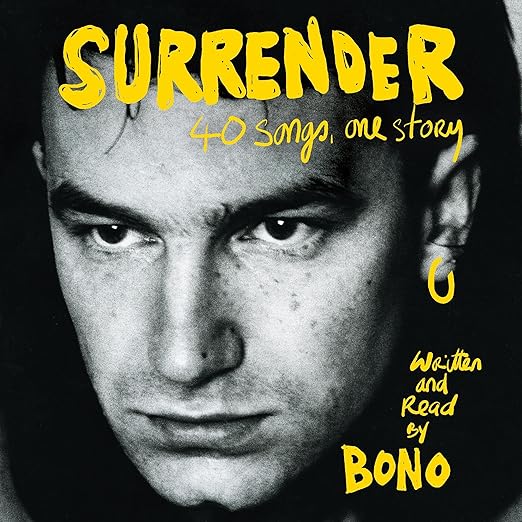
Bono's prose style announces itself within the first few minutes of this audiobook: dense, allusive, shot through with Dublin light and the rhythms of someone who has been writing lyrics since his teenage years in Artane. Surrender, winner of the 2024 Audie Award for Audiobook of the Year, runs to over twenty hours, and the format is not incidental to the experience - it is integral to it in ways that no print edition can replicate. Bono's voice carries the memoir not just as a delivery mechanism but as an instrument in its own right, finding a performer's authority in the familiar passages and cracking at the places where the material breaks through rehearsed ease. Few celebrity memoirs justify the audio format as completely as this one does.
What separates this from the standard celebrity memoir is structural ambition. The audio version weaves actual music into the narrative - original U2 recordings, fragments of The Clash, Patti Smith, Johnny Cash, Verdi, and Mozart - not as background texture but as editorial punctuation. Newly recorded reimagined versions of songs including "Sunday Bloody Sunday," "With Or Without You," "One," and "Beautiful Day" appear for the first time here, heard through the particular filter of the stories that generated them. When Bono describes the genesis of a song and the track materializes, transformed, the effect is genuinely arresting. The audiobook becomes a multimedia document - memoir and soundtrack simultaneously - and that combination justifies the format in a way that text alone cannot. The writing repays close attention throughout. Bono is not hiding behind ghost-writer distance; every sentence sounds like the same person who wrote "One" and "Where the Streets Have No Name." His ego surfaces regularly, as reviewers have noted, but so does his self-awareness about that ego, which makes the self-deprecation land as genuine rather than performed. Dublin in the 1970s, early band rehearsals in a house that smelled of ambition and bad plumbing, the grief of losing his mother at fourteen - these sections carry weight because they are written with specificity rather than sentiment. The activism chapters - covering more than two decades of work on debt relief, AIDS funding in Africa, and political advocacy across administrations - are frank about the contradictions of a rock star with a private jet campaigning for economic justice. Bono does not resolve those contradictions; he sits with them, which is more honest than most would manage and more interesting than resolution would be.
Built for Long, Uninterrupted Listening Sessions
At over twenty hours, this is a substantial investment, and it rewards that commitment proportionally. The early sections on Bono's Dublin childhood are among the most vivid memoir writing available in this format - specific, sensory, and free of the vagueness that plagues celebrity retrospectives. His account of U2's ascent from post-punk outsiders to stadium phenomenon is told without sanitizing; the difficulties, the near-endings, the choices that could have gone differently are all present. The production quality throughout is exceptional, and the soundtrack integration is handled with genuine editorial care. Transitions between spoken word and music feel purposeful rather than decorative, and the exclusive reimagined song recordings are a feature unavailable in any other format. The twenty-plus hours work best in extended listening sessions rather than fragmented commute chunks - the memoir builds cumulative emotional weight that gets diluted when interrupted too frequently. Approach it as a sustained experience rather than background audio and it rewards you accordingly.
Demanding, Literary, and Not for Half-Attention
Two practical considerations for potential listeners. First, the length demands genuine commitment. This is not casual listening or background audio for divided attention; it requires the kind of presence you would bring to a book you intend to actually read. Second, Bono's writing style is demanding. Dense, allusive, occasionally self-indulgent - the register is literary memoir at a level that rewards active engagement but resists passive consumption. Listeners expecting a breezy celebrity autobiography will find the actual text considerably more demanding and considerably more rewarding than that expectation suggests. The music integration means this is not a shared-listening experience in the casual sense - the shifts between speech and music require an actual listener's attention to land as intended. For U2 devotees, none of this is a caveat. For listeners approaching cold, know that the payoff for attentive engagement is substantial and real.
A Book That Wonders Aloud Rather Than Concludes
U2 listeners are the obvious primary audience, and for them this is essentially definitive - the combination of memoir depth, authorial narration, and exclusive musical content creates an experience that no other format of this material replicates. Beyond the fan base, anyone interested in memoir as a form will find this a compelling demonstration of what the audio format can achieve that print cannot. Writers interested in how lyric sensibility translates to prose will find much to consider throughout. Listeners drawn to the intersection of art and political activism across decades will find the later chapters particularly substantive. The faith dimensions - Bono's Christianity runs as a persistent thread throughout - are handled with enough nuance that both believers and skeptics can engage without feeling preached at. This is a book that wonders aloud, which is ultimately more interesting and more honest than one that arrives at conclusions. Readers who came to Bono through activism rather than music will also find his account of two decades of political work among the more candid available from anyone in his position.
A Few Questions About Surrender
Does the audiobook version of Surrender include actual U2 music, or just Bono talking about it?
The audiobook includes real music, both classic recordings and newly recorded reimagined versions of songs like 'Sunday Bloody Sunday,' 'With Or Without You,' and 'One,' woven directly into the narrative. This is a defining feature of the audio format, not available in the print edition.
Did the Surrender audiobook win any major awards?
Yes, it won the 2024 Audie Award for Audiobook of the Year, which is among the most significant honors in audio publishing, selected by industry professionals across the full field of that year's releases.