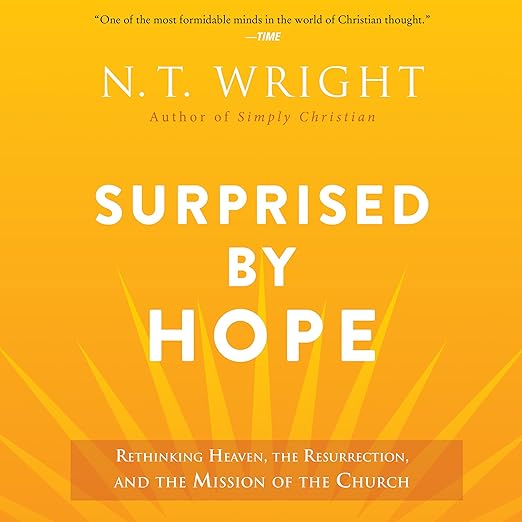
I came to Surprised by Hope the way a lot of listeners probably do: with a vague sense that I already knew what Christian theology said about the afterlife, and a mild curiosity about whether N. T. Wright had anything genuinely new to add. I was listening on a Saturday morning, coffee in hand, expecting something edifying but familiar. By the time Wright finished his argument that heaven, as most Western Christians imagine it, is a significant misreading of what the New Testament actually describes, I had put down the coffee and was paying full attention.
Wright is a former Anglican Bishop of Durham and one of the most respected New Testament scholars working today. He writes with the rare combination of academic precision and pastoral accessibility that marks the best theological communicators. Surprised by Hope was originally published in 2008 and represents a more accessible version of his larger scholarly work on resurrection. The audiobook, narrated by James Langton, brings it to life in a form that rewards concentrated listening.
The Review
The book's central argument is that Christians have largely misunderstood what the Bible teaches about what happens after death. Wright insists that the New Testament's vision is not one of souls floating off to a disembodied heaven, but of bodily resurrection, of new creation, of heaven coming to earth rather than humanity escaping to heaven. This argument is not novel to scholars of early Christianity, but Wright presents it to a general audience with such clarity and force that it feels fresh even to readers with theological backgrounds.
What makes the book more than a corrective is its second movement. Having established what Wright takes to be the correct eschatology, he then draws out the implications for Christian life and mission in the present. If God intends to renew the whole creation and has already begun that work in Jesus's resurrection, the church cannot limit its concern to saving souls. It must participate in that renewal by working for justice, healing, and beauty in the present world. This is where Wright's argument becomes genuinely challenging for many evangelical and mainline Protestant readers alike.
The Best Parts of Surprised by Hope
James Langton's narration is a good match for Wright's prose. Wright writes with rhythmic, argumentative sentences that build toward conclusions, and Langton understands that rhythm. He does not rush the footnotes-in-spirit that Wright builds into his text, and he handles the denser exegetical sections with a steady pace that allows listeners to track the argument without feeling left behind. Reviewer Michael Foret, who describes himself as a non-theologian, noted that he worked a bit at understanding some ideas but found the effort worthwhile. That is an honest account of what this audiobook asks of its listener.
Reviewer G. Stephen Goode described the book as being not so much about dying as it is about living, which captures something essential. Wright's eschatology is ultimately a call to engagement with the present world rather than a retreat from it. For listeners who have grown up in traditions that emphasize personal salvation and heaven as the ultimate destination, this reframing is disorienting in the best possible way.
A Few Reservations
Wright is at his strongest when he is doing close textual work on the resurrection narratives in the Gospels and Paul's letters. His defense of a literal bodily resurrection is one of the most carefully argued treatments of the subject available in an accessible format. He is somewhat less compelling when he moves into his constructive proposals about what renewed Christian mission should look like in practice, where the argument becomes more general and occasionally feels like it could use the specificity he applies so rigorously to the biblical texts.
Listeners who come from non-Christian or secular backgrounds will find the book intellectually engaging as a work of historical and theological argument, but Wright does assume that his reader shares a basic commitment to the authority of the New Testament. He is not making a case for Christianity from the outside; he is making a case within it for a particular reading of what Christianity claims.
Who Should Listen to Surprised by Hope
This is essential listening for Christians of any tradition who want to think carefully about what their faith actually claims about resurrection, death, and the future. It is equally valuable for pastors, theology students, and educated lay readers who want to engage with serious biblical scholarship without needing a seminary degree. Secular listeners interested in early Christian thought and the historical Jesus will find Wright's historical arguments worthwhile, though the book's ultimate address is to believers. Those looking for comfort or reassurance about death will find that here, but only after sitting through a rigorous argument that may first unsettle the comfort they brought with them.
Before You Listen
Is Surprised by Hope accessible to readers without a theology background?
Largely yes. Wright writes for thoughtful general readers, not specialists. Some passages require careful attention, as reviewer Michael Foret acknowledged, but Wright consistently explains technical terms and the argument is well-signposted throughout.
How does this book differ from Wright's larger scholarly work on resurrection?
Surprised by Hope is Wright's popular-level summary of arguments he makes in far greater technical depth in The Resurrection of the Son of God. It sacrifices the exhaustive footnote apparatus for accessibility, but the core argument is intact.
Does James Langton's narration match the material's tone?
Yes. Langton brings warmth and patience to Wright's prose without softening the argument's rigor. He is well-suited to theological narration and does not impose emotional color that would distort Wright's measured scholarly register.
Will this book challenge traditional evangelical views of heaven?
Directly and deliberately. Wright argues that the popular image of souls going to heaven at death is a significant departure from what early Christianity taught. His constructive alternative, resurrection into a renewed creation, is orthodox in the historical sense but unfamiliar to many contemporary Christian listeners.