
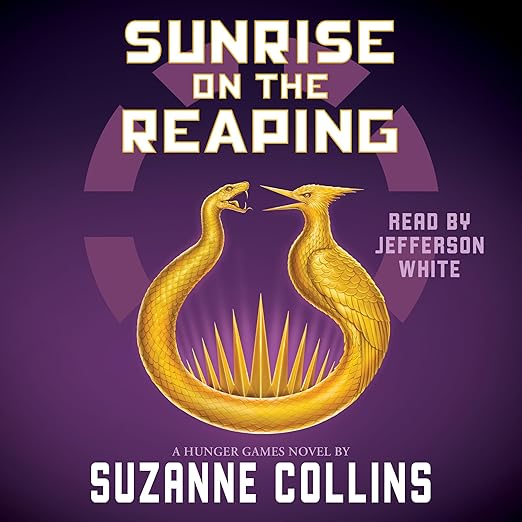
Haymitch Abernathy already has an ending when this audiobook starts, which is the strange contract Suzanne Collins signs with anyone who read the original trilogy. Sunrise on the Reaping covers the fiftieth annual Hunger Games, the Quarter Quell that doubled the number of tributes taken, and it sends a District 12 boy to the Capitol beside a friend who is nearly a sister to him, a compulsive oddsmaker, and the most stuck-up girl in town. How the arena ends for him is not a mystery to anyone.
Haymitch's Ruin Unfolds in Cruel Sequence
Collins has built the whole book on dramatic irony, which is either the strongest reason to listen or a structural problem, depending on the listener. The five-star of January 5, 2026 sets out the placement carefully: the fifth novel published, the second in chronological order, set around the fiftieth Games and twenty-four years before the events of the original book. The headline on that response reads Sunrise on the Reaping [Hardcover], so the page's most careful piece of series guidance is filed against the printed edition.
Knowing the outcome is the design rather than a flaw, and the tragic structure earns it. Haymitch's arc across the original trilogy is a man ruined by something the reader never gets to see; this book shows the ruin happening in sequence, with the girl he loves and the family he still has intact at the opening. That is a cruel piece of engineering, and it works precisely because the audience cannot be surprised, only made to watch it arrive.
Empty Series Fields Leave Newcomers Guessing
Both series fields on this record are empty. Its description begins by calling this the phenomenal fifth book in the Hunger Games series, the title carries the series name in parentheses, and the record supplies no series name and no number of its own, leaving the sequencing entirely to the copy and to whatever a browser already knows. On a series where publication order and chronological order disagree, that gap costs a newcomer real time.
White's Yellowstone Fame Overshadows His Untested Reading
Beetee, Wiress and Mags turn up here as younger people, and that is the specific pleasure this prequel has to offer. A five-star from June 30, 2025 identifies it exactly, describing a book that adds complexity to characters readers thought they already understood and gives room to their struggles, hopes and failed rebellions. Familiar names carrying unfamiliar histories is the whole prequel bargain, and Collins pays it out with far more supporting cast than the description suggests.
Quarter Quell rules drive the plot, and they are laid out cleanly for anyone whose memory of the arithmetic has faded: twice as many tributes taken, in honor of an anniversary, from districts already living in fear. The premise hands Collins a larger arena and more casualties, and it supplies the book's argument, which concerns a rigged system insisting loudly on its own fairness. The reaping sequence alone justifies the setup.
Jefferson White is the name in the narrator field, and the description sells that casting on a television credit, noting that he starred in Paramount Network's Yellowstone as Jimmy Hurdstrom before bringing his talent to this series. What the paragraph never mentions is audio work of any kind. That is a marketing decision rather than evidence, and anyone weighing twelve hours and forty-eight minutes carried by Haymitch's point of view should treat it accordingly and play the sample.
Ninety Ratings Move Fast Toward a Rounded-Up Score
Speed is the recurring note in the written column, and it cuts both ways. One four-star, dated January 22, 2026, says the story moved very fast and remained enjoyable, calls this the most tragic backstory in the series so far, and predicts a strong film adaptation. That same response opens by putting its own grade at three and a half stars, which the star field has rounded upward to four. Anyone hoping a prequel will linger in District 12 should know the pace does not.
Editions are mixed together in this rating panel in a way worth noticing. A five-star filed March 20, 2025, two days after release, reports picking up the audio and the ebook at the same time, warns that this is not a happy-ending story, and recommends reading the original trilogy first. Another, from February 20, 2026, is one line of enthusiasm followed by a note that the book arrived in very good condition. Responses logged from three separate countries sit under a single average here.
Ninety ratings is a small panel for a title with this profile, and the written column inside it is smaller still. Nothing about that is suspicious, since it reflects where a listing sits rather than how a book was received, but it does mean the 4.7 badge should not be read as a referendum. It is a handful of enthusiastic responses resting on top of a series the copy itself describes as worldwide best-selling.
Panem Completists Get the Hardest Backstory Filled
Panem completists have already decided, and they are right to. This is the book that fills the largest hole in the trilogy's backstory, and it does so without softening the character it explains, which is the harder and better choice. Listeners who kept their distance from the earlier prequel will find this one much closer to the original books in texture, since the districts, the reaping and the arena all appear in familiar form rather than through Capitol eyes.
Anyone new to Panem should not start here, whatever the chronology suggests. The book depends on knowing who Haymitch becomes, and reading it first converts the most devastating material into ordinary tragedy. Arena thrills are the wrong expectation as well, because the machinery around the Games occupies more of the runtime than the Games themselves do, and that machinery is the point. Readers who arrive in the right order get twelve hours of the thing Collins does better than almost anyone, which is making a system's cruelty legible through one teenager.
The Short Version
- Narrator: Jefferson White carries Haymitch's story for nearly thirteen hours, and District 12 plainness is the register that has to hold from the reaping onward.
- Subjects: A rigged system insisting on its own fairness, love used as leverage, the making of a broken mentor
- Tone: Grim and propulsive, weighted throughout by what the audience already knows
- Bottom line: The prequel that pays off, provided you have read the original trilogy first.
Good to Know
Should you listen to the Sunrise on the Reaping audiobook before the original trilogy?
No. Almost everything painful in this book depends on knowing what Haymitch becomes afterward, and reading it first flattens the ending into a straightforward tragedy. Chronological order sounds tidy, but publication order is what preserves the effect Collins designed the book around.
Where does this audiobook fall in the Hunger Games chronology?
At the fiftieth annual Games, the Quarter Quell that doubled the tribute count, roughly twenty-four years before the original novel. That places it second chronologically and fifth in publication order, after the first prequel. Haymitch is a District 12 teenager here rather than the mentor readers met later.
Does it work if The Ballad of Songbirds and Snakes disappointed you?
Very likely. The earlier prequel spent its time inside the Capitol with a very different protagonist, while this one returns to a district, a reaping and an arena, with a tribute at the center. The texture is much closer to the original books than to its immediate predecessor.
Why does the listing show no series information?
The series name and number fields were both left blank, even though the description opens by calling this the fifth book in the Hunger Games series and the title names the series in parentheses. Sequencing therefore depends entirely on the copy, which is worth checking before you order a reading list.







