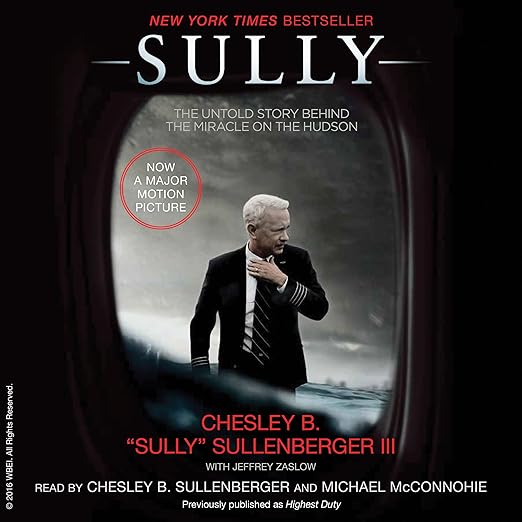
I finished Sully on a quiet Sunday morning, sitting in the kind of stillness that the book itself seems to invite. There is something about Chesley Sullenberger's voice, and I mean his actual speaking voice, because he narrates his own memoir, that operates at a lower frequency than most of the audio I encounter. He is not performing calm. He appears to be calm, in the constitutive sense, and the autobiography reflects that quality on almost every page.
On January 15, 2009, Sullenberger landed US Airways Flight 1549 on the Hudson River after both engines were destroyed by a bird strike ninety seconds after takeoff from LaGuardia. All 155 passengers and crew survived. The world's news coverage turned him into something he has spent the subsequent years gracefully resisting: a symbol. His memoir is, in many ways, a sustained argument that the fifteen minutes in the Hudson were the result of four decades of preparation, and that to celebrate the fifteen minutes without understanding the preparation is to miss the point entirely.
What makes this autobiography unusual is its distribution of attention. The Hudson River landing does not appear until the final portion of the book. The preceding hours are dedicated to the full arc of Sullenberger's career: learning on an Aeronca 7DC crop duster, fighter pilot training in the Air Force, the specific disciplines and habits of mind he developed across decades of commercial aviation, and the accumulation of what he calls the sum of all my experience. This is not false modesty or literary strategy. He genuinely believes that the event is only legible through the preparation, and he is right.
The narration is essential to this argument. Sullenberger reads his memoir with the measured quality of someone who has briefed crews and managed emergencies and testified before Congress, with absolute precision and no desire to dramatize. When he finally arrives at the landing, the restraint in his voice is itself moving. He is not performing heroism. He is describing a professional problem he solved with the tools he had spent forty years acquiring. That quality reads on the page but lands differently when you hear it in his actual voice.
What Chesley B. Sullenberger Gets Right
The book is as much about the culture and history of commercial aviation as it is about its author. Sullenberger has a historian's interest in the development of air safety and a practitioner's understanding of where its remaining vulnerabilities lie. Reviewers note the insights into aviation history and the broader context of flight as among the book's particular rewards. This is not a memoir that exists solely to serve the event that generated public interest in it.
The crew and the first responders are given substantial attention. One reviewer specifically praises the book for treating the landing as a collective achievement, the flight crew, the cabin crew, the air traffic controller, the Coast Guard, the ferry operators who arrived within minutes, rather than a solo feat. Sullenberger is insistent on this point in a way that feels not like political correctness but like professional accuracy. He knows exactly how many things had to go right that weren't his doing.
Where Chesley B. Sullenberger Loses Some Ground
Those who come to this book primarily for the dramatic retelling of the landing should know that they will wait nearly the entire duration for it. The memoir's value is almost entirely in what precedes that account: the professional formation, the philosophy of preparedness, the specific lessons Sullenberger drew from a career's worth of incidents and near-incidents. Listeners who skip ahead or lose patience will miss the reason the landing is presented the way it is.
One reviewer notes that the book goes into significant personal and family detail, sometimes to a degree that feels almost uncomfortably intimate. Sullenberger does not hide behind professionalism when writing about his family life. Whether this reads as vulnerability or oversharing depends on the listener's relationship with memoir as a form.
Who Should Pick Up Sully
Anyone with an interest in aviation, professional competence under extreme pressure, or the relationship between preparation and performance will find this memoir genuinely instructive as well as moving. Those who want a quick dramatization of the Hudson River event should watch the Clint Eastwood film instead, this is a different and slower experience that asks you to understand how someone becomes capable of doing what Sullenberger did, not just that he did it. Those who prefer biographical subjects who embrace their own legend will find his consistent deflection toward the collective and the cumulative slightly frustrating.
Before You Press Play
- Performance: Sullenberger reads his own memoir with the precise, unhurried authority of someone who spent forty years making consequential decisions calmly, the voice matches the man entirely.
- What it covers: Professional mastery and lifetime preparation, the weight of collective responsibility, humility and public identity
- Feel: Intimate and quietly inspiring, with measured intensity in the final act
- Our call: An autobiography that earns its subject's fame by refusing to center it, Sullenberger spends far more time on what built him than on the fifteen minutes that made him famous.
Before You Listen
How much of Sully is actually about the Hudson River landing, and when does it appear in the audiobook?
The Hudson River landing appears in the final portion of the book. The majority of the memoir is devoted to Sullenberger's upbringing, military service, and decades of commercial aviation experience. He explicitly structures it this way to argue that the event is only legible through the preparation that preceded it.
How does Sullenberger's self-narration compare to the Clint Eastwood film in terms of how the story is told?
They are fundamentally different experiences. The film dramatizes the NTSB investigation and the public attention. The memoir is primarily about professional formation and the accumulation of expertise over forty years. Sullenberger himself has said the film has a different shape and emphasis than his book.