Key Details
- Narrator: Gad Saad narrates his own book, and his rhetorical urgency comes through clearly. The delivery matches the polemical register of the text: direct, emphatic, and occasionally withering.
- Subjects: empathy as political liability, civilizational decline, cultural critique
- Tone: Provocative and combative, with high rhetorical temperature throughout
- Bottom line: Saad's argument is forcefully made and consistently readable, but listeners expecting nuance or engagement with counterarguments will need to look elsewhere.
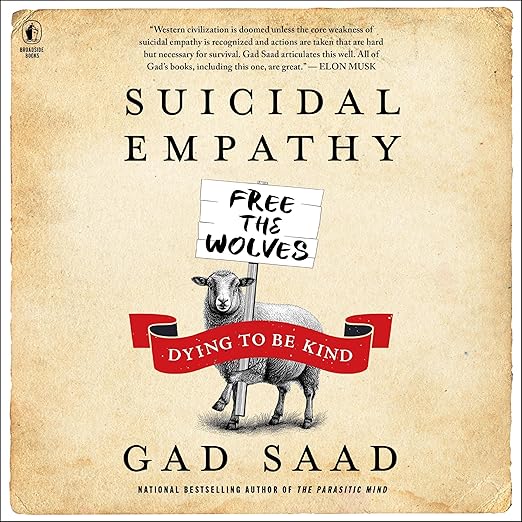
Gad Saad, the evolutionary psychologist and author of The Parasitic Mind, returns with Suicidal Empathy, narrating his own text across six and a half hours. The book's central claim is that the West has developed a pathological form of empathy, a miscalibrated moral reflex that prioritizes the feelings of marginalized groups over outcomes, criminals over victims, and political correctness over functional policy. Saad calls this condition suicidal empathy, and the audiobook is a sustained prosecution of what he sees as its consequences across immigration policy, criminal justice, gender sports participation, and what he describes as the systematic coddling of destructive behavior in the name of social compassion. This is not a book that holds its argument at arm's length. It advances it with full force, and listeners should know that before they begin.
Inverse Morality Drives a Full-Conviction Polemic
The book's intellectual framework is evolutionary psychology applied to political culture. Saad argues that the empathy instinct, adaptive in small-group social contexts, has been hijacked and scaled beyond its functional range by progressive ideology. What results, in his account, is a system of what he calls inverse morality, where the strong are demonized and the destructive are protected. He uses that framework to analyze specific policies: squatters' rights over homeowners, the prioritization of undocumented immigrants over veterans, the removal of biological women's protected spaces in the name of inclusion. Each example is chosen to make the abstract pathology concrete.
Saad's rhetorical method is the full-conviction polemic. He does not present the strongest version of opposing arguments before rebutting them. He frames opposing views as symptoms of the disease he is diagnosing, which is a philosophically significant choice with consequences for the book's persuasive range. Readers who already share his broad orientation will find his analysis satisfying and sharply expressed. Readers who approach these policy areas from different premises will find little engagement with their evidence base. That is not a disqualifying feature of the book but it is a defining one, and it determines who gets the most from listening. The book's follow-up to The Parasitic Mind positions it in an ongoing project of evolutionary-psychological cultural criticism, and listeners familiar with that earlier work will find the framework familiar and the argument sharper in its application here.
Saad's Self-Narration Sustains a Polished Lecture
On the production side, Saad's self-narration brings genuine conviction to the text. His voice carries the cadences of someone who has made these arguments repeatedly in public settings, including his well-known social media presence and podcast appearances, and the audio performance has the quality of a polished lecture rather than a dry reading. That energy sustains the six-and-a-half-hour runtime without flagging.
Paul Bloom's Against Empathy Argues the Centrist Case
The book is most valuable as a coherent, fully developed articulation of a perspective that is widely held but rarely organized into a systematic argument. Saad draws on evolutionary theory, behavioral psychology, and cultural history to build a case that attempts to establish empirical grounding for its claims rather than resting entirely on values-based arguments. Whether that grounding is convincing depends heavily on your priors, but the attempt to systematize the argument is real, and it makes the book more intellectually substantive than comparable cultural commentary that relies primarily on anecdote and rhetorical heat.
Listeners interested in the broader intellectual debate about empathy as a political concept will find Saad's framework one clearly defined pole in a conversation that includes Paul Bloom's Against Empathy, which approaches the misapplication of empathy from a more centrist empirical position and with more explicit engagement with counterarguments. Reading or listening to Saad alongside Bloom gives a fuller picture of the academic and cultural arguments in this space. Suicidal Empathy is the louder and more polemical of the two, but it stakes out its position clearly and defends it without hedging or softening for an audience that might not already agree.
Evolutionary Chapters Outshine the Policy Sections
Saad's strongest chapters are those grounded most specifically in evolutionary behavioral psychology, where his academic expertise provides actual analytical scaffolding. The sections dealing with cultural and policy phenomena as symptoms of the empathy miscalibration are more assertive and less empirically dense, and listeners should hold those sections to a higher standard of skepticism regardless of their political sympathies. The book is written with the confidence of someone who believes he is diagnosing a disease rather than making a value argument, and that framing deserves examination from listeners who want to evaluate rather than simply absorb the claims.
This particular listing carries no listener reviews at all, which means no external feedback exists yet to calibrate against, one way or the other. Given Saad's established and loyal readership from The Parasitic Mind and his substantial social media following, the book is likely to find its audience quickly among listeners already in his orbit. Those encountering his argument for the first time through this audiobook will find it more confrontational than most cultural commentary they are likely to have encountered, but also more systematically argued.
Parasitic Mind Fans Will Find More Here
This audiobook is suited to listeners who engage seriously with cultural and political commentary and want a polemical but structured argument rather than a balanced survey. Listeners who found The Parasitic Mind compelling will find more of the same here, sharper in places and more rhetorically ambitious. Listeners who approach questions of immigration, criminal justice, or gender policy from a progressive or centrist empirical standpoint will find the book frustrating and should not expect their evidence base to receive fair treatment. Academics in behavioral psychology may find the application of evolutionary frameworks to contemporary cultural patterns reductive. The book is not trying to convert skeptics. It is trying to give its intended audience a vocabulary, a framework, and the confidence that the discomfort they feel about certain policy directions is grounded in something more than personal preference.
Questions Listeners Ask
Is this audiobook politically balanced?
No, and it does not present itself as balanced. Saad is making a partisan cultural argument and frames opposing viewpoints as symptoms of the condition he is diagnosing rather than as positions deserving serious engagement. Listeners looking for a balanced treatment of these policy debates should supplement this with other sources.
Does Gad Saad's self-narration enhance or detract from the audiobook experience?
It enhances the experience for listeners already familiar with Saad's public presence, since his delivery has the practiced confidence of someone who has argued these positions in lectures and podcasts. For listeners who prefer a neutral reading voice, the high rhetorical temperature of the narration may be fatiguing over a six-and-a-half-hour runtime.
Is this audiobook appropriate for listeners who disagree with Saad's conclusions?
It depends on your reasons for listening. If you want to understand the internal logic of his argument and its evolutionary psychology grounding, the audiobook delivers that clearly. If you are looking for engagement with countervailing evidence or balanced policy analysis, you will not find it here.