Quick Take
- Voice: Heather Firth differentiates three male leads with enough distinct texture to keep the reverse-harem structure legible throughout.
- Big ideas: why-choose romance, campus mystery fallout, found family under threat
- Atmosphere: Intense, spicy, and emotionally charged
- Worth it?: A satisfying, high-heat conclusion for readers who finished Speak, though pacing complaints from at least one reviewer are worth weighing first.
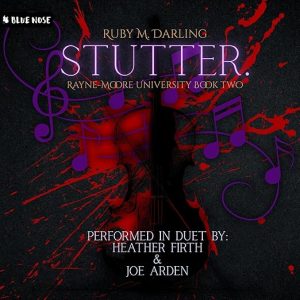
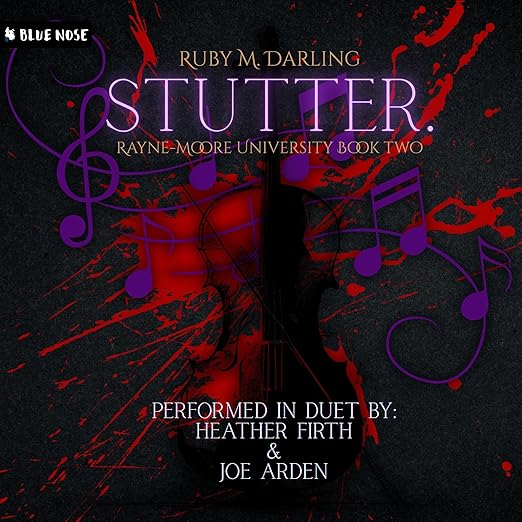
'Damon, Maverick and Jonas love with their entire souls,' reviewer Kim writes, and that intensity is the entire selling point of Stutter, the concluding half of Ruby Darling's Rayne-Moore University Duet. This audiobook follows directly from Speak, and where that first book leaned mystery-thriller, Stutter commits fully to romance: a dark, why-choose structure with three male leads and one fierce female lead, Raven Monroe, working through faculty secrets, circling detectives, and a body count that keeps climbing. Heather Firth narrates, returning from the first installment, and the synopsis frames the danger through Maverick Harrington's own voice: 'I've dived into the ocean for my Siren, fell for her song and I want her more than my next breath.'
Heather Firth Returns to Differentiate Three Leads
The why-choose romance structure, one heroine, multiple committed love interests, all sincere, none disposable, asks a lot of both the writing and the narration, and the found family the trio forms with Raven solidifies despite the danger surrounding them throughout. Angelique, writing as AngeliqueLostInInk, calls the book 'a sin-soaked, pulse-pounding why-choose fever dream' and the explosive conclusion to the duet, language that signals both the intensity level and the genre's specific appeal to readers already invested in the trope.
Heather Firth's return from Speak matters structurally: differentiating three male leads clearly enough that a listener never loses track of who's speaking is a real technical challenge in reverse-harem romance audio specifically, since the format multiplies the voice-differentiation problem a single-hero romance never faces. Firth manages enough distinct vocal texture across the three men to keep the scenes legible, while still finding the emotional intimacy the love scenes and the mystery-thriller tension both require in the same book.
Speak and Stutter Are Both About Voice
The synopsis itself uses genre shorthand worth translating for anyone newer to the category: 'OTT' means over-the-top, and 'O/P MMCs' means overpowered male main characters, terms that signal exactly how intensely the three male leads are written, not restrained love interests but larger-than-life, dominant personalities by design. Readers fluent in that shorthand already know what they're signing up for; readers encountering it for the first time should understand it as a genre convention rather than an incidental detail.
Ruby Darling's choice to title the books Speak and Stutter, both words about voice and communication, or the difficulty of it, rewards a second look. A mystery-thriller called Speak and its romance-forward sequel called Stutter suggests a duet organized around characters learning to actually voice what they want, whether that's naming a killer or naming which relationships they're choosing to keep, rather than two arbitrarily paired titles.
Angelique's review title itself, calling the book dark, dangerous, and purely unforgettable, doubles as a fair one-line summary of the tonal range at play: menace and danger sitting alongside genuine emotional payoff rather than one canceling out the other. That combination is the entire pitch of why-choose dark romance as a subgenre, danger and intimacy heightening each other rather than existing in separate registers, and Darling's execution here, per all three reviewers, delivers on both halves rather than favoring one over the other.
Wondering Why This Needed a Second Volume
Kim's review is useful for genre-positioning specifically: Speak was 'a mystery, thriller with amazing romance,' while Stutter, in her assessment, becomes 'a love story, pure and simple.' That shift matters for anyone choosing whether to continue the duet, since it signals the sequel resolves the suspense elements built up in book one rather than escalating them further, prioritizing the romantic payoff for a reader who came for the relationship dynamics as much as the mystery.
At nearly fifteen hours, this is a substantial runtime for a genre where pacing complaints are common, and Alexandria Segura's review, while positive overall at four stars, raises exactly that concern directly: she admits to wondering why the story needed a second full volume, feeling that outside of the romantic and physical scenes, not much was happening. That's a fair, specific critique worth weighing against Kim's and Angelique's more enthusiastic five-star reactions before committing to the full runtime.
The campus-thriller backdrop, Rayne-Moore University, faculty gossip, an elite institution with secrets worth killing over, gives the why-choose romance a structural engine beyond the central relationship. Detectives circle throughout, and bodies keep dropping according to the synopsis's own framing, which means the mystery-thriller DNA from Speak hasn't disappeared entirely even as the romance takes over; it's operating as backdrop tension rather than the book's primary focus.
A two-book duet, rather than a trilogy or longer series, is a specific structural choice in reverse-harem romance, where the format more commonly stretches across three or more volumes to justify multiple relationship arcs developing in parallel. Compressing that structure into two books means less room for slow-burn development of each individual relationship, which may explain Alexandria Segura's pacing complaint, but it also means the story reaches a genuine, complete conclusion rather than leaving threads open for a further sequel.
Raven Monroe Is Also Working Through Revenge
The explicit content is substantial and central to the book's identity rather than incidental to it; Alexandria Segura confirms directly that 'the spice delivered,' and the erotica classification alongside literature-fiction reflects that balance accurately. Listeners uncomfortable with a reverse-harem structure specifically, multiple simultaneous romantic and physical relationships treated as equally legitimate, should know that's not a subplot here but the entire structural premise of the duet.
This is explicitly book two of a duet, not a standalone, and starting here without Speak first would forfeit the mystery setup, the faculty secrets, and the relationship groundwork the synopsis assumes a returning listener already has. With only three ratings currently attached to this specific listing, the sample size backing that 4.3 average is genuinely small, worth keeping in mind alongside the individual reviews rather than treating the number as fully settled.
The FMC exacting revenge, per the synopsis's own description, adds a sharper edge than a pure romance resolution might suggest; Raven Monroe isn't simply choosing between three men, she's actively working through consequences for whoever created the danger surrounding all of them. Listeners expecting a purely soft, comfort-focused romantic resolution should know the revenge-plot thread keeps some genuine tension and moral complexity running alongside the relationship payoff.
New Listeners Should Start With Speak Instead
Reverse-harem and why-choose romance readers who finished Speak and want the relationship threads resolved are the direct, built-in audience, and Firth's continuity from book one should make the transition seamless for anyone who enjoyed her narration the first time around.
Fans of dark academia settings specifically, elite universities with buried secrets, will find Rayne-Moore's faculty-gossip backdrop a strong pairing with this book's reverse-harem intensity, even though the romance itself is the clear center of gravity by this second volume.
New listeners hoping to start the Rayne-Moore world here, or anyone who prefers mystery plotting over romantic resolution, should begin with Speak instead, or steer clear of the duet altogether.